
The Pionex card works, but only for a narrow kind of spender
 Available in US
The Pionex card is not really a bank card in the ordinary sense. It is a way of spending a stablecoin balance you already hold, wrapped in a Visa or Mastercard number so that shops treat it like any other card. If that is the job you need it to do — turning USDT sitting on a Pionex exchange account into everyday purchases — it does it competently, with no annual fee, no inactivity fee and a working Apple Pay and Google Pay. If you want a normal spending card that happens to link to crypto, or you live somewhere the card is not offered, or you want to top up in pounds, euros or dollars, this is the wrong product and the wrong platform.
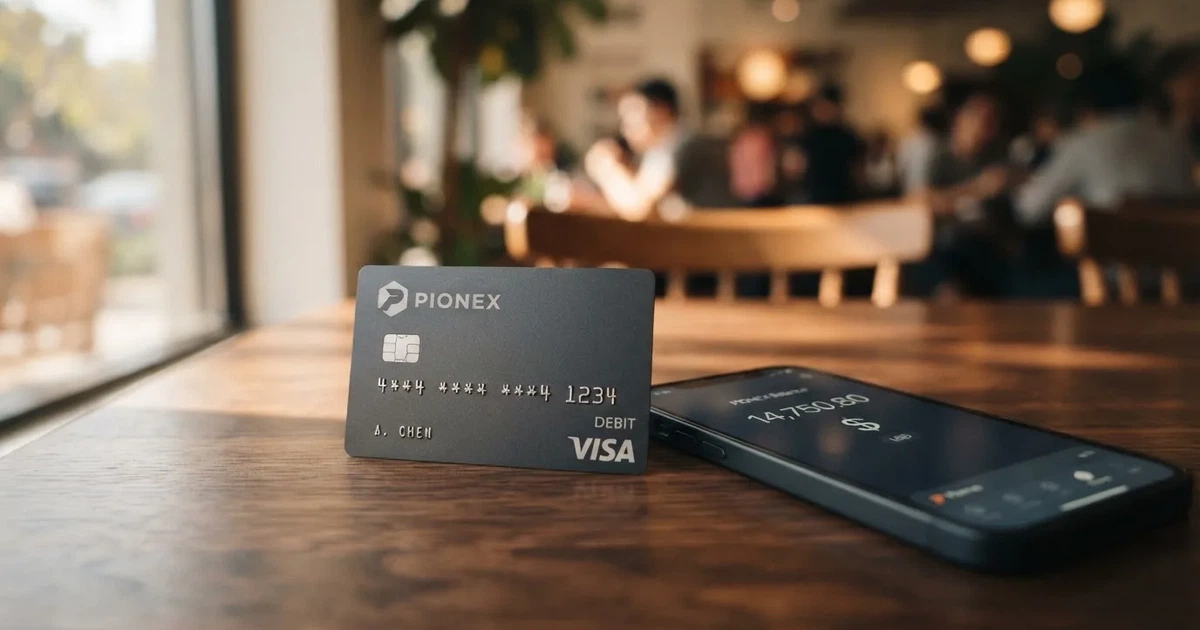
My score is 4.8 out of 10. That is not a verdict on Pionex the exchange, which is a separate question, and not a prediction that you will lose money. It is a verdict on how narrow the card is, how little the public pages tell you, and how the company behaved towards cardholders in the summer of 2026.
The conditions described here are current as of October 28, 2026.
Verdict: 4.8 out of 10, and only for one kind of spender
Here is how the card scores across the things that actually matter when you are choosing a payment card.
| Criterion | Mark | Why |
|---|---|---|
| Who can get it | 6 / 10 | Card type depends on the country of your completed KYC, and no country list is published; users in Pionex restricted regions cannot apply at all |
| Cost | 6 / 10 | Annual fee and inactivity fee are both zero; Visa charges 1% per transaction, Mastercard “up to 3.5%”; no issuance fee appears in either fee schedule |
| Top-up options | 4 / 10 | USDT only, by transfer from your main Pionex account or from an external wallet; networks are not named and there is no fiat route |
| Reliability and complaints | 3 / 10 | The issuing bank is not named; cards of inactive users were cancelled in batches in August and September 2026; Trustpilot shows 2.5 out of 5 on reviews of the exchange, centred on frozen withdrawals |
| Everyday use | 4 / 10 | Only virtual cards are issued, Apple Pay and Google Pay work, the physical Visa is arriving in stages, and the Mastercard has no ATM |
| Total | 4.8 / 10 | A working card wrapped around a narrow use case |
So who is it for? In short: people who already hold USDT on Pionex and want to spend it without converting to fiat first. If your habits are already there — you are using the Pionex trading bots, you keep a USDT balance, you are comfortable with a custodial platform holding your money and with a card that only exists in your phone — then a 1% transaction fee on the Visa is not a disaster and the 5% APY on the card balance is genuinely pleasant. You are being paid to wait, in a sense, and you can spend that yield.
Who is it not for? If you need a physical card in your wallet this week, the honest answer is that you cannot have one yet. If you need to load the card from a bank account, there is no way to do it. If you are in the EU and hoping the card will simply open for you, the public pages contradict each other on France and Spain, and that contradiction is itself the answer. If a card cancellation would leave you stranded, read the risks section below before you fund anything.
One more thing worth saying at the outset, because it colours everything else: Pionex’s own help articles do not name the bank that issues the card. For a Bybit card the issuer is a licensed entity you can look up; here you are told only that some Mastercard cards run through what the help centre calls the “Dogpay channel (BIN 5371)”. That is a programme description, not a reassurance.
Will they give you the card?
The short answer is: it depends on which country your identity verification was completed in, not on your citizenship, and the card does not come with a published list of those countries.
That distinction matters more than it sounds. The rule is by KYC country — the country that appeared on the verification you submitted to Pionex. So a citizen of one country living in another is treated under the rules of the country they were verified in. And if you live in a region Pionex restricts, you cannot apply at all, no matter who you are.
What is stated:
- The card type you get depends on the country or region of your completed KYC. The application page shows this. No country list is published.
- Users in Pionex restricted regions cannot apply.
- Since 14 August 2026, new Visa applications from Belarus have stopped. Applicants verified in Belarus are offered Mastercard instead.
- There is no Russia-specific application rule. But payments are declined at merchants registered in, or operating from, Afghanistan, Venezuela, Russia, Myanmar, Ukraine, North Korea, Iran and Belarus. So a Russian-verified applicant may hold a card that will not work at home.
What is said by third parties and not confirmed by Pionex: card pages are said to be “not available in some EU countries”. Pionex’s terms of service list France, the Netherlands and Spain as restricted jurisdictions — which conflicts with France and Spain appearing in the merchant decline list above. Third-party country pages from 2026 list the card as available in the UAE, South Africa, Malaysia, Nigeria and Australia, and not open in the US and Canada. Treat all of that as a starting point for your own question, not as the answer, because the card’s own application page is the only authority and it decides by KYC country.
If you want to know whether you qualify, the application page itself is the test: start the flow and see what it offers. That is not a trick to get around anything — it is simply the only place the answer exists.
How to get it
You need KYC Level 2, plus account assets above a threshold that the application page shows. That threshold is an eligibility condition, not a fee, and the page does not publish a number for it.
The route is short. In the app: Wallet, then Card, then Apply Now, then your cardholder details, then confirm. Review usually takes about an hour. The web version runs through the same steps. Cardholder name is capped at 25 characters, and you may hold one card network per user.
One requirement differs by card. Visa needs an address on file; Mastercard does not.
What you end up with, today:
| Visa | Mastercard | |
|---|---|---|
| Where it is offered | Most regions | Where Visa is not open |
| Format issued now | Virtual only | Virtual only |
| Validity | About 5 years | 2 years |
| What it holds | USDT only | USDT only |
| ATM | Yes, on the physical card | No |
Only virtual cards are issued at the moment. Physical cards are “currently being rolled out in phases”, and Pionex publishes no delivery countries, no delivery time, no delivery cost and no replacement cost. If you lose the card, there is no published figure for what replacing it costs, or whether it is possible at all.
There are also gaps I want to name rather than gloss over. What KYC Levels 1 and 2 actually unlock is not stated, nor are the card-specific reasons an application could be refused. Age is not stated either. If you are reading this hoping to find the minimum age, the honest answer is that the public pages do not give one.
And one third-party observation worth carrying: a tester in September 2026 received a virtual Mastercard even though the application screen showed Visa artwork. So the network you get may not be the one the application advertises. Treat the artwork as decoration.
Fees: what it really costs
The headline is good: there is no annual fee on either network, and no inactivity fee on either network. But Pionex does not list an issuance fee on either fee schedule, which is different from saying there is none — it means the number is not published.
Where the cost actually lands is per transaction, and the two networks are priced very differently. This is the single most important thing to understand before you choose.
| Fee or limit | Visa | Mastercard |
|---|---|---|
| Annual fee | Free | Free |
| Inactivity fee | Free | Free |
| Issuance fee | Not listed | Not listed |
| Transaction fee | 1% | “up to 3.5%” |
| Fiat-to-crypto conversion | Free (USD/USDT 1:1) | Converts non-USD at its own rate, no separate FX markup listed |
| Small payments (≤5 USD) | First per month free, then 0.2 USDT | Not stated |
| Failed payments | 0.5 USDT after the first free | Not stated |
| ATM withdrawal | 2%, on the physical card | No ATM |
| Per transaction / daily | 10,000 USDT | 20,000 USD |
| Monthly | 50,000 USDT | 100,000 USD |
| Temporary limit raise | To 80,000 per transaction and 500,000 daily/monthly for 14 days, if balance ≥16,000 USDT; 30-day cooldown | None |
Now let the numbers talk for a moment, because “up to 3.5%” is doing a lot of work in that table and you should know what it means in practice. On the Visa, a 20 USD grocery shop costs you 0.20 USD. On the Mastercard, if you hit the ceiling, that same shop costs 0.70 USD. The Visa is the cheaper card to hold by a wide margin, and the difference between them is not a rounding error.
Two more things in the table matter for daily life. The small-payment rule is friendly but narrow: payments of 5 USD or less are free once a month, then 0.2 USDT. If you buy coffee twice a week, you are past that after the first one. And the failed-payment charge means a declined transaction still costs you 0.5 USDT after the first free attempt, which is a small but real cost for a card that may be declined more often than a domestic one.
On currencies: the card balance is USDT, and USD against USDT is 1:1. You can change the display currency — USD, EUR and others — but the card’s own wording is that this “only changes the display currency”. It does not change what you are charged. On the Visa, local USD transactions cost the 1% fee and fiat-to-crypto conversion is free. On the Mastercard, non-USD amounts are converted at the card’s own rate, and no separate FX markup is listed — which is not the same as saying the rate is competitive, it just means one number covers it.
There is no tier structure. No paid plans, no upgrades, no monthly fee tiers. The only lever is the Visa limit increase: hold 16,000 USDT or more on the card and you can temporarily raise your ceiling to 80,000 USDT per transaction and 500,000 USDT daily and monthly, for 14 days, with a 30-day cooldown before you can apply again. The Mastercard has no such option at all.
One last item in this section that is not a fee but behaves like one: the card balance earns 5% APY automatically and you cannot turn it off. That is a genuine benefit if you are comfortable leaving funds there, and a genuine risk if you ever need them out fast — because getting money back out is not instant, as the next section explains.
Top up: USDT only, and there is no other way
This is where the card’s narrowness stops being an inconvenience and becomes the defining fact. There is one funding route: USDT, by transfer. Either from your main Pionex account into the separate card account, or as a USDT deposit from an external wallet. No fiat top-up. No IBAN. No direct from a bank. Debit only, no overdraft.
Details that are worth knowing and details that are not stated:
- The transfer from your Primary Account to the card account is internal, so it is within the platform. The networks for external deposits are not named.
- No deposit fee and no minimum top-up amount appear on the Visa fee schedule or in the Mastercard article. Network fees on an external deposit are not stated either — and those are charged by the blockchain, not by Pionex.
- The card cannot send crypto on-chain, and it cannot send money to a bank card. Everything goes back to the Primary Account first, then out as normal.
Because top-up is USDT-only, this card asks you to already hold the thing it spends. That is the whole design, and it is fine if USDT is what you have. If your income arrives in a local currency and your usual pattern is converting a slice of it, Pionex gives you no direct bridge here — you would be adding steps that other cards do not ask of you.
Getting money back out deserves a paragraph of its own, because this is where I found the most surprises. Funds return to the Primary Account first (in the app: Wallet, Card, Deposit, Transfer; on web: Card, Personal Card, Transfer, with From set to Card Account). Security verification may be requested. The fee for that transfer is not stated. And if the card account goes negative and you do not repay it, your crypto withdrawals are restricted until the balance is settled — a rule reported by users, not stated on the card’s own pages, but it matches how the platform describes negative balances elsewhere.
Two edge cases. Reward-type balances — the Growth Fund principal and the Futures Bonus — cannot be moved to the card at all, so the 5% APY is not the same pool as your spendable balance in every case. And if a card is closed or goes inactive, the balance stays in the card account and you move it by the same transfer guide. Deleting the card and reapplying goes through a form; it is not automatic.
Paying with it every day
Apple Pay and Google Pay both work for contactless payments. Samsung Pay does not. Both networks carry restricted-merchant notices — blocks on particular kinds of merchant — though the specifics are not published and whether gambling is blocked is not stated.
Rewards, and here the picture is unusually good:
| Reward | Rate | Notes |
|---|---|---|
| Cashback on local-currency and general USD purchases | 1% | Credited in real time; no cap mentioned |
| Cashback on listed excluded merchant-category and country combinations | 0% | The exclusion list is published |
| Cashback on ATM withdrawals | 0% | — |
| APY on the USDT card balance | 5% | Credited hourly |
The 1% cashback is credited in real time, which means it is money you can spend, not money you read about in a monthly statement. Set against the 1% Visa transaction fee, that offsets the fee exactly on the transactions it applies to. The 5% APY on the balance is the quiet headline of this card: if you can hold USDT here while it earns, the balance is doing work.
The card lives inside the Pionex app under Wallet, Card, and also on the web. Pionex does not state which platforms are supported or what the app stores rate it.
Then the part nobody likes: getting a refund. Refund clearing generally takes 3 to 30 days and releases automatically — support cannot release it early. Pre-authorisation holds come back within 7 business days after the merchant finalises. VAT refunds take about 3 to 5 business days, up to a few weeks. The transaction fee is returned only when the refund carries the status “Payment Reversal”, so a partial or ordinary refund may leave you having paid the fee twice.
If you need to dispute something on a Visa, the costs are sharp. The appeal fee is 50 USDT per case and is paid regardless of outcome. An arbitration fee of 600 USDT is charged only if you lose. And at least 650 USDT must be available in your main account as a temporary deposit while the case runs. So a contested 30 USD purchase can cost you 50 USDT to argue about, and a lost argument costs 600. That is worth knowing before you need it.
For a payment that was charged but the merchant declined, the route Pionex describes is: ask the merchant for a refund first, then give Support the ARN.
What can go wrong
Start with the thing that will worry me most, because it is documented by the company itself rather than by users.
Between August and September 2026, Pionex cancelled cards belonging to inactive or rarely used users in batches, some without notice. The cancellation is irreversible, there is no reapply, and the balance stays in the card account. Read that again with the 5% APY in mind: an unused card can be closed out from under you, and while the funds are not lost, you now depend on a transfer guide and a support line to get at them. If you are the kind of person who loads a card and leaves it, this is the risk you are accepting.
What users report, on top of that:
- Trustpilot, for Pionex the exchange rather than the card specifically, shows 2.5 out of 5 from about 600 reviews, 124 of them in the last 12 months, read on 20 October 2026. The themes are frozen withdrawals and trading after profits, with the company replying by pointing to its risk team; account closure with a refund delayed 2 months; and cards charged for transactions the merchant declined, with no refund.
- Coin Bureau listed 2.3 out of 5 in August 2025, also on withdrawal complaints.
- A negative card balance pausing withdrawals until repaid — this one comes from a user aggregator and is not confirmed by Pionex.
None of these are card-specific, and that is the point: the complaints are about the platform that holds your money and issues the card, and they are the complaints most likely to affect you.
Then the structural risks. This is a custodial card. Your USDT sits in a card account inside a Pionex exchange account, which means the platform holds the credentials and you must trust it completely. There is a freeze switch in the app under More, Freeze, and it is immediate — but a freeze imposed by risk control can only be lifted through Customer Support, which means a support response time you have no control over. Viewing card details and paying at checkout both require Security Authentication, and payment SMS codes can be switched to in-app authorisation instead. What is not stated: whether insurance or safeguarding applies, and the specifics of two-factor authentication. There is also a small practical trap: freezing the card does not cancel merchant subscriptions that continue to bill.
And the category-level risk, which is worth stating once and plainly. Custodial platforms have a history of failing: Mt. Gox (about US$350 million reported stolen, 2011–2014), Coincheck (about US$400 million, 2018), Ronin Network (US$625 million, 2022). Meanwhile, in November 2022 Visa terminated its global agreements with FTX and the FTX US debit card programme was wound down. WaveCrest, a Visa card issuer that supplied crypto card brands, was suspended by Visa in Europe in 2018 and all its Visa programmes closed. Programme closures follow a pattern — notice, then spending and loading stop, then you are asked to withdraw what is left. That is the structural reason to keep only what you can afford to have frozen, on any card of this kind.
Support, for what it is worth: Pionex Customer Support is named without a chat link, an email address or opening hours. The help centre is translated into six languages, and one of them is Russian, which is a real if small comfort given the number of complaints above about frozen funds.
What to take instead
Let me be straight about the shape of this comparison. The score you have seen for these is not my score — it is the score each card carries in my comparison set, which is why they sit on a slightly different scale than Pionex’s 4.8. Use it to see which of these is a better fit, not to argue about decimals.
| Pionex | Bybit Card | Coinbase Card | OKX | |
|---|---|---|---|---|
| Comparison score | 4.8 | 6.0 | 6.4 | 6.2 |
| Where | Varies by KYC country; no list published | Argentina, AIFC (Kazakhstan), Georgia, Kazakhstan, Australia, Mexico, Brazil, Peru, Asia Pacific | All US states except Hawaii | EU plus Norway, launched 28 January 2026; Iceland and Liechtenstein excluded |
| Card | Virtual only now, physical in rollout | Virtual and physical; a virtual card must be obtained first | Virtual or physical | Virtual only, euro-denominated |
| Card currency | USDT (USD 1:1) | USD, ARS, MXN, BRL, PEN or USD by region | USD | EUR |
| What funds it | USDT only | Funding Account and Easy Earn balance; fiat first, crypto sold at payment | Bank link or crypto balance | USDC or USDG in OKX Pay |
| Crypto conversion fee | 1% Visa / up to 3.5% Mastercard | 0.9% over the One-Click Sell rate; 0.5% in Argentina | No Coinbase transaction fee; a spread applies when Coinbase buys, sells or trades | 0.1% per an explainer (May 2026) against 0.4% market spread in the launch release — a conflict, explainer being newer |
| FX fee | None listed separately on Visa | 2% on top of the network rate in Australia, Asia Pacific, Georgia, Mexico; 7% Argentina; 1.5% Brazil; 1% Peru | Not stated | No OKX FX fee |
| Physical card cost | Not listed | Australia 29.99 USD; Argentina 5 USD/USDT; Georgia and AIFC 29,99 USDT; Asia Pacific 5 USDT; Brazil and Mexico none; VIPs on several of these pay none | Not stated | No physical card mentioned |
| Annual fee | Free | “Auto interest, no annual fees” | “Zero spending fees and no annual fees” | None |
| Rewards | 1% cashback, 5% APY on balance | From 5 October 2026 only crypto-funded transactions earn: 2% to 10% by tier, monthly cashback cap 5 to 600 USD, cashback in USDT = points × 0.002 | Optional crypto rewards, variable rate, US users only | Cashback only on USDG purchases: 2% cap 10 EUR rising to 10% cap 1,000 EUR by VIP tier |
| ATM | Visa 2%, physical card; Mastercard none | Not stated | Yes, crypto converted to USD | Not stated |
| Main catch | USDT only, virtual only, no named issuer | Not for EEA customers at all: “All European Economic Area customer participation is strictly prohibited” | US only | Needs USDC or USDG, other coins must be converted first |
The four possibilities sort into four different reasons to switch:
- If you want a real card with real rewards tiers and are outside the EEA, Bybit has the most developed reward structure on paper — 2% up to 10% by tier, with caps from 5 to 600 USD a month. The catch is structural: the EEA is excluded outright, and since 5 October 2026 only crypto-funded transactions earn anything at all.
- If you are in the United States and want the simplest thing, Coinbase is a prepaid Visa with zero spending fees and no annual fee, funded from a bank link or a crypto balance. The trade is that its crypto rewards are optional and variable.
- If you are in the euro area, OKX is the one that fits the currency: a euro-denominated virtual Mastercard through OKX Pay, funded in USDC or USDG, with no transaction fee and no OKX FX fee. The conversion figures conflict between sources, and the card is virtual only.
- If you want a physical card in hand, Pionex is simply not there yet. Only virtual cards are issued.
If none of those fits, the honest conclusion is that the category is not mature where you are. That is a legitimate finding, not a reason to force something.
Who I would recommend it to
I would recommend this card to exactly one person: someone who already keeps a meaningful USDT balance on Pionex, is comfortable with a custodial platform holding it, and wants to spend that balance directly without a conversion detour — while remembering that the 1% Visa fee is offset by 1% cashback on most purchases, and that the balance earns 5% while it sits there.
I would not recommend it as a first card, as a backup for someone without a reliable banking relationship, or as a way to hold money over months. Not because the fees are predatory — they are not — but because the operational risk is the product. A card that can be cancelled in batches without notice, on a platform whose exchange reviews sit at 2.5 out of 5 with frozen withdrawals as the dominant theme, on a platform that does not name its issuing bank, is not something I would ask anyone to depend on.
Before you fund it, I would check three things in this order. First, the application page, to see what your KYC country actually gets you — that single check answers the eligibility question that no article answers. Second, whether you can live with USDT-only funding and a transfer back to the Primary Account for every withdrawal. Third, how much you are willing to leave sitting on a custodial platform, because that number, not the fee table, is what the real downside looks like.
Frequently asked questions
What is the Pionex card?
It is a Visa or Mastercard number attached to a separate USDT balance inside your Pionex exchange account, rather than to a bank account. You load it with USDT and spend it like a normal card, with the balance converting to the purchase currency at the point of payment. It is a prepaid-style arrangement: the card can only spend what is already in it.
How does the Pionex card actually work?
You transfer USDT from your main Pionex account into a card account, then spend from that balance. USD is treated 1:1 with USDT. The balance earns 5% APY automatically and cannot be switched off, and it cannot be overdrawn. Money going back out returns to your Primary Account first — the card cannot send crypto on-chain or pay out to a bank card.
Is Pionex a bank, and who issues the card?
Pionex is not described as a bank, and its own card articles never name the issuing bank. The only hint is a reference for some Mastercard cards to what help calls the “Dogpay channel (BIN 5371)”. Pionex’s company registration and licences are not stated on the card pages, and third-party lookups did not find them either.
Which countries can get the Pionex card?
It depends on the country of your completed KYC, not your citizenship, and no country list is published. Third-party 2026 pages list it as available in the UAE, South Africa, Malaysia, Nigeria and Australia, and not open in the US or Canada — unofficial, and the application page is the only authority. Pionex restricts some regions entirely, and EEA treatment is contradicted across pages.
Do I need KYC to get the Pionex card?
Yes, KYC Level 2, plus account assets above a threshold shown only on the application page. That threshold is an eligibility condition, not a fee. Review usually completes within about an hour, cardholder names are capped at 25 characters, and you can hold one card network per user.
What does the Pionex card cost to use?
On the Visa, 1% per transaction, with fiat-to-crypto conversion free and USDT treated 1:1 against USD. Annual and inactivity fees are both zero, and no issuance fee is listed. Mastercard charges “up to 3.5%” and converts non-USD at its own rate. Small payments of 5 USD or less are free once a month then 0.2 USDT; a failed payment costs 0.5 USDT after the first free one.
How do I top up the Pionex card?
With USDT only, either by transfer from your main Pionex account or by USDT deposit from an external wallet. There is no fiat top-up and no IBAN. Networks for external deposits are not named, and no deposit fee or minimum is stated on either schedule. On-chain network fees are charged by the blockchain, not by Pionex.
Is the Pionex card safe, and is it worth it?
The card is custodial: funds sit in an account inside a Pionex exchange account, so you trust the platform completely. Pionex cancelled cards of inactive users in batches between August and September 2026, some without notice, irreversibly, with no reapply. Trustpilot shows 2.5 out of 5 for the exchange, on frozen withdrawals. Worth it only if you already hold USDT there.
Can I get a physical Pionex card, and does Apple Pay work?
Not yet in practice: only virtual cards are issued, with physical cards “currently being rolled out in phases”. Pionex publishes no delivery countries, timing, cost or replacement cost. Apple Pay and Google Pay both work for contactless payments; Samsung Pay does not. The Mastercard has no ATM, while the Visa charges 2% on ATM withdrawals from the physical card.
What happens if I need a refund or a chargeback on the Pionex card?
Refunds generally clear in 3 to 30 days and release automatically — support cannot speed that up — and pre-authorisation holds come back within 7 business days. The transaction fee is returned only under a “Payment Reversal” status. A Visa dispute costs 50 USDT to appeal regardless of outcome, 600 USDT more if you lose, and needs 650 USDT held as a temporary deposit.
Exchange cards – cryptocardchooser.com
Content created by the «cryptocardchooser.com» team