
Fizen, read closely: a USD prepaid card funded by USDT
 Available in US
Fizen is a USD Visa prepaid card that you fund with USDT and then spend like an ordinary payment card. The score I give it is 6.4 out of 10. That is not a failing mark — it is a card that does one narrow job well and asks you to accept several sharp edges for it. It suits you if you already hold USDT, you want a dollar card that works in places your own bank card does not, and you are comfortable with a Hong Kong company rather than a bank holding your money. It does not suit you if you need a physical card in your hand, a long list of countries you can open an account in, or a regulated EU or US institution standing behind the balance.
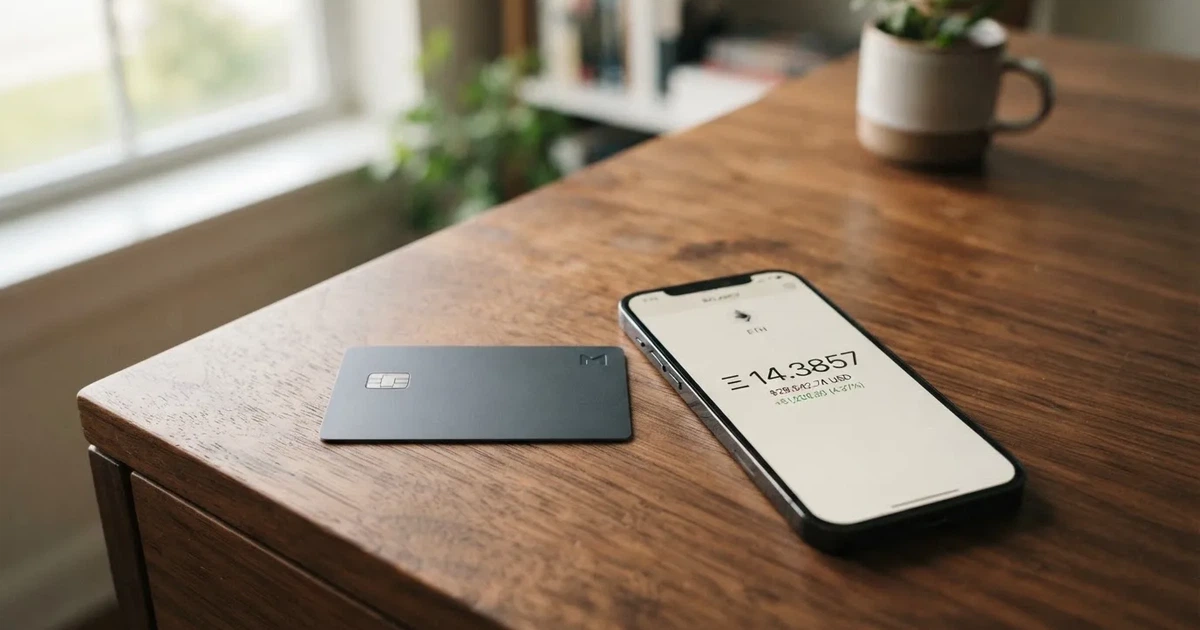
The conditions described here are current as of October 28, 2026.
| Criterion | Mark | Why |
|---|---|---|
| Who can get it | 8 / 10 | Not available in 43 countries including Russia, Belarus, Serbia, India, China (Mainland), Iran and Ukraine; use is stated in 160+ countries |
| Cost | 6 / 10 | Adventure issuance $9.99; maintenance $0 with $500 of spending, otherwise $1.50; FX 1%, crypto conversion 0.5%, card closure $2.00; ATM $2 + 1.5% |
| Top-up options | 6 / 10 | USDT to a Fizen-controlled wallet; QR Pay funded only with USDT on Solana or BNB Chain; fiat via Transak |
| Reliability and complaints | 6 / 10 | Fizen Limited, Hong Kong, not a bank or licensed payment institution; issuer not named in the text; Tether investment from 30 July 2026; Trustpilot 4.1 from 5 |
| Everyday use | 5 / 10 | Virtual Visa issued instantly, Apple Pay and Google Pay; metal is still “coming soon”; physical-card ATM: first withdrawal up to $200 a month free |
| Total | 6.4 / 10 | A usable dollar card for crypto holders, with real limits in reach |
A word on what kind of user I had in mind throughout: someone funding a USD virtual card with USDT. If that is not you, several sections below will tell you quickly that this is the wrong card.
Will they give you the card?
Mostly yes, and this is the strongest part of the card — but “mostly” is doing real work in that sentence, and the rule is written in two different places with two different emphases.
The card page claims use in 160+ countries. The card itself, though, is not available in 43 countries, and the named list includes the Russian Federation, Belarus, Serbia, India, China (Mainland), Croatia, Slovenia, Montenegro, North Macedonia, Bosnia and Herzegovina, Iran, Ukraine and Venezuela. Georgia, Turkey, Kazakhstan, Armenia and the UAE are not on the restriction list — but the card does not publish a matching list of countries it is *supported* in, so absence from the blacklist is not the same as a green light. There is no published list of countries where you can sign up. That is stated nowhere on the public pages, and you should treat it as something to check with support before you commit money rather than something you can read off the website.
The terms add a second layer. You cannot be a citizen, resident or located in a jurisdiction where the service is prohibited or under comprehensive sanctions, and eligibility is checked at onboarding and continuously afterwards — through KYC, IP address, device and location. That last part matters more than people expect: a card that is fine to hold can become unusable if you travel somewhere and the account’s location checks start failing.
One genuinely useful detail, from Fizen’s own exceptions page: if you are a citizen of a restricted country but currently live in a supported one, you may still be eligible. So the blacklist is not simply a citizenship test.
What I would do before applying: pick your country of residence, look it up in the 43-country list, and if it is not there, still ask support to confirm in writing. Because the eligibility test is continuous rather than one-off, a yes today does not guarantee a yes for the whole life of the account.
How to get it
The path is short: app → wallet → card, and the application is described as taking about five minutes. The Adventure card is virtual and issued instantly. The physical metal cards — Pioneer and Frontier — are both still “coming soon”, and the card page does not state which countries they would ship to, how long delivery would take, what delivery would cost, or what a replacement would cost. So if your plan depends on a metal card in your wallet, that plan has no date attached to it yet.
On KYC: the terms say some services require identification “at the level each Service requires”, verified once at setup the way any regulated payment app verifies a customer, with eligibility rechecked on an ongoing basis. The public pages do not state the levels, which documents count, how long verification takes, or the reasons an application can be refused. Age is not stated either. Practical reading: expect to be asked for identity documents, expect the answer to be “it depends on the service”, and do not assume a rejection was about your documents — it may have been the ongoing screening.
One structural point worth holding on to. The terms describe the issuer as a regulated institution licensed by Visa, and the card is a USD Visa Prepaid Card. The name of that issuer appears only in the Issuer Cardholder Agreement, which is not part of the pages I read. So: the card is a genuine Visa product, but the specific bank behind it is something you would have to open a separate document to learn.
Fees: what it really costs
The card’s fee structure requires care, as the card page and the official fee documentation do not entirely align. The card page advertises “0 crypto-to-fiat conversion fees” and “0 top-up fees within plan limits” for Adventure, while the official fee table lists a standard crypto-to-fiat conversion of 0.5%. The 0.5% rate is the standard, and the zero-fee claims likely apply only to specific Adventure plan usage.

| Fee or limit | Amount |
|---|---|
| Virtual card issuance | $9.99 (free for pre-registered users) |
| Pioneer (physical metal) | $999.99 — coming soon |
| Frontier (physical metal) | $9999 — coming soon |
| Monthly maintenance | $0 if spending ≥ $500, otherwise $1.50 (first month free) |
| Card closure | $2.00 |
| FX fee | 1% on payments billed in a non-USD currency; 0% on USD payments |
| Crypto-to-fiat conversion | 0.5% standard |
| Small transaction fee | $0.50 on transactions under $50 |
| ATM withdrawal | $2 + 1.5% |
| Free ATM quota | physical card: first withdrawal up to $200/month free; size of the quota on Adventure not stated |
| ATM limits | $100,000/day, $200,000/month, 3 per day, 30 per month |
| Per transaction | $150,000 |
| Daily spending | $1,000,000 |
| Monthly spending | $1,000,000 |
| Multi-currency balances | not stated — the balance is a stablecoin/USDT balance |
| Annual fee | not stated |
Three everyday payments, so you can see which fees actually bite:
A $12 coffee in a country that charges in euros. The 1% FX fee applies because the payment is billed in a non-USD currency — call it $0.12 on twelve dollars, plus the network’s own conversion spread. This is the fee you will pay most often and the one people forget most often.
A $30 phone top-up or a $9 bus ticket. Anything under $50 picks up the $0.50 small transaction fee. On a $9 bus ticket that is over five percent of the purchase. Small purchases are penalised, and that is worth knowing before you decide the card is your everyday card.
A $40 withdrawal at a cash machine. On the physical card the first withdrawal up to $200 a month is free, so a single $40 draw costs nothing under that quota — but the physical card is “coming soon”. On the numbers as published: $2 plus 1.5% of $40 is $2.60, and Adventure’s free quota size is not stated, so I cannot tell you what your first withdrawal would actually cost you. Check the app before you rely on cash.
Also folded into the picture: using the wallet itself is free, and network fees for a deposit go to the blockchain’s validators, not to Fizen.
Top up: how the money gets in
The card is funded by transferring USDT to a Fizen-controlled wallet (terms cl. 3.2). That single sentence tells you most of what you need to know about custody, and I come back to it in the risks section. Practically, this is a crypto transfer to a wallet address belonging to the company — not a deposit into an account in your own name.
There are two other routes. Fiat comes on and off through third parties such as Transak (cl. 2.2, 3.1) — that is a separate provider with its own requirements, and your eligibility and rates depend on them as much as on Fizen. And QR Pay is funded only with USDT on the Solana or BNB Chain networks. The card page’s warning on this is blunt and worth repeating: other networks or tokens may be permanently lost. If you hold USDT on Tron or Ethereum, QR Pay is not for you.
On fees: the fee schedule has no top-up fee line, while the card page advertises 0 top-up fees within plan limits. The minimum top-up is not stated. Crypto-to-fiat conversion is 0.5% as standard, and the validator network fee is not Fizen’s revenue but is still your money leaving.
Getting money back out is the part people ask about most and the docs answer least clearly. Closing the card costs $2.00. A QR Pay balance can be discharged through withdrawal where available, and Fizen says it will provide a reasonable method — but that method may require identity verification, proof of source of funds, or a verified destination address (cl. 3.3, 16). The terms do reassure you of one thing: a QR Pay balance will not be forfeited solely because your access is suspended or terminated, and wallet assets stay on-chain after you stop using the platform. The withdrawal terms for the card balance itself sit in the Card Terms and Issuer agreement — not read here, and worth reading yourself before you load a large sum.
Paying with it every day
This is the weakest category for the card, at 5 out of 10, and it is worth being blunt about why.
What works: you get a virtual Visa immediately and can add it to Apple Pay and Google Pay, which is where most of the practical value sits — tap-to-pay on your phone is how a virtual card gets used daily. Scan-to-Pay by QR is offered in countries including Brazil, Argentina, Peru, Vietnam and the Philippines. On rewards, Adventure carries discounts and cashback on eSIMs, hotels and flights, “FiPoint cashback” at a rate that is not stated, and a 5% APR bonus on the USDT Vault; Pioneer and Frontier raise the vault bonus to 10% and 20% with higher cashback. A blog promotion advertised “up to 10% cashback + FiPoints on every spend”, terms apply, and there was a $10 eSIM credit offer on 19 August 2026. Adventure also carries 0 trading fee on US stocks and ETFs for the first $5,000. I would treat all of these as small extras, not as a reason to pick the card.
What does not work: there is no physical card you can hold. That single fact removes ATMs, in-store card-present reliability, and the fallback plan people normally keep when a virtual card gets declined at the till. The app is the Fizen Super App on iOS and Android; app store ratings were not available to me, and one Trustpilot reviewer describes the app as “a bit buggy” sometimes. Support is reachable by in-app live chat (cl. 21), at [email protected], on Discord, and [email protected] for formal notices; the card page advertises 24/7 support, with priority and VIP support on the higher tiers.
Two more day-to-day limits. Which merchant categories are blocked is not stated — you will not find a list, though the terms do prohibit illegal gambling and other illegal activity. And if something goes wrong with a payment, the route is a written Notice of Dispute to [email protected], with 60 days of good-faith resolution and then SIAC arbitration in Singapore, class actions waived, and claims to be brought within one year. Blockchain transactions are generally irreversible; Fizen may reverse “where technically possible”. Chargebacks are not addressed in the Master Terms.
What can go wrong
Start with the entity. Fizen Limited is a Hong Kong company (company no. 77059696, Unit 1411, 14/F, Cosco Tower, Queen’s Road Central), and its own terms state it is not a bank, e-money institution or licensed payment institution. The name of the issuer sits in a separate agreement. Tether announced a strategic investment in Fizen on 30 July 2026, amount undisclosed — a vote of confidence from a stablecoin issuer, and also a commercial relationship worth thinking about.
Then the custody model, which is the real risk here. The terms split the product three ways:
- Fizen Wallet and Swap are non-custodial — your private key is generated on your device and encrypted locally, and Fizen cannot recover it. That is the strong part.
- Fizen Card is a custodial balance. Assets are pooled on Fizen’s internal ledger. Your money is an entry in the company’s books, not coins in a wallet you hold.
- QR Pay: ownership of accepted assets passes to Fizen and is not segregated.
Underlying any custodial arrangement is the counterparty and hack risk that runs through this whole category — Mt. Gox (about US$350 million reported stolen, 2011–2014), Coincheck (about US$400 million, 2018), Ronin Network (US$625 million, 2022). Programme closures are also a real pattern: Visa terminated its global agreements with FTX on 13 November 2022, and WaveCrest, a Visa issuer that supplied crypto card brands, was suspended in Europe in 2018, closing all its Visa programmes.
Practical safeguards on your side: enable 2FA where offered, use the card-management freeze and controls, and report unauthorised access to [email protected] within 72 hours. Insurance is not stated — I found nothing saying your balance is insured, so do not assume it.
On complaints, the picture is thin in both directions. Trustpilot shows 4.1 from 5, with the visible reviews positive and dated 21 April to 3 June 2026, all five-star, and the company replied to each; one reviewer mentioned the app being “a bit buggy”. The company does not appear to be soliciting reviews, which cuts both ways — it means the sample is not engineered, and it also means the sample is small. No Reddit threads and no card-specific complaints surfaced in the search. Trustpilot does flag that the company “may be associated with high-risk investments”. And the timeline is worth knowing: the Master Terms took effect 5 June 2026, with material changes taking effect 30 days after notice — so the terms I read are recent, and may move again.
And the network risk, which belongs in this section rather than the top-up one because the loss is permanent. Transfers are irreversible. Send a deposit on a network the provider does not support, or to an address of another network, and it can be lost or need manual support recovery with no guarantee. USDT exists on Ethereum, Tron, Solana, Polygon, Avalanche and others; ERC-20 gas is paid only in ETH, so a wallet with USDT but no ETH cannot send. And Tether says it disables tokens for wallets on the OFAC sanctions list and has frozen funds tied to illicit activity — stablecoins are not censorship-proof in either direction.
What to take instead
If Fizen’s shape is wrong for you, the reason is usually one of four things: countries, currency, custody or physicality. Here is how the three closest alternatives line up against Fizen’s 6.4.
| Fizen | RedotPay | Bitpanda | Wirex | |
|---|---|---|---|---|
| Score | 6.4 / 10 | 6.9 / 10 | 6.5 / 10 | 6.7 / 10 |
| Form | Virtual Visa now; metal coming soon | Virtual and physical | Physical Visa debit, EUR only | Virtual and physical, one of each |
| Card currency | USD | USD and HKD | EUR only | not stated |
| Who can get it | Not in 43 countries; use in 160+ | KYC blocked in a long list incl. Russia, Belarus, Ukraine, Serbia; card issuance also barred for residents of India, Indonesia, Morocco, Nepal, Singapore, Turkey | Verified account and residence in a euro-area country | Availability depends on region; “Worldwide (130+ countries)” |
| Issuance | $9.99 | Virtual $10, physical $100 | Free | Free |
| Ongoing | $0 if spending ≥ $500, else $1.50 | No monthly or annual fee; Pro tier $12.90/mo | No monthly cost stated | No annual fee stated |
| FX / conversion | 1% FX; 0.5% crypto conversion | 1% transaction fee; 1.20% on non-default currency | EUR 0, but Visa mark-up fees apply | Not specified on the fee page; card page says no FX fee |
| Small payments | $0.50 under $50 | First 5 under $1.00 waived/month, then $0.2 | not stated | not stated |
| Rewards | FiPoint cashback (rate not stated); 5% APR vault bonus on Adventure | $5 welcome reward, spending only, 30 days | 1% cashback on crypto spend per body, “up to 2%” per summary | Cryptoback in WXT: 0.5% Standard, 3% Premium, up to 8% Elite |
A few observations that matter more than the table.
If the problem is countries, RedotPay is the one to look at first. Its rules are unusually explicit — it publishes both a KYC country list and a separate card-issuance list dated 28 August 2026 with 47 places — and it says outright that its restrictions are “based on local regulations and sanction policies—not on individuals”. One nuance worth knowing: the card-issuance list bars residents of India, Indonesia, Morocco, Nepal, Singapore and Turkey from both card types and from using those addresses as billing addresses, without mentioning citizenship. Russia, Belarus, Ukraine and Serbia appear on both lists; Georgia, Armenia, Kazakhstan and the UAE on neither.
If the problem is currency, Bitpanda is built for the euro area and spends in EUR only, from a chosen main asset — listed cryptocurrencies, precious metals or EUR, converted at payment. It is the least crypto-shaped of the four and the most conventional. Note its own inconsistency: the body says 1% cashback on crypto spending while the page summary says “up to 2%”, and fiat, stocks, metals and stablecoins are excluded. Verified through “Bankident” accounts cannot order.
If the problem is breadth, Wirex advertises worldwide reach in 130+ countries, virtual and physical cards in one, spending from cash, stablecoins and cryptocurrencies, and fiat deposits free by SEPA, Faster Payments, ACH and PIX. The catches: availability depends on your region, cash withdrawals are not permitted in Singapore under the Singapore terms, and the exchange fee is not a fixed number — it varies by pair and liquidity and is shown in the app before you confirm. Its Cryptoback excludes ATM withdrawals, crypto purchases, gambling and a long list of merchant category codes.
Who I would recommend it to
I would recommend Fizen to someone specific, and I would not recommend it to everyone.
Yes, if all four of these are true of you:
- You already hold USDT and think in dollars, and you want a dollar card without touching a crypto exchange for every purchase.
- You are willing to treat the card balance as custodial — an entry on Fizen’s internal ledger — and size your balance to what you could afford to lose if the company or the programme stumbled.
- Apple Pay or Google Pay covers how you would actually pay, because there is no physical card yet.
- You have read the fee table and accept the 1% FX fee, the 0.5% conversion, the $0.50 under $50 charge and the $1.50 maintenance fee in months when you spend under $500.
No, if any of these are true, and each is a real reason rather than a preference:
- You need to hold a card — for cash, for a payment terminal that refuses virtual cards, or as a backup.
- You need a card from an institution in your own regulatory area, under a deposit or e-money regime you recognise. Fizen is a Hong Kong company that is not a bank or a licensed payment institution, and the issuer is named only in a separate agreement.
- You are in one of the 43 restricted countries, or your citizenship is — unless you can rely on the citizenship-versus-residence exception and confirm it in writing.
- You are putting life savings or tax money on a custodial balance whose insurance status is not stated.
- You need to know exactly which networks you can top up from, because the wrong one can lose the money permanently.
Before you load it, three documents are worth ten minutes each: the Issuer Cardholder Agreement (who the issuer is), the Card Terms (withdrawal and dispute terms for the balance), and the QR Pay Terms if you intend to use QR Pay. None of them were available to me, and each answers a question this page can only flag. The Master Terms took effect on 5 June 2026 and material changes come 30 days after notice, so check the dates when you read them.
Frequently asked questions
What is Fizen card?
Fizen is a USD Visa prepaid card that you fund with USDT and spend like an ordinary payment card. The virtual Adventure card is issued instantly; the physical metal Pioneer and Frontier cards are both still marked “coming soon”. Fizen Limited is a Hong Kong company and states in its own terms that it is not a bank, e-money institution or licensed payment institution.
Is Fizen a bank?
No. Fizen Limited, of Hong Kong, says in its terms that it is not a bank, e-money institution or licensed payment institution. The card is described as issued by a regulated institution licensed by Visa, but the issuer’s name appears only in the Issuer Cardholder Agreement, a separate document. Treat Fizen as a crypto platform with a card programme, not as a bank.
Which countries is Fizen available in?
The card page claims use in 160+ countries, but the card is not available in 43, including Russia, Belarus, Serbia, India, China (Mainland), Iran and Ukraine. No list of supported countries is published. Georgia, Turkey, Kazakhstan, Armenia and the UAE are not on the restriction list — but absence from the blacklist is not confirmation, so ask support.
Does the Fizen card require KYC?
Yes, at a level the terms call “the level each Service requires”, verified once at setup, with eligibility rechecked on an ongoing basis using KYC, IP, device and location. The public pages do not state which documents are required, how long verification takes, or the reasons an application can be refused. Age requirements are also not stated.
How much does the Fizen card cost?
The virtual Adventure card costs $9.99 to issue. Monthly maintenance is $0 if you spend $500 or more and $1.50 if you spend less, with the first month free. Closing the card costs $2.00. On top of that come a 1% FX fee on non-USD payments, a 0.5% crypto-to-fiat conversion, and a $0.50 fee on transactions under $50.
How do I top up the Fizen card?
You transfer USDT to a wallet controlled by Fizen, which is how the card is funded under the terms. Fiat goes through third parties such as Transak. QR Pay accepts only USDT on the Solana or BNB Chain networks — other networks or tokens may be permanently lost. The minimum top-up is not stated, and network fees go to the blockchain validators.
Can I use the Fizen card in Apple Pay and Google Pay?
Yes — Apple Pay and Google Pay are both supported, and with no physical card available this is how most people would actually use the card day to day. Apple Pay replaces the card number with a device-specific number stored in the Secure Element and uses a one-time code per payment. QR Scan-to-Pay is offered in countries including Brazil, Argentina, Peru, Vietnam and the Philippines.
Is the Fizen card safe?
It depends on which part you mean. Fizen Wallet and Swap are non-custodial — your key is generated on your device and Fizen cannot recover it. But the Fizen Card balance is custodial, pooled on Fizen’s internal ledger, and QR Pay asset ownership passes to Fizen and is not segregated. Insurance is not stated. Enable 2FA and report unauthorised access to [email protected] within 72 hours.
How do I withdraw money from Fizen?
Closing the card costs $2.00. A QR Pay balance can be discharged through withdrawal where available, and Fizen says it will provide a reasonable method — but that may require identity verification, proof of source of funds or a verified destination address. Terms say the balance will not be forfeited merely because access is suspended. Card-balance withdrawal terms are in the Card Terms and Issuer agreement.
Is Fizen card free?
Not quite. The $9.99 issuance is free only for pre-registered users, and monthly maintenance becomes $1.50 in any month you spend under $500. Using the wallet itself is free, and the card page advertises no crypto-to-fiat conversion fee and no top-up fees within plan limits for Adventure — though the standard conversion rate in the fee documentation is 0.5%.
App and neobank cards – cryptocardchooser.com
Content created by the «cryptocardchooser.com» team