
Promising wording, thin paperwork: a careful look at the Kontigo card before you rely on it
 Available in US
Some cards arrive with a table of fees, a list of countries and a support page that answers the question you actually asked. The Kontigo card is not that kind of card. Its public pages use confident language — the first international credit and debit card in USDC that earns yield, spending straight from a USDC balance, transfers and top-ups without commissions — and then leave the parts you would need to make a decision mostly unwritten. Countries of issuance are not stated. Fees are not published on the site. Limits are not published. The card issuer and its licences are not named on the pages I read.
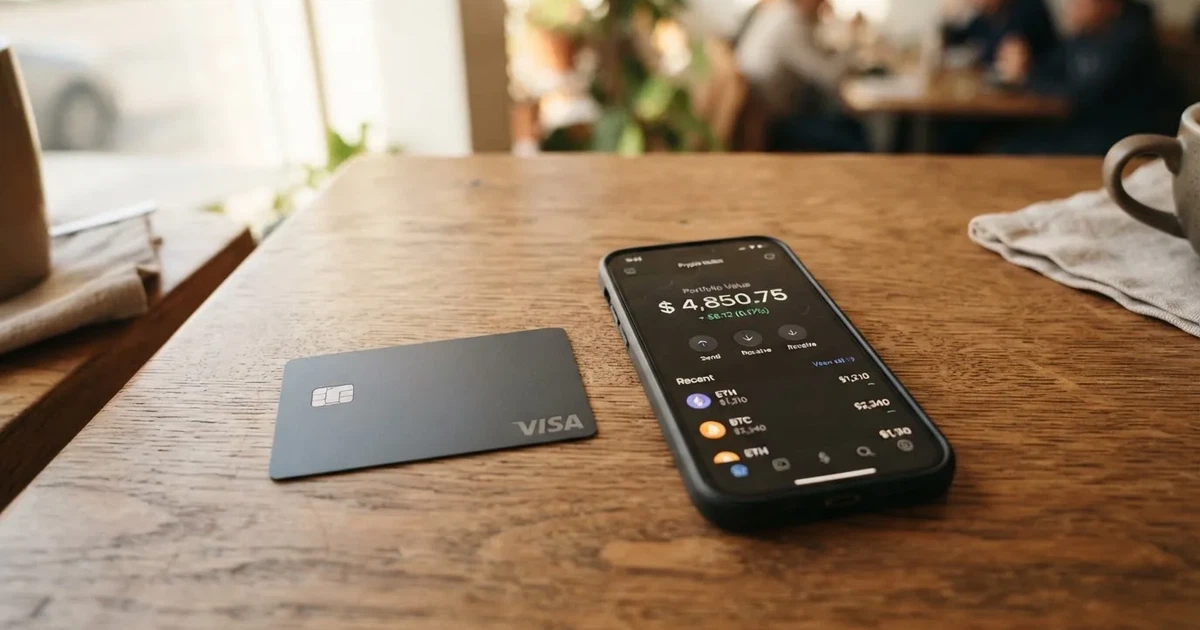
I am going to walk through what is documented, what is only marketing, and what the gaps mean for you. My score for this card is 4.7 out of 10, and the reason is not that the product sounds bad. It is that the ratio of promise to disclosure is poor, and for a card meant as a bridge between a crypto balance and everyday spending, disclosure is the product.
Conditions are current as of October 28, 2026.
The score, and who this suits
Four point seven out of ten. That is not a zero, and it is not a condemnation. It is a statement that I could verify a shape but not a price. Let me show the working, criterion by criterion, and then tell you who I think the card is for.
| Criterion | Mark | Why |
|---|---|---|
| Who can get it | 5 / 10 | Countries of card issuance are not named; availability depends on country of residence, sanctioned and high-risk jurisdictions are not permitted; the site footer lists Argentina, Bolivia, Brasil, Chile, Colombia, El Salvador, Espana, Estados Unidos, Mexico, Peru |
| Cost | 5 / 10 | Not disclosed: fees and spreads are shown in the app; the site says sending, receiving and top-up in USDC are “without commissions” |
| Top-up options | 4 / 10 | Purchases are debited from the USDC balance, the app runs on Base; other coins and networks are not named |
| Reliability and complaints | 4 / 10 | Kontigo, Inc. (Delaware), issuer and licences not named, assets in self-custody; unofficial: a hack drained 340,905.28 USDC from 1,005 accounts, the company said it refunded |
| Everyday use | 5 / 10 | Not disclosed: card form, wallets and ATM not named; the site writes about hybrid, credit and debit cards |
Two things stand out in that table. First, nothing scored above five, and the two highest marks are both fives sitting on top of a “not disclosed” answer. Second, the company itself tells you that it is not a bank and not a deposit taker: the footer says Kontigo does not provide financial services or take deposits, and that assets are held in your own custody.
So who does this suit? The audience the marketing points at is Latin American users saving and spending in USDC — that is the group whose language the site is written in, and whose countries appear in the footer. If you already hold USDC, already accept that self-custody means you are responsible for keys, and you are moving money you have decided to spend rather than money you need to be certain about, the proposition is coherent: load, spend, keep the remainder. If you need a bank card that a shop will always accept, a figure for what a coffee costs, or a named issuer answerable to a regulator, this is the wrong card — not because it is a scam on the evidence available, but because you cannot verify it is not.
Will they give you the card
The short answer: I cannot tell you, and neither can the public pages.
Kontigo does not state which countries the card is issued in. Its footer lists ten countries — Argentina, Bolivia, Brasil, Chile, Colombia, El Salvador, Espana, Estados Unidos, Mexico, Peru — under a heading of countries, but the list is not tied to the card. It reads as a set of places the platform is present in, not a statement that residents of those ten countries can be issued a card, and not a statement that residents elsewhere cannot. The terms say availability depends on your country of residence and that sanctioned and high-risk jurisdictions are not permitted. That is the whole of the eligibility statement I could find.
This matters more than it might look. Card acceptance abroad often turns on where a card was issued, not where you live — a merchant’s systems can look at the issuing country and the first digits of the card number and decide the transaction looks foreign. So the country of issuance is not a technical footnote; it is one of the main predictors of whether your card will work at the till. And here it is not published.
What does apply to you regardless of country: identity verification comes before use. The terms require that your identity be verified before you can use the services, covering name, date of birth, address, nationality and ID documents, with financial information possible, plus sanctions and credit checks, and one account per user. The terms describe no tiers of verification for the card, though Kontigo’s developer documentation notes that deposit methods depend on your KYC level without naming amounts. Processing times and rejection reasons are not stated. Developer docs mention levels and the help centre lists a topic called “Niveles Kontigo” alongside Kontigo Cash, Kochinitos and Kontigo Credit — I did not read those pages, so I am not going to characterise them.
One more thing I will flag as unofficial rather than confirmed: a Spanish-language piece says users can get a stablecoin card with Bitcoin cashback and a 10% USDC yield, and describes it as promotional. I could not verify that against the card’s own pages, so treat it as marketing material rather than a term.
If you want to know whether you qualify before you spend an afternoon on it, the only honest answer is that you will have to ask the platform directly, and you should judge the answer by how specific it is. A company that cannot tell you which country issues its card is unlikely to volunteer much else.
How to get it
Nobody has published a card-specific signup sequence. That is not a gap I can fill for you, and I am not going to invent one.
What is documented: verification happens before use rather than as an optional extra, with the identity elements listed above, sanctions and credit checks in the terms, and a single account per person. Beyond that, the card-specific steps are not stated — not the application flow, not whether approval is instant or reviewed, not what happens if you are turned down, not how long a decision takes.
So the practical shape of applying is: find the app, complete the identity checks the terms require, and then discover the card steps yourself. Whether there is a waiting period, whether the card is issued automatically once you are verified, whether you can hold a card without a balance, and whether the card is physical, virtual or both — none of that is stated. The site does say it is the first international credit and debit card in USDC that earns yield, and the footer lists hybrid, credit and debit cards, which reads like a roadmap rather than a specification. The network is not named, and whether a virtual card exists alongside a physical one is not stated. Delivery is not stated either: not the method, not the cost, not the time.
Given that, the honest test for you is not “will I be approved” but “will I be able to see what I am approving”. If you can get to the fee screen and the card terms inside the app before you commit, that is the minimum. If someone is directing you to sign up on the strength of a yield figure, the terms you have not read are the thing you are actually buying.
Fees: what a payment really costs
Nothing is published. That is the finding, and it is the reason this section is shorter and blunter than it could be.
Kontigo’s terms say fees, commissions and spreads are shown in the app and may change. On the home page the company says you can send, receive, top up and save in USDC “without commissions”. Neither statement tells you what a coffee costs.
| Fee or limit | What the card’s public pages say |
|---|---|
| Issuance | not stated |
| Monthly fee | not stated |
| Conversion | not stated; fees and spreads are shown in the app and may change |
| Foreign exchange | not stated |
| ATM | not stated |
| Daily limit | not stated |
| Monthly limit | not stated |
Read that table with the three uses that matter. At a café in your own currency, the cost is whatever spread sits between USDC and that currency at the moment of payment — invisible from outside the app. At a shop abroad, it is that spread plus whatever the foreign-exchange treatment turns out to be, and the card currency is not stated either; terms say fiat accepted include USD and other local currencies shown in the platform, and that liquidated balances may be held in a fiat currency Kontigo chooses, for example USD. At a cash machine, you have no published figure at all, and ATMs are the classic place where a crypto card’s hidden costs surface.
Two categories from the wider market are worth knowing, because Kontigo’s silence covers both and you may meet them anyway. The first is network fee: gas or bandwidth for your deposit is charged by the blockchain, not by the card company — that is true of every provider, Kontigo included. The second is merchant-side friction, which does not show up in any fee schedule: a shop can decline a prepaid or foreign-issued card because the card lookup reveals the card type and the issuing country, an address-verification check may not work for a foreign-issued card, and a declined payment can leave a hold on your funds that lasts several days, typically up to seven.
My advice is procedural rather than numeric: before you rely on this card, open the app and write down the conversion spread, the foreign-exchange treatment and any withdrawal charge on a piece of paper, then check them again after a week. A rate that changes under you without notice is allowed under terms that say fees may change. That is not a defect; it is a condition of the product as documented, and it is worth more of your attention than any single number would be.
How to Top up
Purchases are debited directly from your USDC balance — that comes from customer testimony quoted by the company, and from a Kontigo article saying the app runs on Base. Sending, receiving and topping up in USDC is described as commission-free on the home page.
Beyond that: what the card accepts for funding is not stated. Other coins are not named. Networks other than Base are not named. Minimums are not stated; developer documentation says deposit methods depend on your KYC level, without amounts. Whether you can top up from a bank account, from another card, or only from a crypto wallet is not stated. No tiers or levels for the card are described, although the help centre lists a levels topic plus Kontigo Cash, Kochinitos and Kontigo Credit, which I did not read.
The mechanics of getting money out are partly documented, and they are worth reading carefully because they tell you what happens when you want to stop. The terms say digital assets can be transferred to external wallets “when that feature is available” — note the conditional. After account closure you have a reasonable period, for example 30 days, to instruct a withdrawal. If you do not, Kontigo may sell the assets and hold the proceeds in a fiat currency of its choosing, with no interest. Closing an account requires no pending obligations and no positive balance, or a withdrawal already instructed.
Set out plainly: topping up means transferring USDC on the right network to the right address, and blockchain transfers are irreversible. A deposit sent on a network the provider does not support, or to an address belonging to another network, can be lost or need manual recovery with no guarantee. Because Kontigo does not publish which networks it accepts, the first transfer you make is the one where you check the network twice — not as advice about circumventing anything, but because an irreversible transfer to a wrong-format address has no undo button.
Paying with it every day
The everyday experience is the least documented part, and it is the part you will feel most.
The form of the card is not stated: not plastic or virtual, not what network it runs on. Wallets are not stated — whether it can be added to Apple Pay or Google Pay is not said anywhere I looked, which matters because a card you cannot put in your phone is a card you have to carry. ATMs are not named. The help centre and developer documentation do not reference blocked merchant categories, but that is not the same as a statement that nothing is blocked.
On the money side the card is marketed as one that earns yield — that is, returns. The rate is not stated, the form of payout is not stated, and no cashback figure appears. One unofficial Spanish-language piece mentions Bitcoin cashback and USDC yield as promotional; I could not confirm it against the card’s own pages and I would not plan a budget around it. Note also the tension worth thinking about: a card that pays a yield and offers credit has to fund that from somewhere, and the terms describe a company that says it does not take deposits and does not provide financial services. Ask where the return comes from.
Where the terms do speak, they speak about disputes, and this is the most reassuring paragraph I found. Kontigo says it will negotiate in good faith for up to 15 business days after written notice, and that if that fails the matter goes to the courts of Delaware. Local consumer-protection authorities remain available to you. Chargebacks are not mentioned, so do not assume the chargeback route is open to you, and the terms ask you to report unrecognised transactions as soon as possible. That last point is worth internalising: the speed of your own report is doing work that a dispute window alone would not.
The app exists on Google Play and App Store, and the site cites over 10,000 user reviews. The store rating itself is not stated. For support, there is a help centre with a WhatsApp contact channel, and the terms describe communication through in-app messages, push, email, SMS and messaging apps, with no direct phone, chat or email line listed. Help centre pages are in Spanish; English article pages exist at /en/article.
So: for a person paying for groceries and transport, what you have is a card whose acceptance, wallet support, ATM behaviour and reward rate are all unpublished, wrapped in a support channel that runs through WhatsApp and an app. That combination can work well. It also means that when something goes wrong at 9pm on a Sunday, the person helping you is a chat window, not a regulated complaint handler with a file number.
What can go wrong
Start with the one concrete incident on the record, flagged as unofficial and unverified in dates: third-party reporting describes a hack that drained 340,905.28 USDC from 1,005 accounts, with the company saying refunds were processed. Separately, a US$20M seed round was reported in December 2025. If the first account is right, it is also a stress test with a good ending — but note what it was: a test of the company’s ability to make people whole, not a test of the custody model. In self-custody, a stolen private key has no built-in recovery; the network cannot freeze or return funds.
Which brings me to the custody structure, because it is the core of both the promise and the risk. The footer says users hold assets in their own custody. The terms say assets may be in a self-custodied wallet or with third-party custodians, that Kontigo cannot access or recover your private keys, that you are solely responsible for your credentials, and that transactions are generally final. Two-factor authentication, a card freeze feature and any insurance are not stated — and those are precisely the three things you would reach for in the bad hour.
Then the company layer. Kontigo, Inc. is a Delaware corporation. The issuer, the BIN sponsor and the licences are not named. Its dispute path ends in Delaware courts, which is workable but is not local recourse. And the search I ran for user complaints found none — but read that carefully. The results were for an unrelated brand, and there is no Trustpilot page for Kontigo. So the absence of complaints is not evidence of good service; at this card’s size and age, it is mostly evidence that there are not yet many public accounts to complain.
The category history is worth keeping in view, because it is the reason the questions above matter. Card programmes do close: Visa terminated its global agreements with FTX on 13 November 2022 and the FTX US debit card was wound down by its issuer; WaveCrest, a Visa issuer that supplied crypto card brands, was suspended by Visa in Europe in 2018, closing all WaveCrest-issued Visa programmes. A closure typically means a notice period, then spending and loading stop, then you are asked to withdraw. Kontigo’s own terms describe something close to that sequence, with 30 days to instruct a withdrawal, and then a fallback: assets sold, proceeds held in a fiat currency of the company’s choosing, no interest.
Stablecoins are not risk-free either, in either direction. USDC lost its peg temporarily in March 2023 during the US banking crisis; TerraUSD collapsed in May 2022. A USDC balance is a dollar-denominated claim that is not a bank deposit.
What to take instead
I want to be careful here. None of these is a recommendation to switch; they are the cards whose terms you can actually read, and reading is the thing Kontigo makes hardest.
| Alternative | Score | Card and costs as published | Who it is documented for |
|---|---|---|---|
| RedotPay | 6.9 / 10 | Virtual and physical; Visa debit per the Singapore terms; USD card and HKD card; application 10.00 USD virtual, 100.00 USD physical (not cancellable or refundable once paid); virtual replacement 5.00 USD first, 10.00 USD each later; no monthly or annual fee; Pro tier 12.90 USD monthly or 129.00 USD annual; 1.00% transaction fee, 1.20% on a non-default currency | Two official lists word it differently: the KYC list bars citizens of named countries including the US, UK-listed Russia, Belarus, Ukraine, Serbia; the card-issuance list (dated August 28, 2026, 47 places) bars residents of India, Indonesia, Morocco, Nepal, Singapore, Turkey from virtual and physical cards and as billing addresses |
| Wirex | 6.7 / 10 | Virtual and physical, one of each; metal card is a Visa Signature debit card; issuance free in UK, EEA, APAC, SG, AU and “Other”; metal card order fee 45 GBP on the UK page with free DHL Express, “only 45 EUR” delivery fee elsewhere; card page says no annual or foreign exchange fees; cryptoback in WXT: Standard 0.5%, Premium 3%, Elite up to 8%; terms are “subject to change” | “Worldwide (130+ countries)”; fees published for UK, EEA, APAC, SG, AU and “Other”; Singapore terms say cash withdrawals are not permitted there and bar transactions with prohibited countries; residence country must match your ID |
| Bitpanda | 6.5 / 10 | Physical Visa debit, EUR only, one active card; account opening and monthly cost not stated, first shipment free; reissue EUR 5.90 (FAQ: EUR 9.90 for lost or stolen), each additional physical card EUR 10; non-EUR FX fee EUR 0 but “VISA mark-up fees apply”; 1% cashback on crypto spending, with the page summary saying “up to 2%” | Verified Bitpanda account and residence in a euro-area country; users verified via “Bankident” cannot order; the rule is by residence |
Two things stand out when you put them side by side. All three name their prices, which means you can do the arithmetic on a sandwich before you commit. And all three restrict eligibility in writing, listing countries, states or regions, which means you can check yourself against the list instead of applying and hoping. Kontigo restricts eligibility in principle and not in detail, which is the more frustrating version.
The counter-argument is fair and I will state it: Wirex and Bitpanda are narrower. Wirex’s rewards are paid in its own token and exclude ATM withdrawals, cash advances, crypto purchases and gambling. Bitpanda is effectively euro-area residents only, its cashback figures are internally inconsistent, and its crypto conversion spread is not stated. If you are in the euro area and want a card attached to a regulated exchange with a euro balance, Bitpanda may simply be the plainer choice.
If your problem is the problem Kontigo seems built for — being outside the euro area, holding USDC, wanting to spend it — then RedotPay is the closest of the three on published terms: on-chain deposit, card currencies and application fees all in the open, with a clearly stated 1% transaction fee that you can actually decide about.
Who I would recommend it to
Three groups, and only three.
Someone who already holds USDC and has decided how much of it is spendable money. For them the self-custody model is a feature they have already accepted, the Base network is a network they have already used, and the absence of a monthly fee may be exactly what they want.
Someone in a country where the alternative is nothing. If your usual banking route is closed to you and the fee schedule of a mainstream card is irrelevant because the mainstream card does not exist for you, then a published-nothing card can still beat an unavailable card — as long as you have read the in-app fees yourself and you can see your balance before you commit to a payment.
Someone testing it with small amounts. This is the honest version of the second group: put in a little, spend a little, check the spread, check that a declined payment does not leave a hold for a week, and only then decide whether it earns its place.
And who I would not recommend it to, plainly: anyone whose financial safety depends on knowing which institution is liable for their money. That includes people who need a dispute route in their own language and country, people who plan to hold a balance on the card for more than a month, and anyone who would be unsettled by terms that say fees and spreads may change without the figure ever having been published. For all three, an issuer that publishes is worth more than a yield that is advertised.
One last practical note for the kind of reader who got here searching about specific places: availability depends on your country of residence, sanctioned and high-risk jurisdictions are not permitted, and where the card is issued is not stated — so if you are outside the countries in the footer, your first question to Kontigo is whether a card is issued to you at all, and your second is which country issued it.
Frequently asked questions
What is Kontigo card?
Kontigo is presented as the first international credit and debit card in USDC that earns yield, with purchases debited straight from your USDC balance. Its footer also lists hybrid, credit and debit cards, which reads as a range being planned rather than a firm specification. Kontigo, Inc. is a Delaware corporation that says it does not provide financial services or take deposits, and that assets are held in your own custody. The card issuer and its licences are not named on the public pages.
Is Kontigo a bank?
No, not by its own account. The footer states that Kontigo does not provide financial services or take deposits, and that assets are held in user custody rather than on the company’s books. That is consistent with a card you fund yourself, in the same way a prepaid card is not a bank account. It also means there is no deposit guarantee behind the balance, so the safety of the money depends on the custody arrangement rather than on a bank.
Is the Kontigo card safe?
I would not call it unsafe, and I would not call it verifiable either. What supports it: assets in your own custody, so Kontigo says it cannot access or recover your keys; a dispute process of up to 15 business days before Delaware courts, with local consumer-protection authorities still open to you; and an app with over 10,000 user reviews cited. What argues for caution: two-factor authentication, a card freeze and any insurance are not stated, transactions are generally final, and unofficial reports describe a hack draining 340,905.28 USDC from 1,005 accounts.
What countries can I use the Kontigo card in?
The card’s countries of issuance are not stated, which is an unusual thing for a card page not to say. The footer lists Argentina, Bolivia, Brasil, Chile, Colombia, El Salvador, Espana, Estados Unidos, Mexico and Peru, but that list sits under countries generally and is not tied to the card. Terms say availability depends on your country of residence and that sanctioned and high-risk jurisdictions are not permitted. Practically, where you can spend depends on where the card was issued, and that is exactly what is unpublished.
How much does the Kontigo card cost?
The card’s public pages do not publish issuance fees, a monthly fee, conversion spreads, foreign-exchange treatment, ATM charges, or daily and monthly limits. The terms say fees, commissions and spreads are shown in the app and may change, while the home page describes sending, receiving, top-up and saving in USDC as commission-free. So the only way to know your cost is to open the app and read the current numbers before you make a payment — and to check them again, because they can move.
How do I top up the Kontigo card?
Purchases are paid from your USDC balance, and Kontigo says the app runs on Base. Beyond that, the funding options are not stated: other coins are not named, other networks are not named, minimums are not stated, though developer documentation says deposit methods depend on your KYC level. The practical sequence is a USDC transfer on the right network to the right address, and because blockchain transfers cannot be reversed, check the network and address carefully before your first one.
Does the Kontigo card pay cashback or yield?
Kontigo markets the card as one that earns yield, but it does not state the rate or how it is paid, and no cashback figure appears in the terms. A Spanish-language piece mentions Bitcoin cashback and USDC yield as promotional, which I could not confirm against the card’s own pages. Treat any number you see as marketing until it appears in the app or in the terms you can hold.
Can I use Kontigo with Apple Pay or Google Pay?
The public pages do not say. Whether the card can be added to a mobile wallet is not stated, and neither is whether any merchant categories are blocked. For a card meant for daily spending that is a real limitation of the documentation: before you depend on it, confirm in the app that tokenised mobile payment works for your setup, and check how a declined payment behaves.
What happens if I want to withdraw or close my account?
The terms say digital assets can be transferred to external wallets “when that feature is available” — so check that it is available for you. After closure you have a reasonable period, for example 30 days, to instruct a withdrawal. If you do not, Kontigo may sell the assets and hold the proceeds in a fiat currency it chooses, with no interest. Closing requires no pending obligations and no positive balance, or a withdrawal already instructed.
Is the Kontigo card worth it?
It depends on what you are replacing. If you already hold USDC, already use self-custody, and your alternative is no card at all, a small test with an amount you can afford to lose is reasonable. If you are choosing between crypto cards, the deciding factor is disclosure: a competitor that publishes its 1.00% transaction fee and its application cost gives you something to weigh, and Kontigo currently gives you neither.
App and neobank cards – cryptocardchooser.com
Content created by the «cryptocardchooser.com» team