
Wenia is a virtual Mastercard that spends a crypto balance from Colombia — cheap, quiet, and thin on published detail
 Available in US
Wenia is one of those cards that arrives without much noise around it. A Colombian company, a digital Mastercard, an app where you pick which crypto pays for the purchase, no monthly fee, and a long list of supported assets. On paper that is a tidy proposition, especially for someone in Colombia who wants to pay online from a crypto balance rather than move money through a bank first. The problem is not the concept. The problem is that almost every practical question a card user normally answers from the provider’s own pages — who qualifies, what identity checks apply, what the exchange rate costs, which network to send funds on, whether there is a physical card — is either unstated or described as coming later.

I read the card’s public material with that gap in mind, and this page is the result: what is confirmed, what is genuinely absent, and where the risk sits if you sign up anyway. The score below is my own mark out of ten, not a grade handed down by Wenia.
Conditions are current as of October 28, 2026.
Verdict: 6.1 out of 10
The honest summary is this. Wenia is inexpensive and structurally simple, and that simplicity is genuinely attractive for a Colombian resident who already holds crypto and only wants to spend it online. What you give up in exchange is almost all of the information a careful user would want: no eligibility list, no KYC detail, no named issuing bank, no stated networks, no currency for the card itself, no ATM, no physical card, and in-store payment described as coming soon. A product can be cheap and still be a poor choice — cheapness does not compensate for being unable to check the terms before you commit.
| Criterion | Mark | Why |
|---|---|---|
| Who can get it | 2 / 10 | Offered by Wenia S.A.S. in Colombia through the Wenia App; eligibility conditions are not listed anywhere public |
| Cost | 9 / 10 | Free to create, no management fee or monthly charges, 0% interest; COPW, USDW and EURC purchases carry no extra cost, other coins may incur a conversion fee |
| Top-up options | 8 / 10 | Paid from the digital asset balance in the app across eleven listed assets, switchable in the Wenia Card section; the networks themselves are not named |
| Reliability and complaints | 7 / 10 | Wenia S.A.S. (NIT 901656609-9), supervised by the Superintendencia de Industria y Comercio, on the Mastercard network, issuing bank not named; no complaints found |
| Everyday use | 5 / 10 | Digital Mastercard only, Apple Pay and Google Pay mentioned, in-store payment through the mobile wallet described as coming soon; no physical card and no ATM |
| Total | 6.1 / 10 | Cheap and simple, but thin on published terms |
Who this suits: a Colombia resident who already holds one of the listed assets, pays mainly online, and is comfortable treating a young financial product as a convenience rather than as infrastructure. Who it does not suit: anyone outside Colombia who is guessing whether they are eligible, anyone who needs a physical card or cash withdrawal, anyone who must know the exchange rate before a purchase rather than after it, and anyone who plans to hold a meaningful balance on the platform for long.
Will they give you the card?
I could not find an eligibility list. That is the plain finding here, and it deserves to be said before anything else rather than buried: the card’s public pages do not state who qualifies. What they do state is the shape of the offer — the product is provided by Wenia S.A.S., a Colombian company, through the Wenia App. So the reasonable inference is that this is aimed at people resident in Colombia, and that anyone elsewhere is looking at an offer whose terms they cannot read.
That inference is not the same as a rule, and you should treat it as such. If you live elsewhere, the sensible thing is to ask customer service directly before you upload any document, because the answer determines whether the rest of this review matters to you.
One thing worth understanding about how any card of this kind looks to a shop is the card number itself. A payment card number begins with an issuer identification number — the BIN or IIN, six or eight digits — that tells the merchant which institution and country issued it; the remainder identifies the account and ends with a check digit. Merchants can look up that prefix, and if the issuer country differs from the billing address they may apply extra scrutiny. This is normal, not a sign that anything is wrong with you, but it is one reason an overseas-issued crypto card can be declined at a checkout that would accept a local one.
The company behind the card is Wenia S.A.S. (NIT 901656609-9), based in Colombia and supervised by the Superintendencia de Industria y Comercio, the country’s consumer and competition authority. It runs on the Mastercard network. The separate bank that actually issues the card is not named on the pages I read — and for a card that touches your money, that is a question worth asking rather than a detail to skip.
How to get it
The signup path is described in four moves, and it is short: download the Wenia App, open an account, create the card in the app, and choose the digital asset you want to pay with. That last step is the one that makes this different from an ordinary card — the spending asset is set per card inside the app rather than being whatever your bank account holds.
What you get is a digital, or virtual, Mastercard for online use worldwide. No physical card is mentioned anywhere. In-store payment through the mobile wallet is described as coming soon, so if you were picturing tapping a card in a shop, that is not what this is today. The currency the card is denominated in is not stated.
On KYC, again plainly: the details are not stated. I will not guess at what documents you will be asked for, because the card’s own pages do not say. What is worth knowing is why that stage exists at all, so it does not feel arbitrary. Anti-money-laundering rules require regulated businesses to verify customers and assess risk as part of their legal obligations, including ongoing transaction monitoring and suspicious-activity reporting. In the EU, customer due diligence typically covers name, address, date of birth, nationality, identity documentation, a sanctions check, the purpose of the relationship, and whether you are a politically exposed person. In the US, the customer identification programme requires name, date of birth, address and an identification number. If due diligence cannot be completed, rules in those jurisdictions require the institution to hold back from the transaction or relationship and, where necessary, close existing ones — which is the usual reason an account sits frozen “pending documents”.
There is a distinction worth keeping in mind, because it catches people out. Nationality is recorded and screened separately from residence, since sanctions screening and issuer risk policy are often applied to citizenship and country of birth as well as to country of address. “I live here” is not always the same answer as “I am from here”. Prepaid and debit cards are generally available to adults from 18, and some issuers set higher limits on top of that.
One practical note on choosing your spending asset at setup: this is a decision you can revisit later. The asset can be switched in the Wenia Card section inside the app, so locking yourself into one coin on day one is not necessary.
What it really costs: Fees
This is the strongest part of the offer, and I want to be precise about it because “free” is a word that gets stretched. Creating the card is free. There is no management fee and no monthly charge — the card’s own wording is that there is no “cuota de manejo ni cargos mensuales”. Interest is 0%. And purchases paid in COPW, USDW or EURC carry no additional cost.

Where the picture gets less clean is everything else. Choosing some other cryptocurrencies may incur a conversion fee, and the rate is not stated on the page. The foreign-exchange fee is not stated. ATM costs are not stated — which matters less than it might, since there is no ATM mentioned at all.
| Fee or limit | What the card states |
|---|---|
| Issuance | Free to create |
| Monthly fee | None — no “cuota de manejo ni cargos mensuales” |
| Interest | 0% |
| Conversion | No additional cost for COPW, USDW and EURC; other cryptocurrencies may incur a conversion fee, rate not stated |
| FX fee | Not stated |
| ATM | Not stated |
| Monthly limit | Up to 10,000 USD per month; higher limits on request via customer service |
| Daily / ATM limits | Not stated |
Two or three everyday payments make the shape of this clearer than any table.
Coffee, paid in USDW. You are in the three assets that carry no additional cost, so on the conversion side nothing is added. But note what is missing rather than what is present: because the conversion fee for other coins is only described as “may incur” and its rate is not published, you cannot fully price a purchase in, say, BTC from the public pages. If a fee does apply, the terms do not tell you how much.
A subscription in a currency other than the Colombian peso. You are buying something denominated in a foreign currency and the FX fee is not stated. There is a category of cost here that you cannot quantify in advance, and that is worth factoring into how you choose where to use the card.
Anything paid in crypto outside those three. A conversion may be charged. Compare that with the way other products in this category are built: one exchange’s card applies a stated crypto conversion fee of 0.9% on top of its sell rate, plus an FX fee on top of the network rate; another’s euro card is described with no transaction fee and a conversion spread quoted at 0.1% in one place and 0.4% in another. Wenia’s charges may well be lower than these. The point is narrower than a comparison: with a published percentage you can compute the cost, and here you cannot.
One structural point that keeps coming up in this category, and that reduces how much can go wrong on your balance: many crypto cards behave like prepaid cards. You convert or top up a balance first, and the card spends only that balance, so it cannot overdraw. On a card with a 10,000 USD monthly ceiling, that is a real limit on the damage a bad month can do.
How to Top up
The card does not take a bank transfer. It pays out of the digital asset balance inside the app, and that balance is funded with crypto, not fiat: COPW, USDW, EURC, BTC, ETH, POL, SOL, AVAX, XRP, LINK and ADA are listed as available. You choose which asset pays for the purchase in the Wenia Card section, and you can switch it.
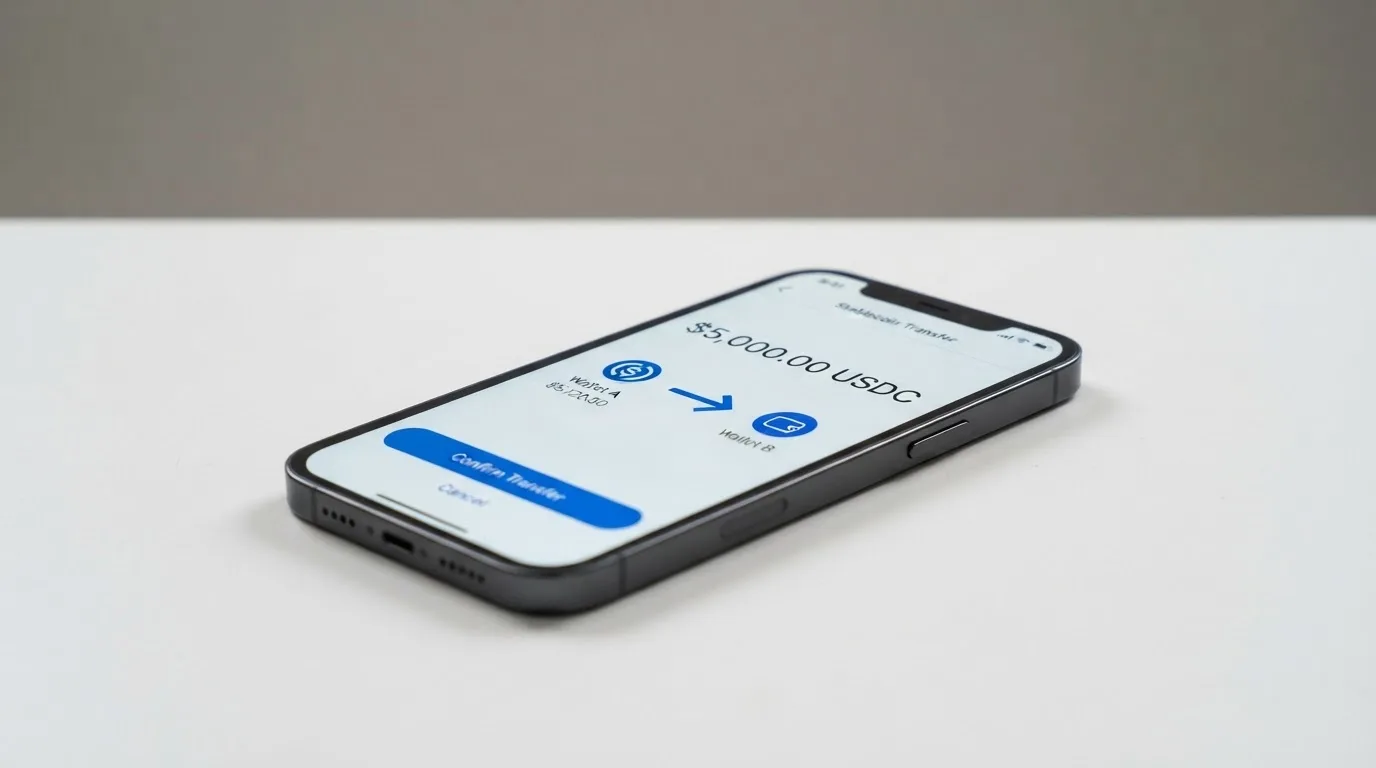
What is missing is the part that trips people up most often in this category: the networks are not stated. That matters more than it sounds, because blockchain transfers are irreversible. A deposit sent on a network the card provider does not support, or to an address belonging to a different network, can be lost or may need manual support recovery with no guarantee. There is no reversing it and no chargeback on a blockchain transfer.
So the honest advice is unglamorous: get the network confirmed in writing before you send anything, and treat the first deposit as a small one.
It is also worth knowing what the coins you are choosing between actually are. A stablecoin aims to hold a stable value against an asset such as a fiat currency, but as the BIS noted, despite the name stablecoins are not necessarily stable. Tether’s USDT and Circle’s USDC are US-dollar-pegged, and the BIS put about 90% of stablecoin market capitalisation in these two as of July 2025. Circle says USDC is redeemable 1:1 for US dollars and 100% backed by cash and cash equivalents, mostly in an SEC-registered government money market fund, with monthly reserve attestations by a Big Four firm. Circle listed USDC as natively supported on 38 networks as of 16 September 2026, including Ethereum, Solana, Base, Polygon PoS, Avalanche, Arbitrum and Stellar. Tether describes USDT as a token built on multiple blockchains with reserves intended to back it 1-to-1, issued on networks including Ethereum, Tron, Solana, Polygon and Avalanche.
Two practical wrinkles if you hold these. Stablecoins can depeg: TerraUSD collapsed in May 2022, and USDC temporarily lost its peg in March 2023 during the US banking crisis. And they are not censorship-proof — Tether says it disables tokens in wallets on the OFAC sanctions list and has frozen funds tied to illicit activity.
One last cost on the funding side: on-chain network fees for your deposit are charged by the blockchain, not by the card provider. They come out of your wallet regardless of anything Wenia does.
Paying with it every day
Day to day, this is a thin offering, and I would rather describe it accurately than make it sound fuller than it is.
What exists: a digital Mastercard for online payments worldwide, Apple Pay and Google Pay mentioned on the home page, and spending from whichever crypto asset you have selected. What does not exist, as far as the pages go: a physical card, an ATM, and in-store payment through the mobile wallet — described as coming soon. Whether any merchant categories are blocked is not stated. Rewards of any kind are not stated either, so if you are comparing this card on cashback, there is nothing published to compare.
The absence of a physical card is the single fact that most changes what this card can be used for. Online subscriptions, services, and digital goods — that is the use case as it stands.
Adding the card to a phone wallet is the kind of thing that sounds technical and is not. Apple Pay replaces the card number with a device-specific Device Account Number held in the phone’s Secure Element, never on Apple’s servers, and each payment uses a one-time dynamic security code. The issuer can still restrict the tokenised number, for example blocking it on magnetic-stripe, phone or website use.
Two reasons a payment can be declined even when the card is perfectly valid, so you can tell whether the problem is the card or the shop. Address Verification Service compares the numeric parts of the billing address a buyer typed — street number, ZIP — with issuer records; it is mainly offered in the US, Canada and the UK and is generally unavailable for foreign-issued cards, which can cause declines. And some merchants decline prepaid or foreign BINs outright because the lookup reveals the card type and issuer country.
3-D Secure is the other half. It adds an identity check to online payments: the issuer assesses the risk and either approves frictionlessly or challenges you, for example with a one-time code or a biometric check. Visa’s brand is Visa Secure, Mastercard’s is Identity Check, and EMV 3-D Secure 2 published in 2016 supports one-time passcodes and app-based authentication aligned with EU strong customer authentication.
One thing to expect: a declined authorisation may leave a hold on your funds that can remain for several days, typically up to seven. It usually reverses, but it is not immediate, and it can look like a spending failure when it is only a pending hold.
What can go wrong
Let me take the reassuring news first, because it is real: I found no complaints and no user reviews for the Wenia Card on Reddit, Trustpilot or in the news, and no official incidents. A young product with a clean record is worth something — it is simply not evidence of anything, since absence of complaints usually reflects a short history and a small user base rather than a proven track record.
The exposures that do exist are structural.
Your crypto is held by someone else. With a custodial wallet the provider holds the credentials, so you must trust it completely, and a seed phrase — typically 12 to 24 words — is an unencrypted form of the private key that anyone who obtains it can use to restore the wallet and spend its funds. Transfers are typically irreversible, and a stolen key has no built-in recovery: the network cannot freeze or return anything. Custodial platforms have a record of this going badly: Mt. Gox, about US$350 million reported stolen between 2011 and 2014; Coincheck, about US$400 million in 2018; and Ronin Network, US$625 million in 2022.
The card is a programme, not necessarily a bank. Card payments involve several parties. The network — Visa or Mastercard — routes messages and sets the rules. The issuer, a bank or e-money institution licensed to issue under the network’s licence, holds the card programme. And the crypto brand is often only a programme manager or the front end that markets it. Wenia’s pages say it issues and operates the card, and name no separate bank issuer.
Programmes can close. Visa and Mastercard do not issue crypto cards to consumers themselves; they license issuers and can suspend a programme. Visa terminated its global agreements with FTX on 13 November 2022 and the FTX US debit card was wound down by its issuer. WaveCrest, a Visa issuer that supplied crypto card brands, was suspended by Visa in Europe in 2018, closing all WaveCrest-issued Visa programmes. Closures typically run in a familiar order: a notice period, then spending and loading stop, then users are asked to withdraw remaining balances. One 2026 closure reported by a secondary source had new loads ending 8 July 2026 and spending stopping 8 August 2026, though that is a single unconfirmed source. None of this is a prediction about Wenia. It is the shape of the risk you accept by holding a balance on any card programme.
Safeguards worth turning on. App-based two-factor authentication, an instant card freeze, spending limits, 3-D Secure confirmation and a tokenised mobile wallet are the standard set. None of them are documented on Wenia’s pages, so treat them as things to look for in the app rather than things you have.
If something goes wrong with a purchase, a chargeback is the route. A chargeback is a refund ordered by the issuer to settle a dispute, with reason codes such as fraud, duplicate billing or goods not received. The rights differ by market and card type — in the US, debit card reversal rights come from Regulation E and credit card rights from Regulation Z, and prepaid-card coverage varies and should not be assumed. And under 3-D Secure, liability for a fraudulent online payment can shift from the merchant to the cardholder’s bank — or, per its critics, to the cardholder.
And the tax question is yours, not the card’s. I am not going to advise you here beyond pointing at where it sits. In the US the IRS treats digital assets as property, so exchanging them for goods, services, dollars or other digital assets generally produces a taxable gain or loss, measured in local fiat currency at fair market value on the date of the transaction — which means each card payment funded from crypto can be a separate disposal. Whether any of that applies to you, and how, is a question for a professional in your own jurisdiction.
What to take instead
I have read these three for the same criteria, so the comparison is on the same basis rather than on marketing copy. All three are alternatives in the same category — cards that turn a crypto balance into everyday spending — and each solves some of what Wenia leaves open.
Bybit Card — 6.0 / 10. The widest geographic spread of the three, and the most expensive to use. The help centre lists Argentina, AIFC (Kazakhstan), Georgia, Kazakhstan, Australia, Mexico, Brazil, Peru and Asia Pacific; the app asks for your country of residence, and if the country is not supported it says it “will register your interest”. The cards page is explicit that the product is not meant for European Economic Area customers and that all EEA participation is strictly prohibited. It offers both virtual and physical cards (a virtual card must be obtained first; the physical card is not available in Peru and has rolled out in phases), with Mastercard in most regions and Visa in Brazil, Peru and Asia Pacific. Virtual issuance is free in all regions until further notice, with “no annual fees”. The costs are where it bites: a crypto conversion fee of 0.9% over the One-Click Sell rate in most regions, 0.5% in Argentina, and FX fees of 2% on top of the network rate in several markets, 7% in Argentina, 1.5% in Brazil and 1% in Peru. Rewards are unusually well specified — cashback tiers from 2% up to 10% with monthly caps, and since 5 October 2026 only crypto-funded transactions earn them.
Coinbase Card — 6.4 / 10. The narrowest and, for its one market, the simplest. It is available in all US states except Hawaii, with account opening following the USA PATRIOT Act identity rules. It is a Visa prepaid debit card, virtual or physical, spending cash or crypto, with crypto converted to US dollars at the point of sale or ATM withdrawal. On cost it is the most generous: “zero spending fees and no annual fees”, with all fees disclosed in the Cardholder Agreement — though a spread applies when Coinbase buys, sells or trades crypto, which is where the real cost sits. Funding is by linking a bank account or depositing part of a paycheck, at zero fees. Optional crypto rewards on every purchase, US users only, at a variable rate shown in the app.
OKX — 6.2 / 10. The European option. Launched for the EU plus Norway on 28 January 2026, with Iceland and Liechtenstein excluded; the rule is by EEA user of OKX Europe Ltd., the MiCAR-licensed entity. It is a Mastercard, euro-denominated virtual debit card linked to OKX Pay, issued via an unnamed European licensed payment provider; no physical card is mentioned. The fee line is clean — no card fee as of May 2026, no transaction fee, no OKX FX fee, and a conversion spread quoted at 0.1% in one place against 0.4% in the launch release, an inconsistency the card’s own material does not resolve. Funding is USDC or USDG held in OKX Pay; other coins must be converted first, there is no auto top-up, and a payment is declined if the balance is insufficient. Cashback applies only to USDG purchases, with tier caps in euro.
So which direction should you go? If you are in Colombia and want the cheapest, simplest version of this, Wenia is the one to look at first, accepting that you will learn the details from support rather than from a page. If you want both a virtual and a physical card and live somewhere in Bybit’s list, and you spend enough that the cashback tiers matter, Bybit’s rewards may outweigh its higher conversion and FX fees — but check its region rules carefully, because it is explicit about who it excludes. If you are in the US, Coinbase is the one with published fees and no annual charge. If you are in the EEA, OKX is the natural comparison, with the euro card and the licence named, and the caveat that its own spread figure is stated inconsistently.
| Wenia | Bybit Card | Coinbase Card | OKX | |
|---|---|---|---|---|
| Score | 6.1 / 10 | 6.0 / 10 | 6.4 / 10 | 6.2 / 10 |
| Where | Colombia via the Wenia App | Argentina, AIFC, Georgia, Kazakhstan, Australia, Mexico, Brazil, Peru, Asia Pacific; EEA excluded | US states except Hawaii | EU plus Norway; Iceland and Liechtenstein excluded |
| Card form | Digital only | Virtual and physical | Virtual and physical | Virtual only |
| Network | Mastercard | Mastercard or Visa by region | Visa | Mastercard |
| Card fee | Free to create | Virtual free; physical varies by region, some free | No annual fee | None as of May 2026 |
| Main hidden or variable cost | Conversion fee on other coins, rate not stated; FX fee not stated | 0.9% conversion, 0.5% Argentina; FX 2% or regional rate | Spread when Coinbase converts crypto | Conversion spread, quoted 0.1% or 0.4% |
| Rewards | Not stated | Tiered cashback, crypto-funded only from 5 October 2026 | Optional crypto rewards, variable rate | Cashback on USDG only |
Who I would recommend it to
To the Colombian resident who already holds USDW, EURC or COPW, pays mostly online, and treats this as a convenience they can walk away from. The no-monthly-fee, no-conversion-cost structure for those three assets is the best part of the offer, and a 10,000 USD monthly ceiling with higher limits on request is a reasonable shape for ordinary spending.
I would not recommend it as your only card. I would not recommend it to anyone who cannot confirm their own eligibility from the published terms, because there is no eligibility list to read. I would not recommend it to anyone who needs cash, a physical card, or in-store payment today. And I would recommend that anyone who does sign up keeps only a working balance on it, on the reasoning that the issuer bank is unnamed, the networks are unnamed, and the cost of the one error I cannot rule out — sending funds on an unsupported network — is permanent.
Before you deposit anything, I would ask three questions in writing: which networks are supported for each of my assets, what does a conversion between assets cost at the rate applied, and which institution is the issuing bank. If those come back clearly, this is a 7. If they come back vaguely, treat the 6.1 as the ceiling.
Frequently asked questions
What is the Wenia card?
The Wenia card is a digital Mastercard provided by Wenia S.A.S., a Colombian company, through the Wenia App. It spends a balance of digital assets rather than a bank account: you hold crypto in the app and choose which asset pays for each purchase. It is offered in Colombia, works online worldwide, and exists only in digital form — no physical card is mentioned.
How does the Wenia card work?
You open an account in the app, create the card, and select the digital asset you want to spend from. The card pays out of that asset balance, so the crypto is converted at the moment of purchase rather than held as fiat. The asset can be switched in the Wenia Card section inside the app. Purchases in COPW, USDW or EURC carry no additional cost; other cryptocurrencies may incur a conversion fee.
Is Wenia a bank?
No — it is not described as one. Wenia S.A.S. (NIT 901656609-9) is a Colombian company supervised by the Superintendencia de Industria y Comercio, and it says it issues and operates the card on the Mastercard network. The separate bank that acts as issuer is not named in the public material, which is a question worth asking support directly if the balance matters to you.
Who can apply for the Wenia card?
The public pages do not list eligibility conditions — that is the honest answer. The product is offered by Wenia S.A.S. in Colombia through the Wenia App, so it is aimed at people resident there. If you live in another country, ask customer service before uploading any document, since residency and citizenship can be screened separately and the two do not always give the same answer.
How much does the Wenia card cost?
Creating the card is free, there is no management fee or monthly charge, and interest is 0%. Purchases paid in COPW, USDW or EURC have no additional cost. What is not stated is the rate of the conversion fee that may apply to other cryptocurrencies, the foreign-exchange fee, and any ATM cost — so for those you are working without published numbers.
Can I use the Wenia card outside Colombia?
The card is described as usable for online payments worldwide. Two caveats. A card issued in one country can be declined by shops that scrutinise the issuer country against your billing address, and address verification is generally unavailable for foreign-issued cards. And the monthly limit is up to 10,000 USD, with higher limits available on request through customer service.
Does Wenia require KYC?
The details are not stated on the card’s public pages, and I will not guess. In practice, a regulated provider is required to verify identity under anti-money-laundering law, so expect some form of identity check. Note that if checks cannot be completed, rules commonly require the provider to hold back or close the relationship — which is the usual reason an account sits frozen pending documents.
How do I top up the Wenia card?
You top it up with crypto, not fiat. The listed assets are COPW, USDW, EURC, BTC, ETH, POL, SOL, AVAX, XRP, LINK and ADA. The networks are not stated, and this is the detail to settle before sending anything: blockchain transfers are irreversible, so a deposit on an unsupported network can be lost. Start with a small transfer and get the network confirmed in writing first.
Is the Wenia card safe?
I found no complaints, no user reviews on Reddit or Trustpilot, no news coverage of problems and no official incidents. But that reflects a short history rather than a proven record. Treat funds on the platform as money held by a company whose issuing bank is unnamed, set up two-factor authentication and spending limits in the app if they exist, and keep only a working balance.
Can I withdraw cash or get cash from the Wenia card?
There is no ATM mentioned in the card’s material, and ATM limits and costs are not stated. Combined with the absence of a physical card, that means cash is not part of what this card currently does. In-store payment through the mobile wallet is described as coming soon, so Apple Pay and Google Pay in a physical shop is also not something to rely on today.
Exchange cards – cryptocardchooser.com
Content created by the «cryptocardchooser.com» team