
A self-custody card with honest fees and a lot of unanswered questions
 Available in US
The Karma card is a Visa payment card that spends straight out of your own, non-custodial crypto wallet. There is no bank account in the middle, no sign-up fee, no monthly subscription and no card metal tier — the fee structure is short and readable: a service fee of 0.5% per transaction, 1% on non-USD conversion plus $0.30 international, 1% on the way in and 0.5% on the way out. That transparency is real and unusual. What is not there is nearly as notable: the public pages do not state the KYC process, the card currency, whether you get a physical or virtual card, the delivery time, the spending limits, or even a full fee schedule.
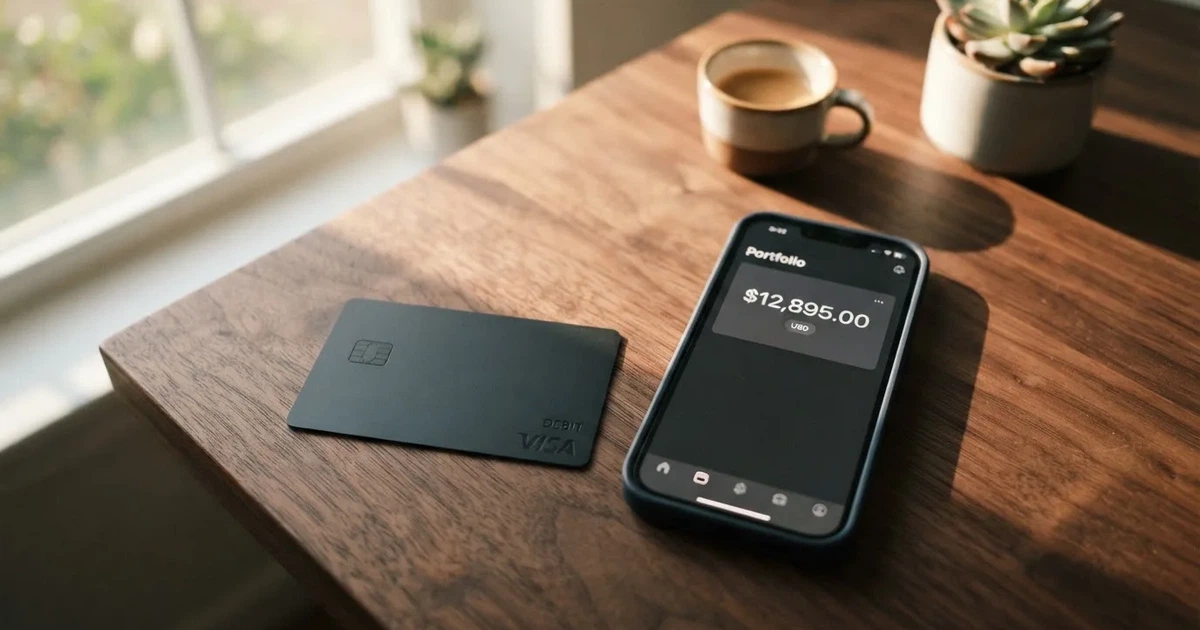
That combination — costs you can compute, terms you cannot — is what produces the score below. It is a card for a specific person: someone who already holds crypto, already keeps their own keys, and wants to spend it without handing custody to a platform. It is not a card for someone trying to open their first financial account, and it is not a card for someone who needs Apple Pay tomorrow.
The conditions described here are current as of October 28, 2026.
Verdict: 6.4 / 10
Karma scores 6.4 out of 10. Not a bad card — a card with a genuinely good fee structure attached to a product description you have to assemble from several pages and one App Store listing. Let me show you where the marks come from, because the shape of the number matters more than the number itself: the strongest criteria are the ones about access and cost, and the weakest is the one about using it every day.
| Criterion | Mark | Why |
|---|---|---|
| Who can get it | 8 / 10 | Issuance is closed to residents or registrants of 17 named countries — which excludes Russian and Belarusian residents — while other countries are not excluded; FATF grey-list countries are reviewed case by case |
| Cost | 8 / 10 | No sign-up, monthly or hidden fees (“No subscriptions”); service fee 0.5% per transaction, FX 1% on non-USD plus $0.30; 1% on the way in, 0.5% on the way out |
| Top-up options | 5 / 10 | The card loads with USDC, with Solana named as a network; fiat in USD, EUR and GBP is converted to crypto through Bridge; the coin list is not disclosed |
| Reliability and complaints | 6 / 10 | Cards are issued by Third National under a Visa licence, the seller is Karma Fintech LTD, registration country not stated, programme runs on Rain; no complaints found, 5.0 from 6 App Store ratings; the card terms read like a credit line |
| Everyday use | 3 / 10 | Apple Pay and Google Pay not disclosed (unofficial: not supported), no credit advance and no cash machine, virtual or physical unconfirmed |
The everyday-use mark is the one to sit with. A card that works online but cannot be added to a phone wallet, and that has no confirmed answer on physical versus virtual, is a different object from the one most people picture when they hear “card”. If your week is contactless taps at a supermarket, this is not yet that.
Will they give you the card?
They will not give it to everyone, and the list of exclusions is long and specific. Issuance is blocked for residents or registrants of: Belarus, mainland China, Cuba, India, Iran, Iraq, Israel, Myanmar, Nepal, Nicaragua, North Korea, Russia, Syria, Turkey, Ukraine, Venezuela and Vietnam. Note the wording — “residents or registrants”, which reads as residence or registration, not citizenship. So if you live in one of those countries, that is the end of it, regardless of what passport you hold. Everything else is not on that list; the card’s own framing is that other countries are not excluded.
Then there is the softer layer: countries on the FATF grey list are approved case by case, which means your application can sit in a queue decided by a risk team rather than by a rule. I cannot tell you how long that takes, because the pages do not say.
Spending is restricted in a shorter list of countries than issuance: Cuba, Iran, North Korea, Russia, Syria, Ukraine and Venezuela. So even where you could hold a card, some places you could not spend it.
The one other thing worth knowing at this stage: the card terms have you confirm that you are not a US citizen and not sanctioned. That is a citizenship test, distinct from the residence test above.
How to get it
Here I have to be blunt: the application process is not stated. Not the documents, not the steps, not the review time. That is a real gap, not a stylistic one — identity checks are the part of any financial signup that people most want described in advance.
What I do have is the App Store listing and the card terms. The terms say there is no KYC process, and that the user must confirm not being a US citizen and not being sanctioned. That is thinner than the question deserves. One third-party site, Crypto Cards, describes an “ID Verification (Lv 3)” level requiring email, phone and an identity document, and says proof of address and a selfie are not required — but that page carries no date, describes a “Karma Card by Karma Wallet” with a Visa, Solana and SEPA focus, and assumes it is the same product. Treat that as unofficial, and not confirmed by the card.
On what you get: the cards are issued by Third National pursuant to a licence from Visa. The App Store says a Visa card is accepted at 80M+ merchants. Whether it arrives as a virtual card, a physical card, or both is not stated, and neither is the currency the card is denominated in. The card terms do mention that physical or virtual cards may be limited and that replacements can be requested through your account, possibly with new numbers — but no countries, no time, no cost. Activation is not described either.
If you need a working card in a week with a known delivery date, this is not the product to gamble on.
Fees: what it really costs
This is the part Karma does well, so let me give you the whole picture before the caveats. There is no sign-up fee, no monthly fee, no annual fee and no subscription. The App Store states “No subscriptions”, and the fee list is short enough to hold in your head:
| Fee or limit | Value |
|---|---|
| Sign-up fee | None stated; “No subscriptions” |
| Monthly fee | None; no monthly or sign-up fees |
| Service fee | 0.5% per card transaction |
| FX fee | 1% on non-USD, currently, charged by Visa with no Karma markup |
| International fee | $0.30 on non-USD transactions |
| On-ramp (fiat in) | 1%; SEPA transfer $1.45; ACH transfer $0.95; EUR/GBP/MXN conversion at mid-market plus 0.50%; “high-risk payments” extra fee capped at 5% of the deposit |
| Off-ramp (fiat out) | 0.5% |
| Swap | 0.5% |
| Cash machine | Not stated; cash advances and balance transfers are not available |
| Spending limits | Not stated; Karma sets the limit, the issuer may add per-card or total limits, changeable at any time even to $0 |
| Card currency | Not stated |
Three everyday payments, with the fees that actually apply:
A $40 lunch in your own country, in dollars. Service fee 0.5% of $40 = $0.20. Nothing else. This is the case where the fee structure is hard to criticise.
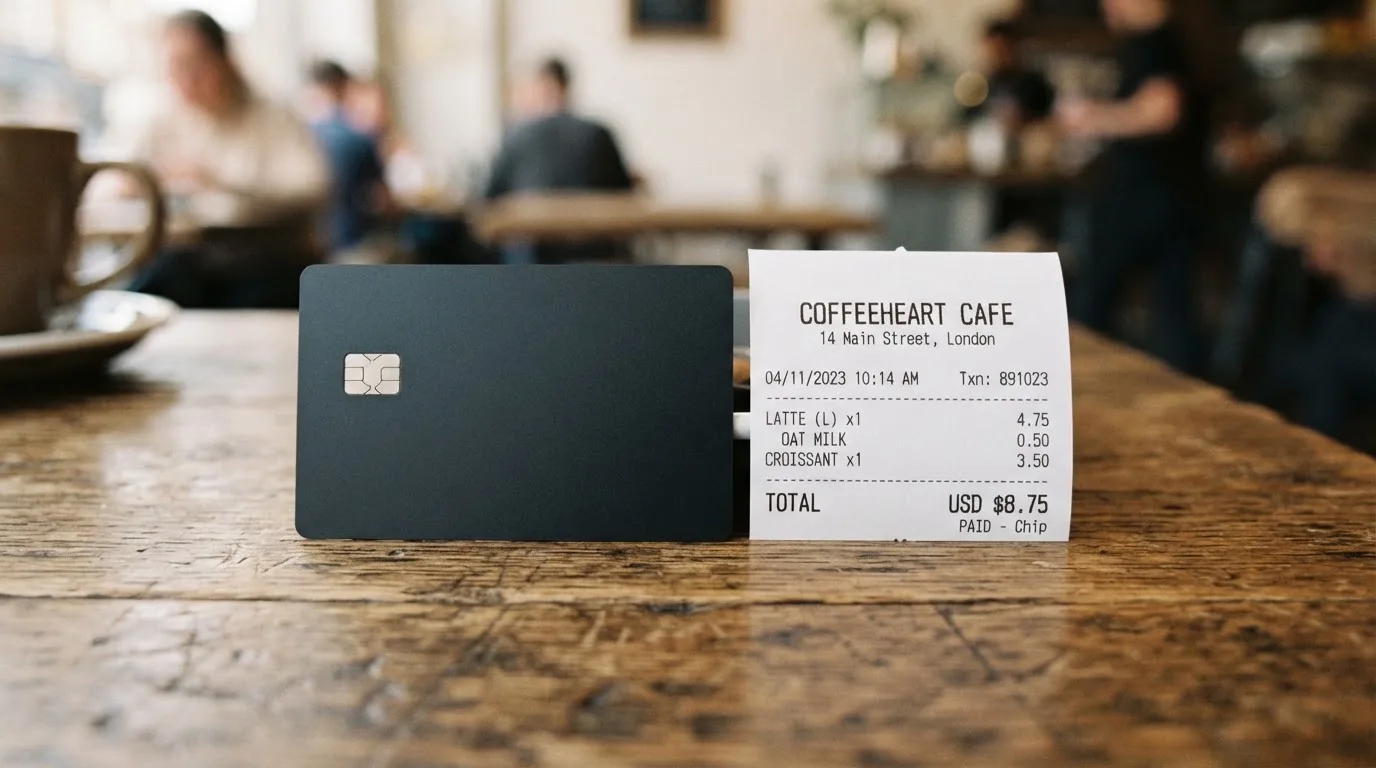
The same $40 lunch while travelling, paid in euros. The transaction is converted to US dollars by the card network. You pay the 1% FX fee plus the $0.30 international fee — roughly $0.40 on $40 — plus the 0.5% service fee. The card terms say the FX fee can be up to 3% and is currently 1%, and the documentation separately lists 1% on non-USD plus a $0.30 international fee.
A $30 subscription bought online in a currency that isn’t your card’s. Same structure, but the merchant may also decline the card outright. The terms do not tell you what currency the card holds, so you cannot predict this one in advance.
Two things to keep in mind. First, the $KARMA token changes the arithmetic. Holding it puts you in a tier that rebates swap fees and, at higher amounts, cuts the card service fee: $10+ earns a 10% rebate with the full fee, $100+ 20%, $500+ 35%, $2,500+ 50% rebate and the fee halved, $5,000+ 70% and half off, $10,000+ 90% and the service fee free. That is a real discount ladder, but it is also an incentive to hold a token whose price you are exposed to. Second, the App Store says Karma covers all on-chain transaction costs for USDC transfers on Solana, and staking $KARMA gives fee discounts. Nice, but scoped to one asset on one network.
One contradiction to flag: a third-party site lists an ATM fee as free with “unlimited” cash withdrawals for a virtual Visa card, and daily and monthly spend as “unlimited”. The official terms say the opposite on both counts — cash advances and balance transfers are not available, and limits are set by Karma and possibly the issuer. That page has no date. Where the two disagree, believe the card.
How to top it up
Topping up is the part I understand least well after using it, and understanding it badly is how money gets lost. Karma is a non-custodial wallet: USD, EUR or GBP that arrives in your account is converted into crypto by Bridge and deposited to your wallet, and the card is loaded with USDC, with Solana named as a network. Which coins beyond USDC you can top up with is not stated.
The costs of getting money in, from the published list:
- Fiat on-ramp fee of 1%, with the note that additional fees may apply.
- SEPA transfer $1.45.
- ACH transfer $0.95.
- EUR, GBP and MXN converted at mid-market plus 0.50%.
- A “high-risk payments” surcharge, capped at 5% of the deposit. Worth reading twice: what triggers it is not described.
- Karma sponsors network gas on default routes.
- No monthly or sign-up fees. Minimum top-up not stated.
The two structural warnings are not about fees. One: stablecoin transfers go on a specific network, and a transfer sent on a network the provider does not support, or to an address belonging to a different network, can be lost or need manual support recovery with no guarantee of success. Send a small test amount first, and confirm the network matches what the app shows you. Two: if the token you hold is USDT on Tron, note that Circle stopped supporting USDC on Tron in February 2024, so “USDC over TRC20” is not a native option anywhere in this ecosystem.
Getting money back out: withdrawals convert to fiat and settle to your bank account at an off-ramp fee of 0.5%, and the App Store says you can withdraw to a bank or an external wallet “at any time”. But “at any time” sits next to a clause saying the issuer may suspend or cancel access at any time. Both are in the same product.
Paying with it every day
Everyday use is where this card scores lowest, and it is worth being concrete about why.
Mobile wallets. Apple Pay and Google Pay are not stated in the official material. One third-party site says they are not supported, with no date. Either way, plan for the card to be used by typing numbers until someone confirms otherwise.
Cash. Cash advances and balance transfers are not available. No ATM withdrawals.
What you cannot buy. The prohibited list includes digital currency purchases except through Karma, cannabis and CBD, the dark web, unlicensed pharmacies, firearms, escort services, payday lending, multi-level marketing and Ponzi schemes, counterfeit goods, and “illegal gambling operations or unregulated betting platforms”. Regulated gambling and fantasy sports are allowed but may draw enhanced review, as may crypto platforms and exchanges and money-service businesses. That last one is the sharp edge: if you pay a crypto exchange with this card, expect extra scrutiny, not a smooth transaction.
Rewards. App Store release notes for version 1.1 describe reward tiers with cashback on fees and “Karma Points” earned on card spend, with pending cashback tracking. The rates are not stated. The v1.1 release was on 12 March; the year is not shown. Do not build a spending plan around a cashback rate nobody has published.
The app. iOS only in practice: iOS 15.1 or later, version 2.0.2 the latest as I read it on 20 October 2026, rated 5.0 out of 5 from 6 ratings. Six ratings is a very thin base. A Google Play listing exists at the package id xyz.karmapay.app but its rating was not readable to me. Android users should treat the app as unproven.
When something goes wrong with a payment. Try the merchant first. You can file a chargeback in your Karma account, but no more than 60 days after the charge posts. If you win, the money is credited to a current or future statement. If you do not resolve it, you can be hit with fees, lower limits or suspension.
What can go wrong
Start with the one that keeps me up at night, because it is not a fee.
The terms read like a credit line. The card terms mention 0% APR, a late payment charge up to $40, a returned payment charge up to $29, and a repayment obligation that survives closure — while cash advances are unavailable. That is the vocabulary of a revolving credit card, not of a wallet you preload with USDC. The two descriptions do not fit together, and I cannot tell you which one governs your use. If borrowing is what you want, this may not be it; if you never intend to borrow, the clause is noise you can ignore — but you should notice that it is there.
A credit line does not mean a bank. Karma says plainly that it is not a bank, not an exchange and not a custodian. The seller in the App Store is Karma Fintech LTD, and its registration country is not stated. The card programme runs on Rain, and the issuer is Third National under a Visa licence. So your money sits with your own wallet, and your payment relationship sits with a third-party issuer you have never heard of. Those are different kinds of counterparty.
No deposit insurance, and told to expect it. The security page says there is no insurance and “do not provide FDIC insurance”. That is honest of it to say, but it means this is not a bank deposit.
Custody is yours, and so is the risk. Non-custodial means you control your wallet and your keys, and Karma says it cannot freeze, seize or move your funds. That is the strongest single argument for this card, and it cuts both ways: a seed phrase is typically 12 to 24 words in plain form, anyone who gets it can restore the wallet and spend everything, blockchain transfers are irreversible, and a stolen key has no built-in recovery. Past custodial failures are a reminder that this problem is not theoretical — Mt. Gox reported about $350 million stolen across 2011–2014, Coincheck about $400 million in 2018, Ronin Network $625 million in 2022. You are choosing which risk you take: the custodian’s competence, or your own key hygiene.
Programmes close. Visa terminated its global agreements with FTX on 13 November 2022 and the FTX US debit card was wound down. WaveCrest, a Visa issuer that supplied several crypto card brands, was suspended by Visa in Europe in 2018, closing all its Visa programmes. Closures tend to follow a pattern: notice, then spending and loading stop, then you are asked to withdraw what is left. If a provider gives you a shutdown date, take it seriously the first time.
Nobody is watching. I found no Karma-specific Reddit threads, no Trustpilot page and no news complaints. That is genuinely reassuring as far as it goes — but the absence of complaints from a product with six App Store ratings tells you very little about a product with six ratings.
What the issuer can do. The terms say access can be suspended or cancelled at any time. Visa and Mastercard themselves do not issue crypto cards to consumers; they license issuers and can suspend a programme. And because merchants can look up the issuer country from the card’s first digits and apply extra scrutiny when it differs from your billing address, a card issued in one country can look foreign to a shop in another — which is a plausible explanation for a decline you will not be warned about in advance.
One credit-line clause to reread. Declined authorisations may leave a hold on your funds for several days, typically up to seven. Note also that prepaid-card reversal rights vary by jurisdiction and should not be assumed to follow the same rules as a debit or credit card.
Recent news, for what it is worth. The site says the $KARMA token is live on Robinhood Chain and that v1 holders can migrate to v2, and that a Swiss non-profit, Karma ICM Association, oversees the protocol and treasury. Version 2.0.0 arrived on 17 September (year not shown) with stock tokens. I found no licence news and no news of an issuer change.
What to take instead
Let me put the three comparators next to each other honestly, because two of them score below Karma and are still worth considering.
MetaMask (7.1 / 10). Open in 45 listed countries and territories, with proof of residency required; other regions join a waitlist, and US and UK sign-ups are temporarily closed per the FAQ. Crucially, ineligible regions limit sign-ups, not spending. A Mastercard from Monovate with Crypto Life as card provider: a virtual card issued instantly, with metal pre-orderable in the app afterwards, one card per user. Virtual is free with no annual or maintenance fee; metal is $199/year. Fees are described only as a minimal fee per transaction, with no additional MetaMask fees and no foreign transaction fee. Spends directly from your connected wallet across Linea, Base, Monad and Solana. Cashback in mUSD: 1% on virtual, a headline 3% on metal which its own footnote limits to the first $10,000 spent and then 1%. Stronger on daily life, weaker on price at the top tier.
KAST (6.1 / 10). The most explicit eligibility logic of the four — the country list shows at KYC, and if your country isn’t listed it means KAST is not available there — and the sharpest warning: living in a supported country while holding an ID from a restricted region may still make you ineligible. Dual citizens with an ID from a supported country may pass. No bank account needed. Virtual and physical, up to 10 cards per user, from Visa Platinum through Visa Infinite metal and gold plated. Pricing is where it hurts: Standard 0 USD a year, Premium 1,000 USD, Private 10,000 USD, billed annually upfront, plus an inactivity fee of 1 USD a month after 12 months. In exchange it publishes real numbers others do not — stablecoin top-up 0%, USD spend 0%, transaction fee 0%, Apple and Google Pay 0%, FX 0.5% to 1.75% depending on where you live, a 0.10 USD fee on non-USD transactions under 25 USD, and 0.50 USD for a declined transaction on insufficient balance. Cashback from 1.5% to 3% USD depending on tier, with points on top.
Zeal (6.1 / 10). Spend in 150+ countries, with issuance dependent on eligibility and regional availability; the card programme is live in the EU, UK, Brazil, Colombia, Mexico, Japan, Singapore, Philippines, Indonesia and Thailand. A Visa, virtual, addable to Apple Pay — that alone puts it ahead of Karma on daily use. Accounts in EUR, USD and GBP. Zeal charges no additional FX fee and converts at the Visa wholesale rate, though Gnosis Pay fees may still apply. Up to 4% cashback paid in GNO, which must be held in the card Safe to qualify. No fee schedule is published at all, and physical card availability is not stated.
Where that leaves Karma: it is the most transparent on fees of the four, and the least clear on eligibility, card type and everyday mechanics. If your blocker is documentation rather than principle, MetaMask’s residency model is plainer. If your blocker is cost transparency, KAST publishes figures Karma does not. If your blocker is a phone wallet, Zeal states Apple Pay support outright.
Who I would recommend it to
I would recommend Karma to a self-custody user who wants to keep their keys, already holds stablecoins, is comfortable picking the right network on a transfer, and mainly spends in a single currency from a phone or laptop rather than tapping at a terminal. That person gets a genuinely clean fee structure, no subscription, and funds that Karma itself says it cannot touch — and gets told plainly that there is no FDIC insurance, which is more honesty than most products in this category manage.
I would not recommend it as a first financial account, as a way to receive salary, as a card for a household that lives on contactless payments, or for anyone in the 17 countries where issuance is blocked. Nor would I recommend it to someone who needs to know today what the KYC looks like, whether the card is physical, and when it will arrive — because the card’s public pages do not say, and I am not going to guess on your behalf.
My own test, if I were applying that standard to this card: read the fee table (it holds up), then try to answer three questions from the official site alone — what documents will you ask me for, is this card physical, and what is my daily limit. Two of those three have no published answer. That is where the points missing from the score live, and it is documentation, not design, that would close the gap.
Frequently asked questions
What is Karma?
Karma is a crypto payment card built around a non-custodial wallet. You keep your own keys, the card is loaded with USDC, and it is issued as a Visa by Third National under a Visa licence. Karma says it is not a bank, an exchange or a custodian, and that it cannot freeze, seize or move your funds.
How does the Karma card work?
You top up, either with fiat that Bridge converts into crypto, or with crypto directly, and the card spends that balance. The App Store says a Visa card is accepted at 80M+ merchants, with USDC on Solana named as the loading asset. What is not stated publicly is whether the card is virtual, physical or both.
Who owns Karma?
The App Store seller is Karma Fintech LTD, developed as “Karma Pay”. It says it is not a bank, exchange or custodian. The card programme runs on Rain, and the cards themselves are issued by Third National under a Visa licence. Karma’s own registration country is not stated on the pages I read.
Does the Karma card require KYC?
Officially, not stated. The card terms describe no KYC process and instead have you confirm that you are not a US citizen and not sanctioned. A third-party site describes an “ID Verification (Lv 3)” level needing email, phone and an identity document, with no proof of address or selfie — unofficial, undated, and not confirmed by the card.
Is the Karma card free?
There is no sign-up fee, no monthly fee and no subscription — the App Store states “No subscriptions”. You pay 0.5% per transaction, 1% FX on non-USD plus a $0.30 international fee, 1% on the fiat on-ramp and 0.5% on the off-ramp. Card metal tiers are not offered; discounts come from holding $KARMA.
Can I add the Karma card to Apple Wallet?
Not stated officially. Apple Pay and Google Pay support are not described in the card’s own material, and one third-party site says they are not supported, without a date. Zeal, by contrast, states Apple Pay support outright — which is the single clearest everyday-use difference between these products.
How do I top up the Karma card?
Fiat in USD, EUR or GBP is converted to crypto by Bridge and deposited to your wallet; USDC on Solana is the named loading asset. The on-ramp fee is 1%, SEPA transfers cost $1.45, ACH $0.95, and a “high-risk payments” surcharge can apply, capped at 5% of the deposit. Send a test transfer first and check the network.
Is the Karma card available in my country?
Issuance is blocked for residents or registrants of 17 countries: Belarus, mainland China, Cuba, India, Iran, Iraq, Israel, Myanmar, Nepal, Nicaragua, North Korea, Russia, Syria, Turkey, Ukraine, Venezuela and Vietnam. FATF grey-list countries are decided case by case. Spending is separately blocked in Cuba, Iran, North Korea, Russia, Syria, Ukraine and Venezuela.
Is the Karma card safe?
Your keys stay with you, which removes custodian risk but makes you fully responsible for key loss and phishing, since blockchain transfers are irreversible. Karma states there is no insurance and that it does not provide FDIC insurance. Charges are protected by passkeys, biometrics, extra confirmation for higher-risk actions, in-app freeze and velocity limits, and audits only under NDA.
Is Karma worth it?
At 6.4 out of 10, worth it for a self-custody user spending mainly in one currency, and not worth it if you need Apple Pay, cash withdrawals, a clear KYC process or a firm delivery date. Compare MetaMask at 7.1 for a clearer eligibility model and a wallet you can add to a phone, or KAST for published fees you can check before signing up.
Wallet cards – cryptocardchooser.com
Content created by the «cryptocardchooser.com» team