
A free virtual Visa attached to a hardware wallet, with fees that only start to bite when you spend outside the US
 Available in US
Tangem Pay is the payment card attached to Tangem, the hardware-wallet brand. The pitch is unusually simple for this category: a virtual Visa you can hold with no plan fee, funded with USDC or USDT, spendable wherever Visa is accepted, and freezable from your phone in a second. That simplicity is the reason it is worth a close look, and also the reason it is easy to misread. This review goes through who can actually get one, what it costs in the situations people really care about, how you put money in it, how it behaves day to day, and the parts the marketing does not dwell on.
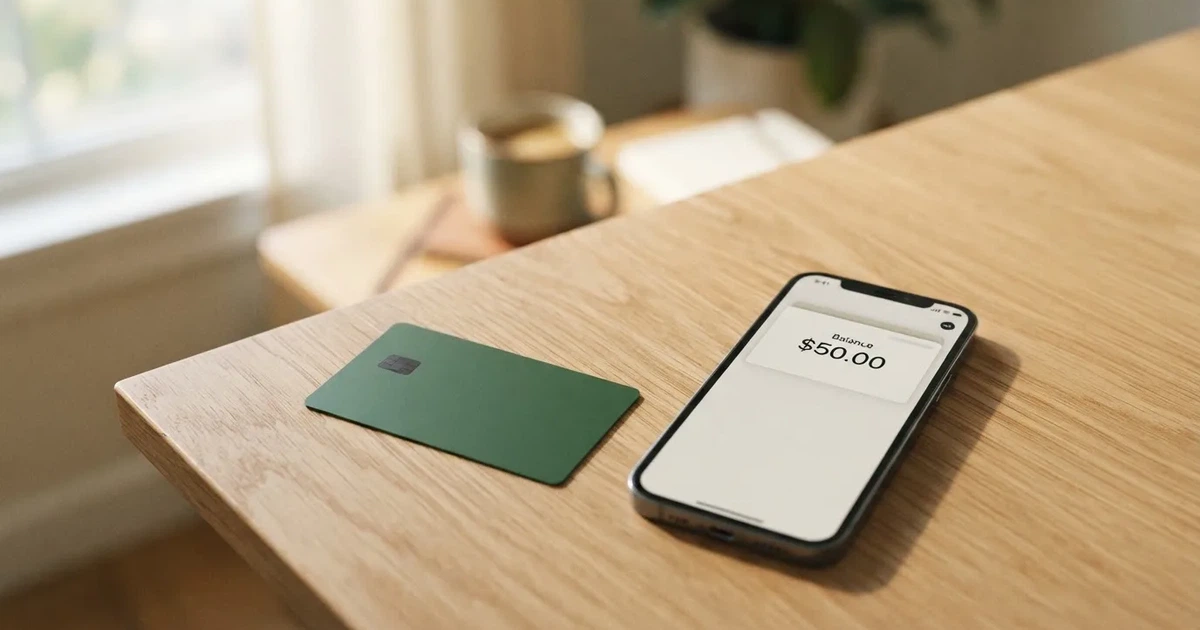
The score I landed on is 7.5 out of 10. That is a good card with real gaps — strong on top-ups and everyday spending, weaker on availability, transparency and the parts of the service that are still being built. The conditions described here are current as of October 28, 2026.
Verdict: 7.5 out of 10, best for people who already hold crypto
Tangem suits a fairly specific person: someone who already holds stablecoins, already uses Tangem’s hardware wallet, and wants a free virtual Visa to spend that balance without opening another exchange account. If that is you, the $0 plan and the 1% cashback make this an unusually cheap way to hold a payment card.

It suits you less well if you need a card that ships to your door, or if you want to know exactly what everything costs before you commit, or if you are the kind of person who needs a bank with a deposit guarantee behind it. The card’s own documentation says Tangem is not regulated as a financial services provider and that the programme is run through partner companies, which changes what kind of protection you are buying.
| Criterion | Mark | Why |
|---|---|---|
| Who can get it | 7 / 10 | Tangem Pay is available in the US and selected countries across LATAM, APAC, MEA and Africa; not all countries or US states |
| Cost | 7 / 10 | Basic plan is $0, first virtual card $0, FX is Visa Exchange Rate + 1.5%, transaction fee $0, ATM 4%; Plus is $29.99/month |
| Top-up options | 9 / 10 | USDC and USDT on Polygon, Base, Arbitrum and BNB Smart Chain, plus ACH or Fedwire bank transfer, other tokens via swap |
| Reliability and complaints | 7 / 10 | Issuer is Rain (Visa Principal Member), programme run by Paera LLC, Tangem is not regulated as a financial services provider; unofficially, issuer Third National; complaints about network outages and support |
| Everyday use | 8 / 10 | Basic issues a virtual card, Plus issues plastic, Apple Pay and Google Pay are supported, ATM 4% on Basic and 2% on Plus, though another page says withdrawals are not yet available |
| Total | 7.5 / 10 | Strong funding and spending, uneven on availability and clarity |
Two things pull the score down before anything else. The first is that the country list is not published: the Tangem Pay page and the tariffs PDF do not name the countries, only saying eligibility of some features is determined by your country and region of residence, and showing the result in the app. So the only reliable test is to enter your residence country during onboarding and see. The second is that several figures exist in two official versions — the delivery fee appears as $15.63–$63.45 on one page and $14.53–$82.10 in the tariff PDF dated 25 Aug 2026 — which is the kind of small inconsistency that makes a careful reader trust the rest less.
Neither of those is disqualifying. They just mean you should not treat Tangem as settled, and should read the app’s own screens as the current truth rather than any page you read last month.
Will they give you the card?
Yes, if your region is supported — and the card does not publish the list. Tangem Pay is available in the US and in selected countries across Latin America, APAC, the Middle East and Africa, but not in every country and not in every US state. The tariff PDF says eligibility of some features “is determined based on your country and region of residence”, and the app shows what applies to you. If your region is unsupported, the application is rejected during KYC — that is where you find out, not at the door.
The base requirements are ordinary ones: you must be 18 or older, and you must have a residence address in a supported country. Citizenship is not part of what the card publishes. That matters more than it sounds, because screening in this industry is often applied to nationality and country of birth as well as address. The card states residence, not citizenship, and the country list is not stated on either the Tangem Pay page or the tariffs PDF.
So the practical answer to “will they give me the card” is: probably, if you are an adult with an address in a supported country, and you will know for sure inside the app. The one hard no is an unsupported region or state.
How to get it
Onboarding is run by Paera LLC, which the card states is “responsible for your onboarding including performing KYC & AML verification”. The page also says “ID verification and eligibility checks applies to the card account only” — meaning Tangem’s own wallet account and the card account are verified separately. Documents: a government-issued ID, a phone number and email verified by codes, and your residence address. Biometric data is collected by Sumsub, the identity provider. Whether you need a separate proof-of-address document is not stated.
You must be 18+. US residents also give their SSN. The verification level you reach determines your limits, so a partial verification is not a smaller version of the same thing — it is a different card.
The card is usually issued within 5 minutes, up to 48 hours; if it does not arrive, [email protected] is the address given. Two rejection causes are named: an unsupported region or state, and a repeat application with the same identity, which is auto-rejected. Tangem says it cannot see the reason for a rejection, which is worth knowing in advance if you are tempted to try again quickly.
Cards come in three tiers:
| Tier | Card network tier | Forms | Max cards | Plan fee |
|---|---|---|---|---|
| Basic | Visa Platinum | Virtual | 3 | $0 |
| Plus | Visa Signature | Plastic | 5 | $29.99/month |
| Prestige | Visa Infinite | Virtual / plastic / metal (coming soon) | 10 | $999/year (coming soon) |
The card currency is USD. Non-USD transactions are FX-converted, which is where the 1.5% comes in.
On delivery: a plastic card ships only inside the country you verified at KYC. The country list and estimated time appear in the app when you order, and the name on the order is accepted in Latin letters only. An order cannot be cancelled. The fee is deducted from your Tangem Pay balance — for the first Basic card the card’s pages say $15.63–$63.45, while the tariff PDF dated 25 Aug 2026 says $14.53–$82.10; two official figures differ, so treat the app’s figure as the one you will pay. On Plus the first card is free and later cards cost the same. Cards arrive inactive. Reissue is $5, though the tariff PDF says $1 for a replacement. An additional virtual card is $5 and is issued in about a minute, rarely up to 48 hours.
That last point is the one to dwell on if you are hesitating: you can get a virtual card in about a minute, but a physical one is a paid, non-cancellable order to an address in the country you verified.
Fees: what it really costs
The headline is good and the details are where people get surprised. The $0 plan and $0 transaction fee are real. The 1.5% on currency conversion is real. Cash withdrawals cost 4% on Basic. And a $29.99/month Plus plan is a very different product from a free one.

| Fee or limit | Value |
|---|---|
| Basic plan fee | $0 |
| Plus plan fee | $29.99/month |
| Prestige plan fee | $999/year (coming soon) |
| First virtual card | $0 |
| Additional virtual card | $5 |
| Replacement | $1 (tariff PDF); reissue $5 |
| Physical card delivery | $15.63–$63.45, or $14.53–$82.10 in the tariff PDF dated 25 Aug 2026; Plus first card free |
| Transaction fee | $0 |
| FX fee, non-USD | Visa Exchange Rate + 1.5% |
| On-chain withdrawal | $0 |
| Dispute fee | $30 |
| Onramp via bank details | ACH $1 / FedWire $11 on Basic, $0 on Plus |
| ATM fee | 4% (Basic) / 2% (Plus) / 1% (Prestige, per product page) |
| Max card balance | $10,000 (Basic) / $50,000 (Plus) |
| Daily spend per card | $10,000 (Basic) / $50,000 (Plus) / $100,000 (Prestige) |
| Annual spend per card | $10,000,000 |
| Daily load | $100,000 |
| Transactions | 100 per day, 1,000 per month |
| ATM withdrawals | max 3 per 24 hours, $250 per withdrawal |
There is no monthly account fee and no standard transaction fee, and no free ATM allowance is stated — the percentage is the whole cost. Network gas for top-ups is paid by the sender, and the swap fee when you convert one token to another depends on the swap provider and is not quantified anywhere I could find. The crypto conversion fee and spread are not stated, which is a real gap: if you spend a stablecoin and the card does any conversion on the way, that is where an unquantified number would live.
Three everyday payments, with the fees that actually apply:
- A $40 lunch in New York. $0 transaction fee, no FX because you are in the card’s own currency. This is the case the product is built for and it costs nothing.
- A €30 dinner in Berlin. Visa sets the rate, then 1.5% is added on top. On €30 that is roughly 45 cents — small, but it applies to every non-USD purchase, and on a $2,000 holiday it is $30.
- $200 in cash from an ATM. 4% on Basic is $8, and $200 is exactly the per-transaction ceiling twice over; on Plus the same withdrawal is $4.
Choosing a service tier is the real cost. Basic at $0 with 1% cashback capped at $100/month, versus Plus at $29.99/month with 2% capped at $300/month and free bank transfers. If you are spending regularly enough to care about the 1% cap, do the arithmetic on your own monthly spend before paying for Plus — and note the fee is charged every 30 days, and if the balance cannot cover it you have 30 days to top up before Plus Signature cards close and the service drops to Basic.
How to top it up
Top-ups are the strongest part of this card, and it is not close. USDC and USDT on Polygon, Base, Arbitrum and BNB Smart Chain, plus a bank transfer by ACH or Fedwire where available, plus any other token through a swap. Nine out of ten.
You can load from your Tangem Wallet, with a swap if you hold a different token; from another wallet or exchange, using the deposit address for the network in question; or by bank transfer, which in some regions is converted to USDC. Bank deposit fees are deducted from the amount you receive — send $1,001 via ACH to get $1,000, or $1,011 via Fedwire; on Plus both are free. Network gas is paid by the sender. Limits: $100,000 daily load, 24 loads a day, 150 a month; the minimum is not stated.
One warning to read twice, because it is the one error that cannot be undone: sending the wrong token or on the wrong network is permanently lost. Blockchain transfers are irreversible. Check the network name, not just the token name.
Getting money back out is straightforward: withdraw USDC or USDT to your Tangem Wallet at any time, with on-chain withdrawal at $0 (swap provider fees if you hold a different token), or a bank withdrawal by ACH at $1 or Fedwire at $11 — free on Plus — to US banks only, capped at $10,000 per transaction with no daily or monthly limit. Merchant refunds land in the card balance and cannot be withdrawn. Account closure is by email to [email protected] after you withdraw the balance. A factory reset or deleting your Tangem account loses access to Tangem Pay and the funds in it, and there is no relinking yet.
Paying with it every day
Tangem Pay lives inside the Tangem app on iOS and Android. I could not find an App Store or Google Play rating or a count of reviews, which is worth noting: there is no visible public score to lean on. Apple Pay and Google Pay are both supported, though Apple Pay depends on your country.
Spending feels like a prepaid card, which is exactly what it is. Your USDC and USDDT are combined into one balance and spent highest balance first, and the on-chain balance updates within 2 business days after a purchase. Non-USD purchases are converted by Visa at Visa’s rate with cross-border fees, the tariff PDF says Visa Exchange Rate + 1.5%, and the help centre advises choosing the local currency at the terminal rather than letting the terminal convert.
Cashback is 1% on Basic, 2% on Plus, 4% on Prestige, with monthly caps of $100, $300 and $1,000. Extra 5%, 10% and 15% on the first $500, and a welcome bonus of up to $75, are both “coming soon”. The payout currency is not stated.
Some categories are blocked, and the list is set by Rain rather than by Tangem: gambling and online casinos, liquor stores, and certain subscription services. Whether any other merchant categories are restricted is not stated.
Two things about the physical experience. A declined authorisation can leave a hold on funds for several days, which is ordinary card behaviour and worth remembering before you retry a purchase. And if a transaction goes wrong, disputes go to [email protected] under the standard Visa chargeback procedure, must be reported within 60 days of the transaction appearing on your statement, and carry a $30 fee when a formal dispute opens; extra documents may be requested.
The ATM picture is genuinely unclear, and I would not plan around cash. The product pages say ATM withdrawals are available at contactless-enabled ATMs: 4% on Basic, 2% on Plus, up to $250 per transaction and 3 per 24 hours, and only for cards issued after 10 March 2026 showing Platinum or Signature in Apple or Google Pay — meaning older cards must be reissued. Another help article says “ATM cash withdrawals are not yet available”. Both statements are on Tangem’s own pages. Ask support which one applies to you before you rely on it.
What can go wrong
The honest list is longer than the marketing.
Wrong network, lost money. Irreversible, no built-in recovery. This is the single most likely way to lose funds with a card like this.
Deleting the account. A factory reset or deleting your Tangem account loses access to Tangem Pay and its funds, and there is no relinking yet. There is no undo for this.
Shipping restrictions. At the launch of physical cards, Tangem said shipping is restricted in about 20 countries, citing KYC, sanctions and banking rules, including China, Russia, North Korea and Palestine. Your virtual card is unaffected, but a plastic card to some addresses simply will not happen.
Conflicting official information. The delivery fee has two official figures. ATM availability has two official statements. Who the issuer is has two answers: officially Rain, a Visa Principal Member, and unofficially per a January 2026 Coin Bureau review, Third National as the Visa-licensed partner with Rain providing co-signing and compliance. That last one is a third-party account, not confirmed by the card, and I treat it as unverified.
The company behind it. The card is issued by Rain, described as a Visa Principal Member; the programme is operated by Paera LLC, which handles onboarding and KYC/AML; Tangem itself is the hardware-wallet brand and its footer says it is not regulated as a financial services provider, with the programme run via Paera and Rain. Registration country for Paera and Rain is not stated, and licences are not stated. Customer funds sitting in an e-money or payment-institution account are not the same as a bank deposit, and deposit guarantee schemes should not be assumed to apply.
Support split in two. [email protected] handles card setup and features; [email protected] handles account, KYC, disputes, declined payments, refunds and personal data. Tangem Support cannot see your KYC status. There is also an in-app Get Help button and an online request form. Expect to deal with two companies for one card.
Complaints. No Reddit or Trustpilot complaint themes surfaced in my search for the card specifically. What is there: a 1-star review of a card order shipped from Hong Kong with poor support, and users disputing the self-custody claim because a USDC withdrawal passes through a swap with fees. Trustpilot shows Tangem at roughly 4.1 out of 5 across about 876 reviews — but that is the brand and the wallet, not the card, so read it as context. Unofficial reports mention network outages and support problems. Official incidents are not stated.
No deposit protection. Insurance or deposit protection is not stated. The security model is otherwise good: card funds sit in separate Tangem Pay smart-contract accounts, main assets stay in the non-custodial Tangem Wallet, the card freezes and unfreezes instantly in the app (showing as Suspended in Apple and Google Wallet), there is a 4-digit PIN, you can set a custom daily spending limit including $0, and only one wallet is linkable per account.
What to take instead
I scored the alternatives in this same way, and the comparison is closer than the marketing of any one of them would suggest. Scores are mine, on the same 10-point scale as Tangem’s 7.5.
| Card | Score | Main cost | Card | Who it is for |
|---|---|---|---|---|
| Tangem | 7.5 | $0 plan, 1.5% FX | Visa Platinum virtual free; Plus plastic | You already hold stablecoins and want a free virtual card |
| MetaMask | 7.1 | Virtual free, Metal $199/year | Mastercard virtual, metal optional | Sign-ups open in 45 listed countries, waitlist elsewhere |
| KAST | 6.1 | $0 to $10,000/year by tier | Visa Platinum / Infinite, virtual and physical | You want published limits and multiple card designs |
| Zeal | 6.1 | Not stated | Visa virtual | Spending in 150+ countries, Gnosis Pay rails |
MetaMask is the closest rival and, at 7.1, slightly behind on this review’s weighting — mostly because its token and network list is narrower and its fees are described rather than stated: “minimal fee for each transaction” with the amount not on the pages I read, no foreign transaction fee, and the Mastercard rate. Its strengths are a free virtual card issued instantly, one card per user, spending directly from the connected wallet on Linea, Base, Monad and Solana, and cashback in mUSD of 1% on Virtual — though the Metal headline of 3% is footnoted down to 1% after the first $10,000 spent. Sign-ups are open in 45 listed countries and territories, US and UK sign-ups are temporarily closed per the FAQ, and ineligible regions limit sign-ups rather than spending.
KAST is the most transparent of the three, which is a genuine advantage even at 6.1. Fees are actual numbers: stablecoin top-up 0%, USD spend 0%, transaction fee 0%, Apple and Google Pay 0%, non-USD FX between 0.5% and 1.75% depending on your residence country, transaction country and card programme, a $0.10 charge on non-USD transactions under $25, and $0.50 for a declined transaction on insufficient balance. What it costs is the membership: Standard $0, Premium $1,000/year, Private $10,000/year, billed annually upfront, plus $40 delivery on a Standard physical card and a $1/month inactivity fee after 12 months. It supports USDT, USDC, PYUSD and RLUSD, with the terms naming only USDT and USDC — a conflict worth knowing about. Cashback is 1.5% on the first $2,000 a month rising to 3% on the first $40,000 on Private, paid in USD. Its KYC rules are the strictest of the four: living in a supported country but holding an ID from a restricted region may still fail, dual citizens with a supported-country ID may pass, and a VPN does not bypass it.
Zeal is the one to look at if countries are your problem: spend in 150+ countries, Visa, virtual card addable to Apple Pay, no additional FX fee from Zeal, conversion at the Visa wholesale rate, accounts in EUR, USD and GBP, and up to 4% cashback paid in GNO — with the caveat that GNO must be held in the card Safe to qualify and rates can change. It has no published fee schedule at all, and its card programme is live in the EU, UK, Brazil, Colombia, Mexico, Japan, Singapore, the Philippines, Indonesia and Thailand.
My own ranking for a reader with a specific problem: if money is the issue, Tangem Basic costs nothing and KAST Standard also costs nothing but publishes its fees; if transparency is the issue, KAST wins on numbers and Tangem loses on two conflicting official figures; if reach is the issue, Zeal covers the most countries; if you want the widest set of chains to fund from, Tangem’s four networks and two stablecoins beat MetaMask’s narrower list.
Who I would recommend it to
I would recommend Tangem Pay to someone who already holds USDC or USDT, already uses Tangem Wallet, and wants a free virtual Visa for spending that balance. That person gets $0 to open, $0 per transaction, 1% cashback, four networks to fund from, instant freeze from the app, and a spending limit they can drop to $0. That is a good deal and I cannot think of many cards that beat it on cost.
I would hold back for someone who needs a physical card urgently, who needs cash from ATMs, who is in a country not on the app’s list, who wants published and consistent numbers before paying, or who needs bank-deposit protection. The card’s own pages will not give you a country list, two official figures disagree on delivery cost, and the ATM story contradicts itself.
And I would be careful in a specific way about money that matters. This is a card with a 10,000 balance cap on Basic, a $30 dispute fee, two support organisations, a partner issuer and an unstated licensing position. Use it as a spending tool with money you can afford to have friction around, not as the place your savings sit. Check your region in the app before anything else, and if you are in a supported country, start with the free virtual card — it costs nothing, arrives in about a minute, and tells you everything the other parts of the service would.
Frequently asked questions
What is a Tangem card?
It is a Visa payment card attached to Tangem, the hardware-wallet brand. Your USDC and USDT are combined into one USD balance and spent like a prepaid card, so the card can never overdraw and cannot be used beyond what you have loaded. There are three tiers: Basic at $0 with a virtual card, Plus at $29.99/month with plastic, and Prestige at $999/year, coming soon.
Is Tangem a bank?
No. The card is issued by Rain, described as a Visa Principal Member, and the programme is operated by Paera LLC, which handles onboarding and KYC/AML. Tangem’s own footer says Tangem is not regulated as a financial services provider. Registration country and licences for the partner companies are not stated on the pages I read.
Does the Tangem card require KYC?
Yes. Verification runs through Sumsub and needs codes to your phone and email, a government-issued ID and your residence address, plus biometric data; you must be 18+, and US residents also give an SSN. The card states that ID verification applies to the card account only, so the wallet account and the card account are checked separately.
Is the Tangem card free?
The Basic plan is $0 and the first virtual card is $0, with a $0 transaction fee. Other costs are real: FX is Visa’s rate plus 1.5%, ATM withdrawals are 4% on Basic, an additional virtual card is $5, and a dispute costs $30. The Plus tier is $29.99 per month, charged every 30 days.
Which countries can get a Tangem card?
Tangem Pay is available in the US and selected countries across Latin America, APAC, the Middle East and Africa, but not every country and not every US state. The published country list is not stated on either the Tangem Pay page or the tariffs PDF, which says eligibility depends on your country and region of residence. The only reliable test is to enter your residence country during onboarding.
How do I top up a Tangem card?
Three ways: from your Tangem Wallet, with a swap if you hold another token; from another wallet or exchange, using the deposit address for the right network; or by bank transfer, ACH or Fedwire where available, which in some regions converts to USDC. USDC and USDT are supported on Polygon, Base, Arbitrum and BNB Smart Chain. Limits are $100,000 a day, 24 loads a day, 150 a month.
Can I use the Tangem card in Apple Pay and Google Pay?
Both are supported, though Apple Pay depends on your country. If you freeze the card in the app it shows as Suspended in Apple and Google Wallet, and unfreezing reverses it. Only one wallet can be linked per account, and you can set a custom daily spending limit, including $0.
What are the Tangem card limits?
On Basic you can hold up to $10,000 and spend $10,000 per card per day; on Plus, $50,000 and $50,000 per day. Annual spend is $10,000,000 per card, with 100 point-of-sale transactions a day and 1,000 a month. ATM withdrawals are capped at three per 24 hours and $250 each. Limits also depend on your risk profile and verification level.
Is the Tangem card safe?
The security model is genuinely strong: card funds sit in separate Tangem Pay smart-contract accounts, main assets stay in your non-custodial Tangem Wallet, and you can freeze instantly with a PIN and your own spending limit. The weak points are practical — sending on the wrong network loses funds permanently, deleting your Tangem account loses access to Tangem Pay with no relinking yet, and insurance or deposit protection is not stated.
How do I withdraw money and close my Tangem account?
Withdraw USDC or USDT to your Tangem Wallet at any time, at $0 on-chain, though converting from another token goes through the swap provider’s fee. Bank withdrawals by ACH cost $1 or Fedwire $11, free on Plus, to US banks only, capped at $10,000 per transaction. To close the account, withdraw the balance and email [email protected].
Wallet cards – cryptocardchooser.com
Content created by the «cryptocardchooser.com» team