A free virtual Visa funded by USDC — priced for the Americas, built around Solana
 Available in US
Fuse is a virtual Visa debit card that you fill with USDC and spend like an ordinary card. There is no plastic in the post, no monthly fee, and no foreign transaction fee — and, in exchange, there is no ATM, no cashback, and only one coin and one country list to work within. That is the whole card in three sentences, and it is why I scored it 6.3 out of 10 rather than higher: the economics are unusually clean, the product surface is unusually thin.

I read the card’s own public pages and terms and went through them line by line. What follows is what I found, sorted into the questions you actually have when you are weighing a card like this: can I get one, what does it cost, how do I load it, can I live on it, and what happens when something goes wrong.
Conditions are current as of October 28, 2026.
The verdict: a cheap, narrow card for a specific person
My score for Fuse is 6.3 / 10. That number is not a shrug. Fuse does two things very well — it charges you nothing to hold, and it charges you nothing to spend abroad — and then stops. Everything a card normally offers beyond those two things is either absent or thinner than a competitor’s.
| Criterion | Mark | Why |
|---|---|---|
| Who can get it | 5 / 10 | Issued in 18 jurisdictions: the US (excluding New York and Alaska), Argentina, Bolivia, Brazil, Colombia, Costa Rica, Dominican Republic, Ecuador, El Salvador, Ghana, Guatemala, Honduras, Mexico, Panama, Nigeria, Paraguay, Peru, Uruguay |
| Cost | 9 / 10 | Issuance $0, monthly fee $0.00, inactivity $0; FX on international transactions 0%; crypto conversion fee not disclosed |
| Top-up options | 4 / 10 | USDC only, from the Main Account to the Card Account, networks not disclosed |
| Reliability and complaints | 8 / 10 | Issuer Lead Bank under a Visa U.S.A. licence, Bridge Ventures LLC runs the programme; one complaint about a closed account with $600 stuck, no Trustpilot page |
| Everyday use | 4 / 10 | Virtual Visa only; Apple Pay is supported, Google Pay is not mentioned; no ATM access |
| Total | 6.3 / 10 | Strong on price, thin on everything else |
The card suits residents of the Americas who already hold USDC and want a plain USD Visa to spend it from — paying at a US merchant, subscribing to something billed in dollars, or travelling without a foreign transaction fee. If that is you, the cost side is genuinely hard to argue with: zero issuance, zero monthly, zero FX.
It does not suit you if you need cash, if you want a physical card, if you want to be paid into it from a bank account, if you want rewards, or if you live outside the eighteen listed jurisdictions. It is also a poor fit if you hold anything other than USDC, because nothing else can be moved to the Card Account.
Will they give you the card?
Eligibility is decided by where you live, not by your nationality — and that distinction matters more here than in most cards. The card’s own pages state the citizenship rule as not stated, so I cannot tell you what happens to a citizen of one country living in another; you would have to ask them.
The residence list is: United States (excluding New York and Alaska), Argentina, Bolivia, Brazil, Colombia, Costa Rica, Dominican Republic, Ecuador, El Salvador, Ghana, Guatemala, Honduras, Mexico, Panama, Nigeria, Paraguay, Peru, Uruguay.
Two things to notice. New York and Alaska are carved out of the US list, so a New York or Alaskan address is not covered even though most of the country is. And the list is heavily weighted towards Latin America plus Ghana and Nigeria — Fuse is, in practice, an Americas-and-West-Africa product. If you are reading this in Europe, in most of Asia, or in Australia, the answer on the card’s public pages is no.
Why residence drives this is worth understanding, because it applies to every card in this category. Merchants can look up the issuer identification number at the front of your card number and see which institution and country issued it, and some will apply extra scrutiny when that issuer country differs from your billing address. A card issued in one country simply looks foreign to a shop in another. That effect, plus each issuer’s own risk policy, is a large part of why country lists exist at all.
There is no tier structure here — one card, one set of terms, no upgrades to pay for.
How to get it
The route is short, and the order of operations matters.
- Verify in the Fuse app. Identity checks are run through Bridge, and every applicant has to pass them. What you hand over is your name, address, date of birth and government ID number. The card also says that further documents, a driving licence being the example it gives, may be requested at any time — so treat “approved” as a checkpoint rather than a finish line.
- Create the virtual card. You get a digital Visa, denominated in USD. The card’s own disclaimer calls it a prepaid debit card.
- Move USDC from the Main Account to the Card Account. This is the moment the card becomes spendable.
Age requirement: 18 and over. What the card does not state, and what you may want to ask about, is the exact document list, the proof-of-address requirement, how long verification takes, and the grounds on which an application can be refused. Those gaps are common across cards in this category, but they are gaps, and they matter if you are in a hurry or if your documents do not match your address.
Nothing is delivered to you. There is no physical card and no delivery process — the virtual card exists in the app and in your mobile wallet, and that is the only form it takes.
One practical note about the app: the iPhone version is the one listed, called “Fuse – Solana Smart Wallet”, and it requires iOS 16.4 or later. At the time I looked, the App Store listing showed no rating at all, described as “not enough ratings”. Third-party card comparison sites put the aggregate rating at roughly 4.5 to 4.6 from about 35 ratings, but that is unofficial and not confirmed by the card, and it is a very small sample either way. If you are on Android, check before you start: I did not confirm an Android listing.
Fees: what it really costs
This is the strongest part of the card, and I want to be precise about how strong, because “zero fees” usually hides somewhere.

| Fee or limit | Value |
|---|---|
| Card issuance | $0 |
| Monthly fee | $0.00 |
| Annual fee | Not listed |
| Inactivity fee | $0 |
| FX / international transaction | 0% of the USD amount |
| Per-purchase fee | None |
| Top-up fees | None |
| Crypto conversion fee | Not stated |
| ATM | Not available — cards cannot be used at ATMs; agreement lists ATM withdrawal and balance inquiry as n/a |
| Default daily spending limit | $2,000, adjustable up to $2,000 in settings |
| Per-transaction limit | $2,000 |
| Monthly limit | Not stated |
| Card currency | USD |
Three everyday payments, with what actually applies to each.
A $40 grocery shop in Mexico City, paid in pesos. The international transaction fee is 0% of the USD amount, so the conversion itself is not marked up by the card. The card states that no top-up fees and no card transaction fees apply — but its own agreement adds that fees may apply, and the crypto conversion fee is not stated anywhere on the pages I read. So: the FX leg is clean, the crypto leg is undocumented. That is the honest summary.
A $12 subscription in the US, virtual card, Apple Pay. No per-purchase fee, no monthly fee, nothing above the $2,000 daily limit. This is the payment Fuse handles most cleanly, because it is the case it was built for: USD merchant, USD balance, nothing to convert.
A $60 withdrawal at an ATM in São Paulo. Not possible. The card says outright that Fuse cards cannot be used at ATMs currently, and the agreement lists ATM withdrawal and balance inquiry as not applicable. There is no fallback here — no fee tier, no limit, just no cash.
Two structural limits to plan around. The daily spending limit starts at $2,000 and can be adjusted up to $2,000 in settings — which, read plainly, means $2,000 is the ceiling the card offers you. The FAQ suggests it may increase after you build usage, so it may not be a permanent wall, but I found no mechanism and no higher figure published. And only USDC sitting in the Card Account can be spent; that is the rule that shapes everything below.
One more thing on cost. The support page says there are no top-up fees and no card transaction fees, while the agreement says fees may apply, and the crypto conversion fee is not stated. Where a card documents its own fee in two places that disagree, assume the less favourable one until you have seen a real statement.
Top up: how the money gets in
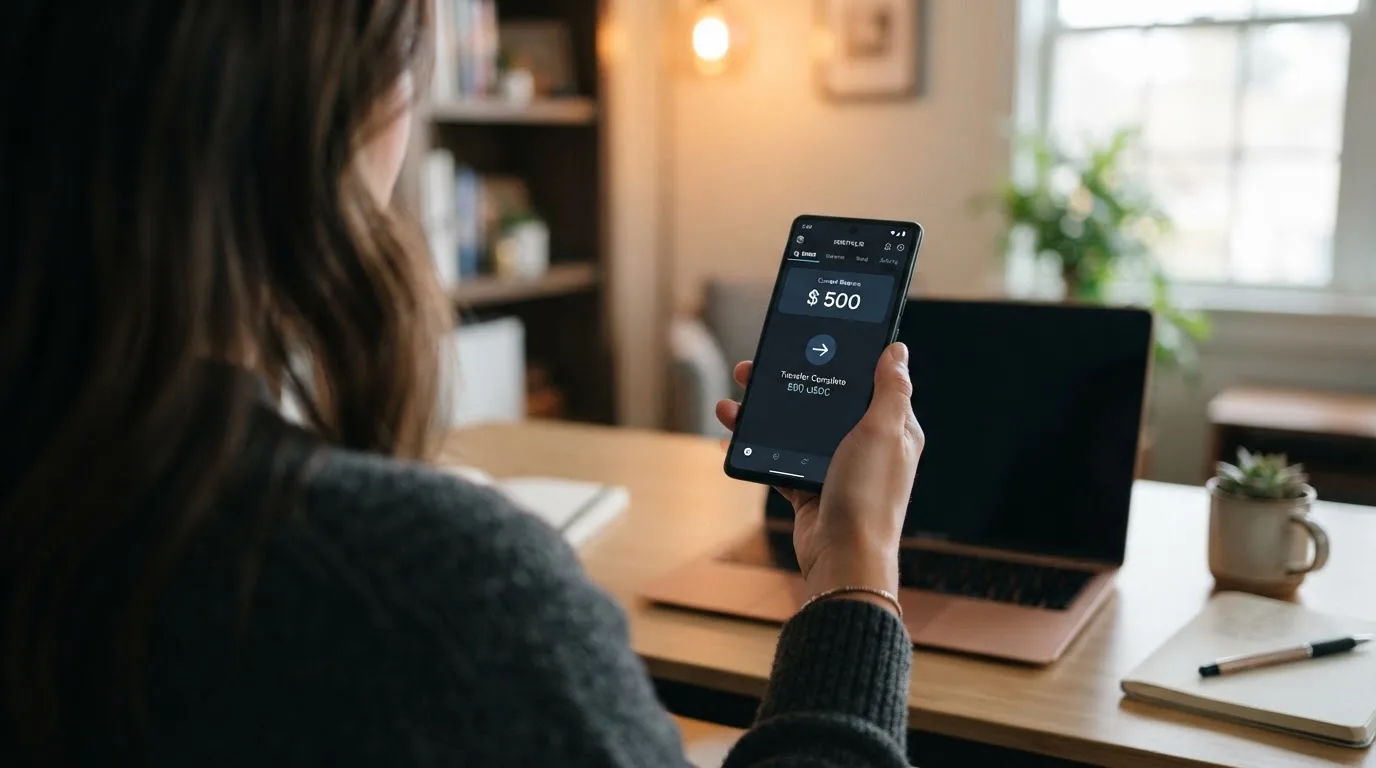
Topping up Fuse is one action: transfer USDC from your Main Account to your Card Account. Funds are ready immediately. That is the entire mechanism, and its simplicity is both the appeal and the limitation.
| Aspect | What the card says |
|---|---|
| Coin accepted | USDC only |
| Route | Main Account → Card Account |
| Availability | Immediate |
| Top-up fee | None; cash reload $0; no minimum listed |
| Fiat top-up options | Not stated |
| Networks | Not stated |
| Other stablecoins | Not supported — only USDC in the Card Account can be spent |
| Selling stablecoins | The Platform Provider or Program Manager may charge separate fees for stablecoin sales |
The networks gap is the one to press on. The card’s product positioning puts the wallet on Solana, but these pages do not confirm it, so I will not state it as fact. It matters because of how blockchain transfers work: a deposit sent on a network the provider does not support, or to an address belonging to a different network, can be lost or need manual recovery with no guarantee. Transfers are irreversible in general. Before your first load, get the network confirmed in writing from support — it is a one-line question and it removes the single most expensive mistake available on a card like this.
Two related mechanics. Moving USDC back from the Card Account to the Main Account is possible, with a five-minute security time lock. And the fee picture on the funding side has a caveat: while the card charges nothing for the transfer itself, the Platform Provider or Program Manager may charge separately when you sell stablecoins to buy them. So the chain leg can be free and the conversion leg can cost something, with the amount not disclosed.
Cash reloads are listed at $0, but no fiat top-up path is described on the pages I read — how you would acquire the USDC in the first place is a question for the company, not one I can answer from the terms.
Paying with it every day
Everyday use is where Fuse scores lowest, 4 out of 10, and the arithmetic is simple: everything you would want from a daily card is on offer, and everything I would call a convenience is missing.
- Virtual only. No physical card exists in this programme. If you need something you can hand over, this is not it.
- Apple Pay works for in-person payments. Google Pay is not mentioned anywhere in the pages I read — not supported as far as the card states, and not confirmed either way.
- No cash. No ATM withdrawal, no balance inquiry at an ATM.
- No cashback. None stated. No rewards of any kind appear in the terms.
- No merchant categories blocked — no MCC list is published. The card does say it cannot be used for illegal transactions or for cash back at point of sale. For context on why that distinction matters, a merchant category code is a four-digit number classifying a business by what it sells; gambling sits under MCC 7995, and many issuers block that category by policy rather than by law, with the blocked list varying by issuer. Fuse publishes none.
The good news is what the card does not restrict. Online and in-store spending on the USD balance, Apple Pay tokenisation, and no ATM-shaped holes in your day.
If you use it online, be aware of two general mechanics that apply to every card in this category. Three-D Secure adds an identity check to online payments, where the issuer assesses risk and either approves without friction or challenges you with a one-time code or biometric; Visa’s brand for this is Visa Secure. And address verification, which compares the numeric parts of the billing address you type against issuer records, is mainly offered in the US, Canada and the UK and is generally unavailable for foreign-issued cards — a common cause of declines. A pending amount after a declined authorisation can also sit as a hold for several days, typically up to 7. Amounts in flight are described as becoming available 24 hours after clearing.
Disputes and error claims are where the terms are unusually detailed, and you should read them as a claim process with deadlines rather than as reassurance. If you report unauthorised use within 2 business days, liability is limited to $50; reported later, it can reach $500. Report errors within 60 days. The bank aims to decide in 10 business days, extending to 45 days, with credit within 10 business days if the decision takes longer; for point-of-sale, foreign and new-card errors the outer limit can be 90 days. You are told the outcome within 3 business days of the investigation ending. Note what is not available: stop payments on card purchases are not allowed, merchant disputes go to the merchant first, refunds land in your wallet as stablecoin, and there is no provisional credit for goods or services disputes.
Also know the direction US law points. Debit card reversal rights come from Regulation E, credit card rights from Regulation Z, and prepaid-card coverage varies and should not be assumed — which matters here, since the card’s own disclaimer describes it as prepaid.
What can go wrong
The honest risks, in order of how likely they are to matter to you.
The account gets closed and your balance is stuck. This is the one real complaint I found: an App Store review describing a closed account with about $600 inaccessible, and an X user reporting unanswered emails, both reported via a third-party comparison site with no date shown and not confirmed by the card. There is no Trustpilot page for Fuse and no Reddit threads I could find, and no official incidents. One complaint is not a pattern — but it is the one complaint there is, and it is exactly the failure mode that hurts a prepaid balance most, because a closed account with funds in it means you cannot spend them at all.
Arbitration, not court. The card agreement contains binding arbitration with a class-action waiver. If something goes wrong, you are not in a courtroom and you cannot join a group of other users. You should read that clause knowing what it forecloses.
Fiat in transit is not insured. The agreement states that fiat caught mid-conversion is not FDIC insured. The funds sitting in your wallet are not FDIC insured either, and the card has no overdraft.
Only one coin. If USDC loses its peg, your spendable balance loses it with you — and stablecoins demonstrably can. USDC temporarily lost its peg in March 2023 during the US banking crisis. For context on what sits behind USDC: Circle says it is redeemable 1:1 for US dollars and 100% backed by cash and cash equivalents, mostly in an SEC-registered government money market fund, with monthly reserve attestations by a Big Four firm, and lists it as natively supported on 38 networks as of 16 September 2026. None of that is a guarantee, and none of it makes the balance a bank deposit.
A platform failure. Custodial platforms have a real record of it — Mt. Gox at about US$350 million reported stolen across 2011–2014, Coincheck at about US$400 million in 2018, Ronin Network at US$625 million in 2022. Your USDC here sits with a provider, which means counterparty and hack risk is part of the picture.
Concentration in one bridge. This card has three companies in the chain, and it is worth knowing all three. The card is issued by Lead Bank, a Missouri state-chartered bank, under a Visa U.S.A. licence. Bridge Ventures LLC is the Program Manager and runs the programme. Squads Labs Inc. is the Platform Provider and is explicitly not a bank. That structure is normal for this category — the card network routes messages and sets rules, the licensed issuer holds the programme, and the crypto brand is usually just the manager and front-end — but it does mean your money depends on firms you did not choose and cannot vote in.
Programmes do get wound down. Visa and Mastercard do not issue these cards themselves; they license issuers and can suspend a programme. Visa terminated its global agreements with FTX on 13 November 2022 and the FTX US debit card was wound down by its issuer. WaveCrest, a Visa issuer that supplied crypto card brands, was suspended by Visa in Europe in 2018, closing all its Visa programmes. Closures typically follow a pattern: a notice period, then loading stops, then spending stops, then you are asked to withdraw what is left. On Fuse’s closure terms specifically: the remaining balance returns to the Platform Provider wallet as stablecoin with no fee, the bank may refuse to return balances under $1.00, and closure can be blocked by a pending transaction, an open dispute, an amount owed, or a hold.
Sanctions and geography. Stablecoins are not censorship-proof: Tether states it disables tokens in wallets on the OFAC sanctions list and has frozen funds tied to illicit activity. Nationality is also recorded and screened separately from residence, because sanctions screening and issuer policy often apply to citizenship and country of birth as well as to address. Fuse publishes no dates for any licence or programme event, so I have no timeline to give you here.
What the card does let you control. In settings: freeze and unfreeze the card, set and reset your PIN, adjust the daily spending limit up to $2,000, and use what the card calls smart account enforced spending limits. Two-factor authentication is not mentioned. The bank may block or cancel a card for suspected fraud. Support is at [email protected] and 833-237-8104; hours are not stated, though the agreement speaks in terms of business days, Monday to Friday excluding holidays.
What to take instead
Three alternatives, each of which I also scored, so the comparison is on the same basis.
MetaMask — 7.1 / 10. The strongest of the three and the broadest. Sign-up is open in 45 listed countries and territories (Andorra, Argentina, Brazil, Canada, Mexico, Germany, France, Spain, Uruguay among them) with other regions on a waitlist, proof of residency required; US and UK sign-ups are temporarily closed per its FAQ. It issues a Mastercard, virtual instantly, with metal pre-orderable afterwards, one card per user, issuer Monovate. Virtual is free with no annual or maintenance fee; metal is $199/year. Fees are described as “minimal fee for each transaction” — the amount is not stated on the pages I read — with no additional MetaMask fees and no foreign transaction fee, at the Mastercard rate. It spends directly from your connected wallet on Linea, Base, Monad and Solana, across tokens including mUSD, wETH, EURe, GBPe, USDC and USDT. Cashback is real: 1% on Virtual, and for Metal a headline 3% that the footnote limits to the first $10,000 spent, then 1%. The catch versus Fuse: metal costs money, and the fee is documented as a table you have to go and read.
KAST — 6.1 / 10. The feature-rich, expensive end. Eligibility is shown at KYC — if your country is not listed, KAST is not available there — with a Restricted Locations list referenced but no countries named, and a citizenship nuance worth reading twice: living in a supported country with only an ID from a restricted region may still fail KYC, while dual citizens with an ID from a supported country may pass. You can create an account in an unsupported country but KYC stays locked. It offers virtual and physical cards, up to 10 per user, on Visa Platinum, Visa Infinite metal and gold-plated, with USD balances from stablecoin deposits converted 1:1 at 0% spread. Then the cost arrives: membership is $0 for Standard, $1,000/year for Premium and $10,000/year for Private, billed annually upfront with no monthly option; a Standard physical card is $0 plus $40 delivery; inactivity is $1/month after 12 months. Fees are generous — 0% stablecoin top-up, 0% USD spend, 0% Apple and Google Pay, 0% transaction fee — but the non-USD FX fee is 0.5% to 1.75% depending on where you live, where you spend and which programme you are on, with $0.10 on non-USD transactions under $25 and $0.50 for a declined transaction. Cashback is USD: 1.5% on the first $2,000/month at Standard, 2% on the first $10,000 at Premium, 3% on the first $40,000 at Private. Read that as a card for people with volume, not for keeping a small balance.
Zeal — 6.1 / 10. The quiet one. Spend in 150+ countries, with issuance depending on eligibility and regional availability, and the card programme live in the EU, UK, Brazil, Colombia, Mexico, Japan, Singapore, the Philippines, Indonesia and Thailand. It is a Visa, virtual, addable to Apple Pay, with accounts in EUR, USD and GBP. Zeal charges no additional FX fee and converts at the Visa wholesale rate — though Gnosis Pay fees may still apply — and cashback is up to 4% in GNO on Gnosis Chain, which you must hold in the card Safe to qualify, with rates subject to change. The App Store also advertises up to 5% variable APY on EUR and USD balances. What I could not find: any fee schedule at all, on zeal.app or the App Store, and any statement about physical cards.
Set beside Fuse, the choice is a trade rather than a ranking. If your problem is that a card costs you money, Fuse’s $0/$0.00/0% is the best of the four and its one-decimal weakness is only that the crypto conversion fee is undocumented. If your problem is breadth — where you live, what you hold, how you get paid — MetaMask beats it. If you want cashback and can afford a tier, KAST. If you want to spend across many countries without an FX markup and do not need the fee schedule in advance, Zeal.
Who I would recommend it to
I would recommend Fuse to you if you live in one of those eighteen jurisdictions, you already hold USDC, you spend in dollars or want to spend abroad without a currency markup, and you are content with a card that lives entirely in your phone. You are not worried about cash, you are not collecting rewards, and you want a second or third spending instrument rather than your main one.
I would not if any of these are true. You need to withdraw cash. You want a card in your hand. You want to load from a bank account and have that path documented. You live in Europe, most of Asia or Australia. You hold a token other than USDC. You want to know exactly what the conversion costs, because the card does not say.
One last thing I would do before applying, in this order: confirm which network the USDC should be sent on, in writing, from support; confirm what happens to the balance if you close the card yourself; and read the arbitration clause, because it is the part of the terms most likely to matter on the worst day rather than the best one.
Frequently asked questions
What is Fuse card?
Fuse is a virtual Visa debit card, denominated in USD, that you load with USDC rather than with money from a bank account. You hold a balance, and the card spends it — closer to a prepaid card than to a normal debit card. It exists only in the app and in your mobile wallet, and it is issued by Lead Bank under a Visa U.S.A. licence with Bridge Ventures LLC running the programme. There is no physical version.
How does Fuse card work?
You sign up in the app, pass identity checks through Bridge, create the virtual card, then move USDC from your Main Account to your Card Account. Only USDC sitting in the Card Account can be spent, and it is available immediately. Moving money back out has a five-minute security lock. From then on the card behaves like any Visa, minus cash, minus rewards.
Is Fuse a bank?
Not really, and the distinction is worth keeping. The card is issued by Lead Bank, a Missouri state-chartered bank, but Squads Labs Inc. is the Platform Provider and is explicitly not a bank, and Bridge Ventures LLC is the Programme Manager. So a bank issues the card, and crypto companies operate the wallet around it. Your balance is not a bank deposit and is not FDIC insured.
Who owns Fuse?
The card programme is run by Bridge Ventures LLC as Programme Manager, with Squads Labs Inc. providing the platform and Lead Bank issuing the card under Visa U.S.A. licensing. Ownership of the wider Fuse brand is not something the card’s public pages state, so treat that part as unconfirmed. What is documented is the three-company structure and which role each plays.
Can I use Fuse card in my country?
Only if you live in one of the eighteen listed jurisdictions: the US except New York and Alaska, Argentina, Bolivia, Brazil, Colombia, Costa Rica, Dominican Republic, Ecuador, El Salvador, Ghana, Guatemala, Honduras, Mexico, Panama, Nigeria, Paraguay, Peru or Uruguay. Eligibility follows residence, not citizenship, and the citizenship rule itself is not stated. If your country is missing from that list, the card’s own pages give you no route to it.
How do I get Fuse card?
Download the app, verify your identity — you need to be 18 or over and will be asked for your name, address, date of birth and government ID number, with possible further documents such as a driving licence requested at any time — then create the virtual card and transfer USDC across. There is no application form to post and no card to wait for. What the card does not publish: the document list, processing times and rejection reasons.
Does Fuse card require KYC?
Yes, and it is mandatory — checks run through Bridge and every applicant must pass. In the US, the customer identification programme requires name, date of birth, address and an identification number, and electronic systems validate proof-of-address documents against records. If checks cannot be completed, the institution is expected to hold off or close the relationship, which is why accounts freeze pending documents.
How do I top up Fuse card?
You move USDC from your Main Account to your Card Account, and it is spendable immediately. No bank account is involved and no minimum is listed. The important gap: which network to send on is not stated on the pages I read. Transfers are irreversible, so get that confirmed before your first load — a deposit on the wrong network can be lost or need manual recovery with no guarantee.
Is Fuse card free?
Holding it, yes: issuance $0, monthly fee $0.00, no annual fee listed, no inactivity fee, 0% foreign transaction fee and no per-purchase fee. What is not free, or at least not disclosed: the crypto conversion fee is not stated anywhere I could find, and the Platform Provider or Programme Manager may charge separately when you sell stablecoins. The support page also says fees may apply under the agreement, so check a real statement rather than trusting the headline.
Is Fuse card safe?
It is reasonably well constructed, with freeze and unfreeze, PIN controls, spending limits and Apple Pay tokenisation, and it sits on a licensed US bank’s Visa programme. But the balance is not FDIC insured, funds in flight during conversion are not insured either, the agreement uses binding arbitration with a class-action waiver, and stablecoins can lose their peg — USDC did briefly in March 2023. There is one report of a closed account with about $600 inaccessible, and 2FA is not mentioned. Treat the balance as money you could lose, not savings.
Wallet cards – cryptocardchooser.com
Content created by the «cryptocardchooser.com» team