
Six points out of ten for a cheap stablecoin card with an unnamed issuer
 Available in US
The KAST card is a Visa card you spend out of a stablecoin balance. You load it with USDT or USDC from several networks, the balance shows in dollars, and you pay like you would with an ordinary card — in stores, online, at ATMs, or by phone. That is the whole idea, and on the mechanics it works well: topping up and spending in dollars cost nothing, Apple Pay and Google Pay are supported, and the free tier is genuinely free.
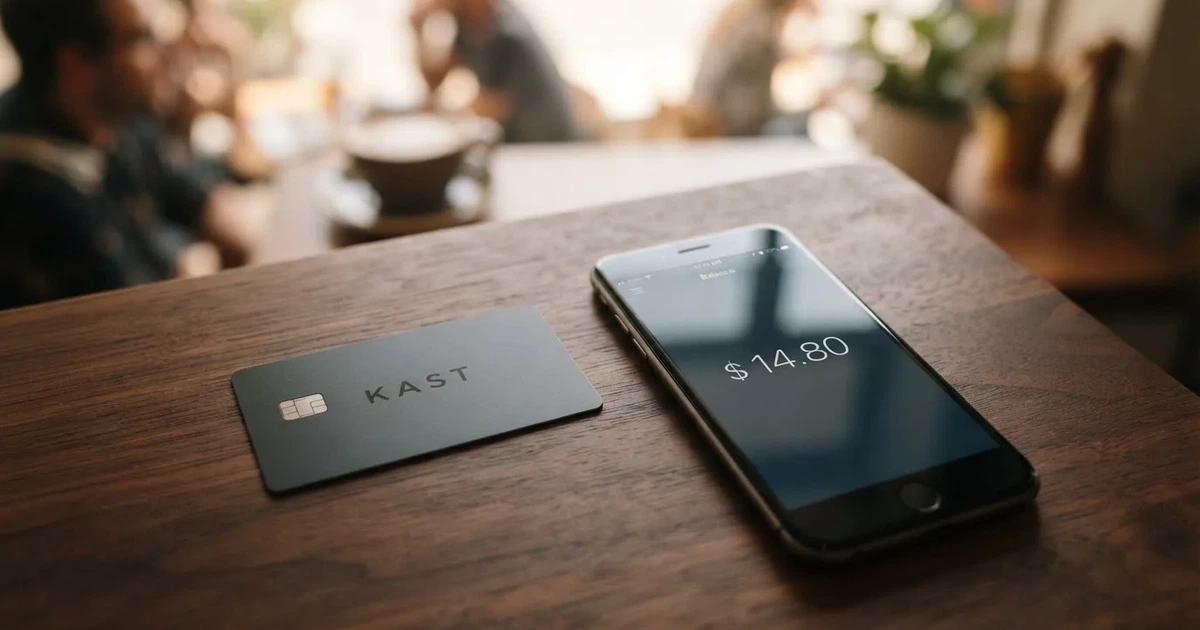
What gave me pause is everything around that idea. The card issuer is not named on the pages I read, no licence numbers appear, the contracting entity is registered in Anjouan in the Comoros, and the Trustpilot picture is rough — accounts frozen soon after a deposit, repeated document requests, and a run of 0.50 USD decline fees in April 2026 that pushed at least one balance negative. I rate the card 6.1 out of 10. That is a working product with real strengths in cost and daily use, held back by thin legal transparency and an unhappy customer base. If your money has to be safe and provable, that last part matters more than the fees do.
Conditions are current as of October 28, 2026
Who gets the card, and who gets turned away
Short version: you need to live in a supported country and hold an acceptable identity document, and the card will decide which countries those are when you reach the identity check. There is no published list.
That is the single most useful thing to know before you start, and it is also the most frustrating. KAST shows its country list during KYC — its own wording is that if your country is not listed, KAST is not available there. The list is not published in advance. A Restricted Locations list is referenced in the terms, but no countries are named in it on the pages I read.
Citizenship matters separately from where you live, and this is the part people get caught by. KAST states that living in a supported country while holding an ID from a restricted region may still make you ineligible to pass KYC. If you hold dual citizenship and one of your documents is from a supported country, you may pass. Only your own ID is accepted — a spouse’s or parent’s will not do — and using a VPN does not change eligibility.
One strange edge: you can create an account while in a country KAST does not support. The account exists, but the identity check stays locked, so it does you no good. I would not start there. If your country is not on the screen when you reach KYC, stop, because there is no fallback route.
| What the card asks for | What it means for you |
|---|---|
| Residence in a supported country | List shown only at KYC; not published in advance |
| Your own valid ID | Passport, national ID card or driver’s licence |
| No restricted-region citizenship on that ID | Dual citizens may qualify with a supported-country document |
| No VPN workaround | A VPN does not change eligibility |
The company claims Visa is accepted in 170+ countries, and says 150M+ merchants. That is a service claim about acceptance, not about eligibility — you can hold a valid card and still not be able to open an account.
How to get it
Three levels, and the level decides what you can do. This is the clearest part of the whole setup.
- Level 1 — account creation with phone and one-time code, PIN, email and country of residence. App access only, no cards.
- Level 2 — government ID (passport, national ID card or driver’s licence, valid) plus a selfie with liveness check. This unlocks sending and receiving funds, and cards.
- Level 3 — proof of address and enhanced checks, with citizenship requested. This unlocks USD and EUR accounts and global payouts.
The practical sequence is: create the account, complete KYC up to the level you need, then order a virtual or a physical card in the app. The app is “KAST: Global USD Account” on the iOS App Store, listed under Troia Limited, rated 3.97 from 276 ratings and updated 2026-10-08. I did not read the Google Play rating.
What I could not find: how long verification takes, and the official list of reasons for rejection. The exceptions are stated — expired IDs are rejected, and so are unsupported or restricted countries — but beyond that the rules are not on the page. Source-of-funds documents can be asked for at any point, which matters if you are moving meaningful sums. US residents give an SSN. Age is the legal age in your country, for example 18.
You can hold up to 10 cards. The card itself is Visa Platinum on Standard, Visa Infinite metal on Premium and gold-plated Visa Infinite on Private, with other designs themed around Pengu, Solana and Bitcoin. Your balance is in USD; stablecoin deposits convert 1:1 with a 0% spread.
Physical delivery takes 7–10 business days. The Standard tier charges 40 USD for delivery of the physical card. Which countries it ships to, and what a replacement costs, is not stated on the pages I read.
What it costs: fees, tiers and the everyday numbers
The headline is good and the details are ordinary. Standard costs 0 USD a year. Spending in USD costs nothing. Topping up with a stablecoin costs nothing. Those three facts cover most people’s everyday use, and it is why the card scores well on cost.
Where money does leak is currency conversion, ATMs, and small decline errors.
| Fee or limit | What the card states |
|---|---|
| Standard annual membership | 0 USD |
| Premium annual membership | 1,000 USD/year |
| Private annual membership | 10,000 USD/year |
| Standard physical card | 0 USD card fee plus 40 USD delivery |
| Premium / Private physical card | Included |
| Extra virtual card | 2 USD |
| Stablecoin top-up | 0% |
| Card spend in USD | 0% |
| Transaction fee | 0% |
| Apple Pay / Google Pay | 0% |
| Non-USD foreign exchange fee | 0.5%–1.75% depending on residence country, transaction country and card programme |
| Non-USD transaction under 25 USD | 0.10 USD |
| Declined transaction (insufficient balance) | 0.50 USD |
| ATM withdrawal fee | 3 USD flat plus 2% of the amount, plus the FX fee for non-USD |
| Inactivity fee | 1 USD/month after 12 months |
| Renewal / reactivation fees | Exist; amounts not stated |
Membership is billed annually upfront — there is no monthly option on Premium or Private.
Three ordinary payments, priced
A 60 USD grocery shop in your own country. No fee at all. The balance is already in USD, the merchant prices in USD, the transaction fee is 0%. This is the case KAST handles best, and it is the case most people care about.
A 200 USD hotel in a euro country. Here you meet the FX fee, which runs 0.5%–1.75% depending on your residence country, the country of the transaction and the card programme. On 200 USD the low end is 1 USD and the high end is 3.50 USD. The amount is not predictable in advance because three inputs decide it.
A 12 USD coffee in a currency that is not USD. This is where the small-transaction charge bites. Non-USD transactions under 25 USD cost 0.10 USD, so on a 12 USD coffee, that 0.10 USD fee is added, which can exceed the FX percentage alone. Above 25 USD that fee does not apply.
That third example is the one to remember. If you travel and spend small amounts in a foreign currency, the 0.10 USD line is what you will actually notice, and the card will not tell you in advance which side of 25 USD a given purchase falls on.
One more cost that is easy to miss: if you send a token that is not a stablecoin, KAST may convert it automatically at a fee shown in the app. That fee is displayed, not hidden, but it means the “0% conversion” headline only applies while you stay inside the stablecoin world.
The tiers, for reference:
| Tier | Annual Cost | Card Type | Cashback | Reserve Rate | KAST Points | Extras |
|---|---|---|---|---|---|---|
| Standard | 0 USD/year | Visa Platinum | 1.5% on first 2,000 USD/month | 8% | No KAST Points | No Visa Infinite benefits |
| Premium | 1,000 USD/year | Visa Infinite metal | 2% on first 10,000 USD/month | 10% | +1% | Visa Infinite benefits |
| Private | 10,000 USD/year | Gold-plated Visa Infinite | 3% on first 40,000 USD/month | 12% | +2% | VIP Concierge |
Cashback is capped by monthly spend: 1.5% on the first 2,000 USD/month, 2% on the first 10,000 USD/month, 3% on the first 40,000 USD/month. It is paid in USD when the transaction is authorised. Visa Infinite benefits — travel, purchase protection, lounge, eSIM — need registration on the Visa Benefits portal, so they do not arrive automatically.
Two things about the reward structure that I would not build a plan around. The Reserve offer on balances ends 1 July 2027, so it has a shelf life. And SOL staking rewards in Points are small: 0.25 per 1 SOL roughly every two days on Standard, 0.5 on Premium and Private.
How to top it up
Top up with stablecoins, and the fee is 0%. That is the intended path, and it is the one I would use.
Supported tokens are USDT, USDC, PYUSD and RLUSD. USDT and USDC can be sent on Ethereum, Solana, Polygon, Arbitrum and TRON, with the app listing current networks. No bank account is needed. The amount is unlimited, though network fees are not included — the blockchain charges those, not KAST.
One conflict worth knowing: the terms say acceptable tokens are “currently USDT and USDC”, while the app and marketing name PYUSD and RLUSD as well. Trust the app at the moment of sending, and keep the smallest practical sum in motion while you confirm.
Bank transfers exist too, and they are where the fees stop being free.
- USD ACH: 2 USD
- FedWire: 15 USD
- SWIFT: 30 USD
- EUR SEPA: 0.5%
The minimum top-up is not stated.
Sending to the wrong network is the real hazard here. Blockchain transfers are irreversible. If you send on a network the provider does not support, or to an address belonging to a different network, the money can be gone, or recoverable only through manual support work with no guarantee. Send a small test amount before sending a large one. If you are on Ethereum, note that a wallet holding USDT but no ETH cannot send, because gas is paid in ETH — which is exactly why the Arbitrum and Solana routes are cheaper to move money over.
Withdrawing out of KAST is where the network choice costs you. Solana (USDT, USDC) is 1 USD plus 0.1%; Arbitrum (USDC) is 0.20 USD plus 0.1%; Tron (USDT) is 5 USD plus 0.1%; Ethereum (USDT, USDC) is 6 USD plus 0.1%. Minimum withdrawal 5 USD. What you are left with if you close the account is not stated.
Internal KAST Tag transfers are free, up to 10,000 USD/day and five a day.
Paying with it every day
This is where the card is strongest, and the reason its everyday-use score is high. Apple Pay and Google Pay both work with virtual and physical cards at 0%. Samsung Pay is not mentioned. Anywhere Visa is accepted is the stated range — the company puts that at 150M+ merchants across 170+ countries.
Spending comes straight out of your balance, deducted at the moment of the purchase. This is not credit, and there is no float. It behaves like a prepaid card in the strict sense: you cannot spend what you have not loaded.
Card limits are listed as “Unlimited” for card transactions, account deposits and balance. Read that with care. The terms say limits are set by the company and shown on the platform, with no figures given, and large transactions may still be flagged for compliance. You can set lower limits yourself in the app, which is worth doing as a matter of habit.
What you are not allowed to spend on, per the terms: weapons, controlled substances, Ponzi/pyramid/MLM schemes, counterfeit goods, Darknet or Tor purchases, adult content, and pseudo-pharmaceuticals. Gambling is not mentioned at all, even though card issuers commonly restrict that category — so I would not assume a casino payment will go through.
Two everyday mechanics that catch people out. A merchant may place a pre-authorisation hold, and a declined authorisation can leave a hold on your money for several days, typically up to seven. And address verification is largely a US, Canada and UK mechanism; foreign-issued cards often fail it, which is one reason a payment can be declined at a shop where the card is perfectly valid.
Support is a KAST Concierge help centre, 24/7 on all tiers, with a VIP Concierge on Private. Email [email protected] appears in company replies. The membership page offers English only — no Russian in the selector.
If something goes wrong with a transaction, the terms ask you to contact KAST within 90 days. The company’s liability is capped at 500 USD, and the chargeback process is not described.
What can go wrong
The mechanics are the smaller risk. The bigger ones are about the company standing behind the card, and the accounts of other users.
The issuer is not named. KAST says it is a financial technology company, not a bank, and that cards, custody and the on/off-ramp are provided by licensed partners. The terms entity is “KAST Tech” (Reg No. 16223), incorporated in Anjouan, Comoros, with governing law in Seychelles and SIAC arbitration in Singapore. The App Store developer is Troia Limited. The card issuer, the entity that holds the BIN, is referred to only as “one of our Partner” — no name. Partners named in the terms include Tazapay and BitGo; logos on the homepage include Stripe, Privy, Fireblocks, Visa, Sardine and Elliptic. That logo list is not a licence. No licence numbers or regulator appear on the pages I read, and availability is “subject to regulatory approval”.
Why this matters concretely: when you want to know who stands behind your balance and which regulator to complain to, “one of our Partner” is not an answer. That gap is not proof of anything bad — plenty of legitimate programme managers publish only this much — but it is a real limit on what you can verify yourself.
User reports are the other half of this section. Trustpilot sits around 2.5 on regional pages and 2.7 on the main page, from roughly 170 reviews, as I read them. The recurring themes: accounts frozen or restricted soon after a deposit, with the money held; repeated 0.50 USD declined-transaction fees that pushed a balance negative in April 2026; repeated document requests on self-transfers; slow support. KAST replies to most negative reviews saying accounts can be restricted by security and compliance systems. Positive reviews praise the low fees and the stablecoin spending.
Official incidents are not stated — that is, KAST’s own pages record none.
Programme risk is real in this category. Card programmes do get shut down: Visa terminated its global agreements with FTX on 13 November 2022 and the FTX US debit card was wound down by its issuer; Visa suspended WaveCrest in Europe in 2018, closing all WaveCrest-issued Visa programmes. Closures typically mean a notice period, then loading and spending stop, then you are asked to withdraw what is left.
Custody risk sits behind all of it. KAST positions itself as a stablecoin money app with custody by licensed partners, so your funds are held by someone else, not by you. That is the whole convenience, and it is also the counterparty exposure. 2FA, card freeze and insurance are not stated on the pages I read, though Premium and Private carry the Visa Infinite benefits.
A note on what I did not find: no regulatory action turned up in my searches, and I am not making a claim either way — I am saying I found nothing.
Fees, limits and the two official pages that disagree
Worth isolating, because it will cost you money at an ATM. KAST’s own concierge fee page says “Up to $500 per withdrawal; up to 3 withdrawals or $1,500 per 24-hour period”. The card marketing page says “$250 per withdrawal, including fees, and three withdrawals per rolling 24 hours ($750/day)”.
Two official pages, two different numbers. The lower of the two is 250 USD per withdrawal and 750 USD per day, which I would assume are the enforceable limits.
What to take instead
If the reason you are here is that a normal bank card is awkward to get, these are the same-shape alternatives I would look at. Each has its own problems; none is a clean win.
| KAST | MetaMask | Zeal | Rizon | |
|---|---|---|---|---|
| Score | 6.1 / 10 | 7.1 / 10 | 6.1 / 10 | 6.7 / 10 |
| Network | Visa | Mastercard | Visa | Visa |
| Free tier | Yes, 0 USD | Virtual card free | Fees not published | Account maintenance free |
| Annual paid tier | 1,000 USD (Premium) | Metal 199 USD/year | — | Emerald from $5.59/month |
| Non-USD FX | 0.5%–1.75% | No additional fee stated | No additional FX fee; Visa wholesale rate | 1.7% plus $0.1 (Emerald 1.02%, page garbled — verify) |
| Cashback | 1.5%–3% USD | Virtual 1%; Metal 3% to first $10,000 then 1% | Up to 4% in GNO | 2.5% on eligible purchases |
| Where it works | Country list shown at KYC | 45 listed countries/territories; ineligible regions limit sign-ups, not spending | 150+ countries for spending; card programme live in EU, UK, Brazil, Colombia, Mexico, Japan, Singapore, Philippines, Indonesia, Thailand | Residence-based, US and LATAM |
MetaMask scores highest of the four at 7.1. It is open in 45 listed countries and territories — Andorra, Argentina, Brazil, Canada, Mexico, Germany, France, Spain, Uruguay among them — with a waitlist elsewhere, and proof of residency required. Its own line is useful: ineligible regions limit sign-ups, not spending. US and UK sign-ups are temporarily closed per its FAQ. The virtual Mastercard is free and instant, metal is 199 USD/year, and the issuer is named: Monovate, with Crypto Life as card provider. You spend directly from a connected wallet on Linea, Base, Monad and Solana, holding tokens including mUSD, wETH, EURe, GBPe, USDC and USDT. A Solana-only wallet cannot withdraw credit. Cashback is 1% on Virtual; on Metal the headline is 3% with a footnote capping 3% at the first 10,000 USD spent, then 1%. The catch: “minimal fee for each transaction” with the amount not stated on the pages I read.
Zeal, also 6.1. It takes no additional FX fee and converts at the Visa wholesale rate, which is the cleanest conversion story in this group. It pays up to 4% cashback in GNO on Gnosis Chain, but the GNO must be held in the card Safe to qualify, and rates can change. The App Store advertises up to 5% variable APY on EUR/USD balances. Accounts in EUR, USD and GBP via Gnosis Pay. Fees are not stated — no schedule published on zeal.app or the App Store — and Gnosis Pay fees such as ATM charges may still apply.
Rizon, 6.7. It targets people who live in and are domiciled in the US or LATAM, with restrictions elsewhere, while also claiming 122+ countries supported. Visa Platinum, virtual and physical, metal coming soon. Account maintenance is free; Emerald subscription from $5.59/month; card prices are “check app for the price”. Deposit and USD spend are free, non-USD is 1.7% plus $0.1 — though the Emerald figure on the page is garbled at 1.02% and I would verify it. 2.5% back on eligible purchases.
My read on the choice: if you want the cheapest way to spend a USD stablecoin balance and you already know your country is supported, KAST’s free tier is hard to argue with. If you want a named issuer and published numbers, MetaMask names Monovate and publishes more. If you want no FX markup at all, Zeal converts at wholesale — but publishes almost no fees.
Who I would recommend it to
I would recommend KAST to someone already holding USDT or USDC across several networks who wants to spend that balance as dollars without touching an exchange again. If that is you, the card does its job: 0% top-up, 0% USD spend, 0% Apple Pay and Google Pay, ATM access on the Visa network, and a free tier that is actually free. The 0.10 USD small-transaction charge is the only thing that would make me wince, and it only applies to non-USD purchases under 25 USD.
I would not recommend it as the only card you hold, and I would think hard before parking a large balance on it. Three things drive that: no named issuer and no licence numbers on the pages I read, a contracting entity in Anjouan with Seychelles governing law, and a Trustpilot record dominated by frozen accounts and held deposits. The 90-day complaint window and the 500 USD liability cap make a large balance worse, not better.
The people I would point elsewhere first:
- If you need to know who issued your card and under which licence, choose a programme that names its issuer.
- If you spend mostly abroad and conversion cost decides, Zeal’s wholesale-rate conversion is the cleaner mechanism, though its fee schedule is unpublished.
- If you want a named, published fee table and a virtual card you can hold in minutes, MetaMask is the better-documented option, and its US and UK sign-ups are currently closed.
- If you lose access to a bank account and need a card that works from a stablecoin balance right now, KAST is exactly the shape of tool you want — just size the balance to what you can afford to have delayed.
Frequently asked questions
What is the KAST card?
It is a Visa payment card you fund with stablecoins rather than a bank account. You deposit USDT, USDC, PYUSD or RLUSD, the balance shows in dollars, and purchases come straight out of it — deducted at the moment of payment, so it is not credit. You can hold a virtual or physical card, use Apple Pay and Google Pay, and withdraw at Visa ATMs. KAST describes itself as a financial technology company, not a bank.
Is KAST a bank?
No — it says so itself. KAST calls itself a financial technology company, and says cards, custody and the on/off-ramp are provided by licensed partners. The contracting entity in the terms is KAST Tech, registered in Anjouan, Comoros, with governing law in Seychelles. The card issuer is not named on the pages I read, and no licence numbers appear there. That gap is the first thing I would want closed before parking real money.
How do I get a KAST card?
Download the iOS app, create an account with phone, PIN, email and country of residence, then complete identity verification with a valid passport, national ID or driver’s licence plus a selfie. That unlocks cards. Proof of address is a further level and unlocks USD and EUR accounts. Then order a virtual or physical card in the app. Physical delivery takes 7–10 business days, with 40 USD delivery on the Standard tier.
Which countries is KAST available in?
The country list appears only at the KYC step and is not published in advance — KAST’s own line is that if your country is not listed, it is not available there. Citizenship is checked separately: living in a supported country with an ID from a restricted region may still fail. Only your own ID counts, and a VPN does not change eligibility. You can register from an unsupported country, but the identity check stays locked.
Does KAST require KYC?
Yes, and it is staged. Level 1 is account creation with app access only and no cards. Level 2 needs a government ID plus a selfie and unlocks sending, receiving and cards. Level 3 needs proof of address and enhanced checks, and unlocks USD and EUR accounts. Source-of-funds documents can be requested at any point, and US residents provide an SSN. How long it takes is not stated.
What does it cost to use a KAST card?
Standard is 0 USD a year and the Standard physical card has no card fee, though delivery is 40 USD. Topping up with a stablecoin is 0%, spending in USD is 0%, the transaction fee is 0% and Apple Pay and Google Pay are 0%. The costs that bite: non-USD FX at 0.5%–1.75%, 0.10 USD on non-USD transactions under 25 USD, 0.50 USD per declined transaction, and 3 USD plus 2% at ATMs.
How do I top up a KAST card?
Send USDT or USDC on Ethereum, Solana, Polygon, Arbitrum or TRON — PYUSD and RLUSD are also named — and the deposit fee is 0%, with no bank account needed. Network fees from the blockchain are separate. Bank deposits cost 2 USD for USD ACH, 15 USD for FedWire, 30 USD for SWIFT and 0.5% for EUR SEPA. The minimum top-up is not stated. Send a small test first: transfers on a wrong network are irreversible.
Can I add the KAST card to Apple Wallet?
Yes, if you have a virtual or physical card, and there is no KAST fee for it. Google Pay works the same way. Samsung Pay is not mentioned on the pages I read. If either mobile wallet fails you, the physical card still works wherever Visa is accepted, and you can freeze the card in the app — though 2FA and freeze are not stated in detail.
Is the KAST card safe to use?
Safe to use is not the same as safe to depend on. Custody sits with licensed partners rather than with you, the issuer is unnamed, and the terms cap company liability at 500 USD with a 90-day window to report a transaction. Trustpilot sits around 2.5–2.7 from roughly 170 reviews, with recurring reports of frozen accounts, held deposits and repeated document requests. I would keep a working balance there, not your savings.
Can I withdraw money from KAST?
Yes, in stablecoins, at network-based fees: Solana 1 USD plus 0.1%, Arbitrum 0.20 USD plus 0.1%, Tron 5 USD plus 0.1%, Ethereum 6 USD plus 0.1%, minimum 5 USD. At ATMs it is 3 USD flat plus 2% of the amount, plus the FX fee for non-USD. KAST’s own pages disagree on ATM limits — one says 500 USD per withdrawal and 1,500 USD per day, the other says 250 USD and 750 USD — so plan against the lower figure.
Wallet cards – cryptocardchooser.com
Content created by the «cryptocardchooser.com» team