
A fee-light euro card that only pays cashback on one of the two coins it accepts
 Available in US
The OKX card is one of the more attractive of the crypto cards on price. There is no card fee, no per-transaction charge and no foreign-exchange fee charged by OKX, and the conversion spread is thin — between 0.1% and 0.4% depending on which of the card’s own documents you read. If you want a card that spends a stablecoin balance without a monthly charge, that is genuinely hard to find cheaper.
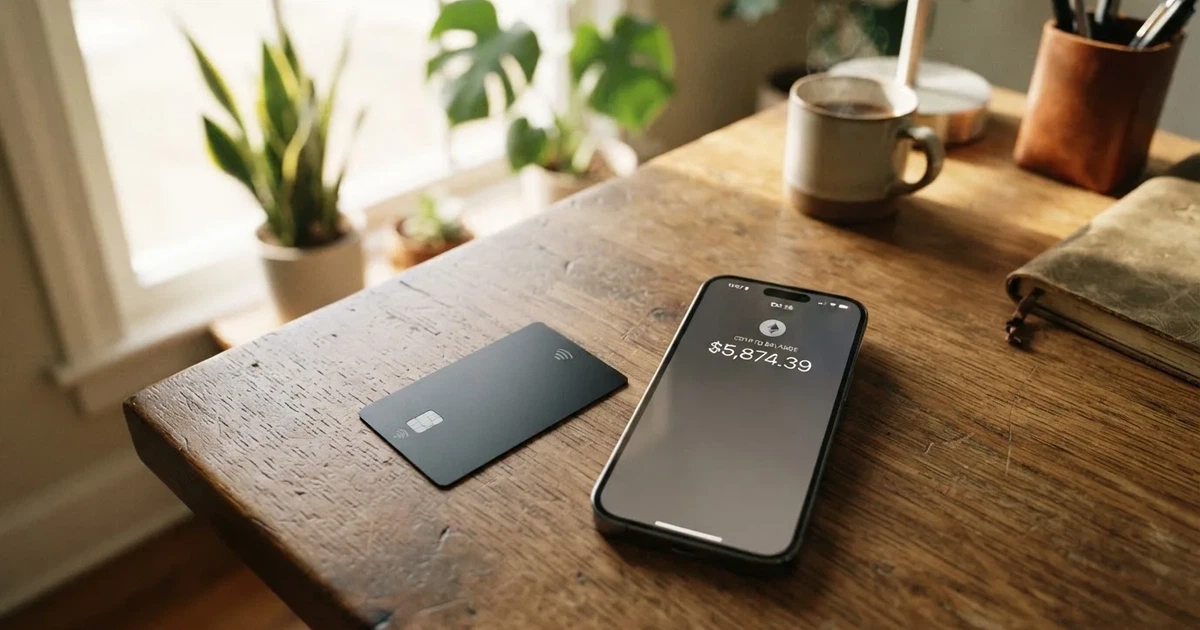
The catch is not the price, it is the scope. The card is virtual only, euro-denominated, and it is aimed at EU plus Norway. It is built for two coins, USDC and USDG, and the cashback pays on USDG purchases only — so if you hold USDC, the most attractive number on the offer sheet means nothing to you. There is no physical card described in the launch material and no ATM terms stated. Daily and monthly spending limits are not stated on the card’s public pages either. And the entity you are dealing with is not a bank: OKX Europe Ltd. is the MiCAR-licensed company for EEA users, while the card itself is issued through an unnamed European licensed payment provider.
I scored this card 6.2 out of 10. That is a good score for a crypto card — most of the field is not better — but it is not a card I would tell a reader to switch their everyday banking to. It suits one specific person: someone in the EEA or Norway who already holds USDC or, better, USDG on OKX Pay and wants to spend it at a shop without paying a monthly fee. It does not suit someone who needs a physical card, who spends in other currencies often, who wants to withdraw cash, or who is outside the eligible area.
The conditions described here are current as of October 28, 2026.
My score, criterion by criterion
The score is built from six criteria. Here they are with the mark each one earned and why, in my own words. Nothing here is a figure of mine — the marks are the assessment, the reasons are mine.
| Criterion | Mark | Why |
|---|---|---|
| Who can get it | 5 / 10 | EU plus Norway, launched 28 January 2026; Iceland and Liechtenstein are excluded |
| Cost | 9 / 10 | No card fee, no transaction fee, no OKX FX fee; conversion spread 0.1% per the explainer, 0.4% per the press release |
| Top-up options | 5 / 10 | USDC or USDG on the OKX Pay balance via Convert or an external deposit; other coins must be converted first, networks not named |
| Reliability and complaints | 6 / 10 | OKX Europe Ltd. holds a MiCAR licence, issuer unnamed in the official text; unofficial: Monavate. Complaints about the exchange include held assets, account limits and slow support |
| Everyday use | 5 / 10 | Virtual euro Mastercard, Apple Pay and Google Pay; physical card and ATM not named |
| Total | 6.2 / 10 | A cheap card with a narrow, clearly drawn user base |
Two things stand out from that table. The 9 for cost is the highest single mark I gave anything here, and it is deserved. The 5 for top-up options is the weakest, and it is where the design shows its seams: only two stablecoins, and you cannot pay directly from a self-custody wallet without going through Convert first.
Who will they give you the card
Here is the eligibility rule as the card states it: the EU plus Norway, launched 28 January 2026, with Iceland and Liechtenstein excluded. The rule is applied to EEA users of OKX Europe Ltd., which is the MiCAR-licensed entity.
Two things to notice. First, “EU plus Norway” means Iceland and Liechtenstein are out, even though both are EEA states — and the explainer’s conclusion describes the coverage as the “entire EEA”, which contradicts the exclusion. Where the card’s own summary says “entire EEA” and its eligibility line names two exclusions, I would go with the exclusions and confirm with support before you move money. Second, this is an EEA-user rule. It is not stated as a citizenship rule, and it is not stated as a residence-versus-nationality rule either. If you are an EEA national living elsewhere, or a non-EEA national living in the EEA, the public pages do not tell you which way you fall.
Note also what this section does not say. There is no age figure. There is no statement about US citizens resident in the EEA, and no statement about people whose address is in an eligible country but whose documents are from elsewhere. Those are exactly the cases where an issuer’s own risk policy bites, and the card’s public material is silent.
How to get it
Getting the card is a short process. You complete full identity verification with a valid ID document and proof of address, you activate the card in the OKX app, and you hold USDC or USDG in OKX Pay. The card is a Mastercard, euro-denominated, virtual, linked to OKX Pay. It is issued through an unnamed European licensed payment provider.
What is not stated is as instructive as what is. Delivery is not stated — the card is virtual, and the explainer says only that you activate it in the app. Age is not stated. There is one verification level for the card, valid ID plus proof of address, no tiers of verification, and the processing time and the reasons a file gets rejected are not stated either.
Read that as: this is a single-step, all-or-nothing check. There is no partial level to climb into, and no published list of what trips a rejection. If your proof of address is old, or in a language the reviewer does not read, or in a name that does not match your ID exactly, you have no fallback within the product. That is the practical risk at this step, not a theoretical one.
Fees: what it really costs
This is the section where the OKX card wins. The costs table below lists everything the card’s public pages state, plus the items they leave open — and the open items are marked as such rather than guessed at.

| Fee or limit | What the card says |
|---|---|
| Issuance | No card fee (explainer, as of May 2026) |
| Monthly fee | None stated |
| Transaction fee | None |
| FX fee charged by OKX | None |
| Conversion spread | 0.1% per the explainer (May 2026); 0.4% market spread in the launch press release |
| ATM | not stated |
| Daily and monthly limits | not stated |
The two conversion figures deserve a straight explanation rather than a hand-wave. The launch press release quotes a 0.4% market spread. The explainer, which is the newer document — it was modified in August 2026 — says 0.1%. I have not seen a card document that reconciles them. The sensible reader treats 0.1% as the best case and 0.4% as the number to plan against, because it is the one the company published when the product launched and because it is the figure that would survive a dispute. Either way, the cost of using this card is well below the 2% FX fee some competitors add on top of the network rate.
Three everyday payments, so you can see where the money actually goes:
- A EUR 30 grocery shop, paid from a USDG balance. You hold USDC or USDG in OKX Pay, the balance converts to euro at the moment of purchase, and the spread is 0.1% or 0.4%. There is no per-transaction charge and no OKX FX fee on top. The USDG side matters here: USDG purchases earn cashback under the rates below, USDC purchases earn none.
- The same EUR 30 shop, paid from USDC. The cost is identical — spread only. The difference is that nothing comes back. If you are holding USDC rather than USDG, the cashback table is not part of your deal.
- A EUR 40 purchase in a eurozone country from abroad. There is no OKX FX fee, because the card is already euro-denominated and there is nothing to convert on the card side. What can still bite is the merchant side: a shop may apply its own scheme or processing fee to a foreign-issued card, and an ATM withdrawal, if you ever find a way to make one, is not covered by anything the card has published.
One unofficial note, flagged as such: a German deals-forum post says a monthly limit was raised to EUR 50 for a cashback promotion. That is per Mydealz in 2026, it is unverified, and it may not be the card limit at all. I would not plan around it.
Cashback exists, but read the conditions before you value it. There is a single card and no paid tiers; the rate depends on your OKX VIP level, and it applies only to USDG purchases. Rates as of 29 May 2026:
| VIP level | Cashback on USDG purchases | Monthly cap (EUR) |
|---|---|---|
| Regular | 2% | 10 |
| VIP1 | 4% | 300 |
| VIP2 | 4.5% | 450 |
| VIP3 | 5% | 1,000 |
| VIP4+ | 10% | 1,000 |
Two caveats on that table. The source text says 2–5% while its own table says 10% for the top level; the table is what the same document lays out, and the discrepancy is not resolved. And a Regular-level 2% capped at EUR 10 a month is worth roughly nothing once you have read the rest of this section — at that tier the only thing that genuinely sets the OKX card apart is the absence of a monthly fee.
Top up: how the balance gets there
You top the OKX card by holding USDC or USDG in OKX Pay. That balance arrives either through Convert inside OKX Pay or through an external deposit of USDC or USDG. Any other coin has to be converted into USDC or USDG first. There is no auto top-up, and if the balance is short the payment is declined.
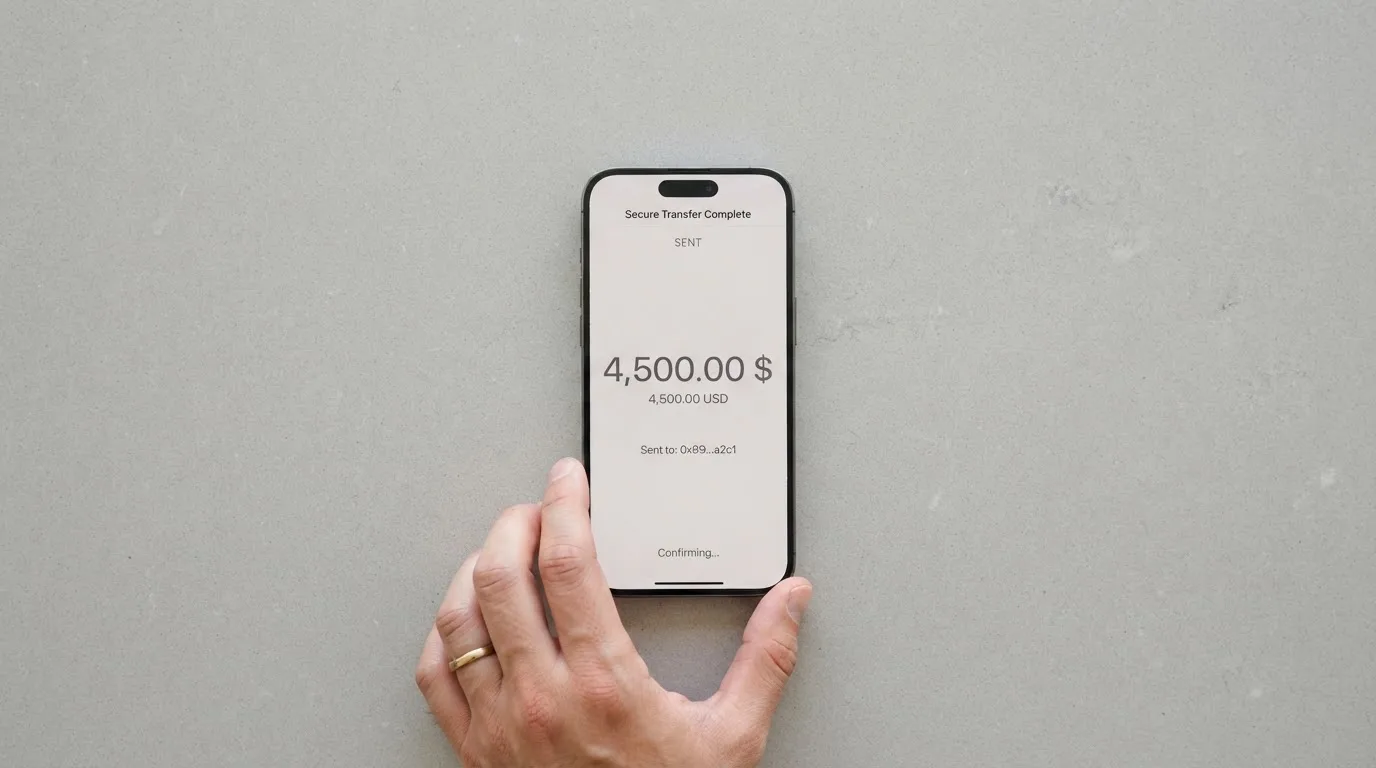
What that means in practice is that the card is a front end for an OKX Pay balance, not a card that reads directly from your own wallet. If you keep your stablecoins in self-custody, your route is: send them to OKX, convert or receive them into the OKX Pay balance, then spend. Your coins sit in that balance until you buy something — they are not on the card itself, and how and whether you can withdraw them out is not stated.
The funding terms the card leaves open are worth knowing before you transfer anything: no deposit fee is stated, the minimum top-up is not stated, and network fees for the deposit are not stated. On the network side, remember that on-chain fees are charged by the blockchain rather than by the card provider, so a deposit on an expensive network is your cost, not OKX’s — and the card does not name which networks it accepts. That combination is the one to be careful with: an unnamed network and an unstated deposit minimum means the only safe procedure is a small test transfer first, on a network you have confirmed, before moving anything you would miss. Blockchain transfers are irreversible, and a deposit to an unsupported network or a wrong address can be lost or need manual recovery with no guarantee.
Paying with it every day
Day-to-day this is a virtual euro Mastercard, and you can add it to Apple Pay or Google Pay for tap-to-pay. That is the whole everyday story. There is no physical card in the launch material, no ATM terms, and no list of blocked merchant categories. On cash, your only route is to load a balance and pay with it at a till — which works, but is not the same as walking up to a cash machine.
Which merchants accept it, and which refuse it, is partly a category fact rather than a card fact. A card number starts with an issuer identification number that identifies the issuing institution and its country, and merchants can look it up and apply extra scrutiny when the issuer country differs from the billing address. Some merchants decline prepaid or foreign-issued cards for exactly that reason. So the honest answer to “where can I use this card” is: online and in-store wherever a Mastercard is accepted, with the usual small tail of declines you would expect from a virtual, foreign-issued card, and no published list of where it will fail. In an online payment you may also meet an identity check — 3-D Secure — which the issuer either waves through or turns into a one-time code or a biometric prompt. Mastercard’s version is called Identity Check.
The app side is decent, with a caveat about what the rating measures. In the App Store the main OKX app shows 4.6/5 from about 23K ratings, read on 20 October 2026 — and that is the listing for the main OKX app, not the card. An unofficial figure from a third-party mirror gives Google Play 4.4/5 from 917,376 reviews; I did not read Google’s listing directly. Disputes and chargebacks: not stated. That is a real gap for a payment card, and it is one you should ask about rather than assume — the general position is that reversal rights on prepaid cards vary by jurisdiction and should not be assumed to apply.
What can go wrong
Here I leave the marketing behind. There are four distinct risks, and they are not equally serious.
The issuer is unnamed in the official material. The card is issued through “a European licensed payment provider”, and the card’s own text does not name it. Unofficial sources point to Monavate, a UK-headquartered e-money institution on Mastercard, per Cointelegraph in January 2026 — treat that as reported, not confirmed by the card. Separately, per Stablecoin Insider, OKX obtained a Maltese Payments Institution licence in February 2026. What this means practically: a virtual card is a Mastercard issued by someone, and if you ever need to complain to the entity that actually holds your card balance, the card’s own pages do not tell you its name. Ask support before you rely on the card.
Complaints about the exchange, not the card. Official incidents specific to the card are not stated. What is documented is user-report data: an aggregator, rfp.wiki, says public reviews often cite slow support and region-dependent verification and withdrawal experiences, and that regional availability drives mixed card and fiat experiences. On Trustpilot, OKX sits at about 1,619–1,621 reviews and OKX Europe at 4.3 from 29 reviews, with negative themes running through assets held with no clear reason, account restrictions blocking access to funds, withdrawal holds, and slow support; App Store reviews say the same. OKX has a complaints section on SikayetVar, though no details were seen. Read that list carefully: held assets and blocked access are custody and compliance problems at the exchange level, and they are the ones that would leave you unable to pay for anything.
Self-custody cuts both ways. The launch release says stablecoins remain in your own wallet until checkout, and the explainer says the balance stays in your wallet. That is a real design point in your favour — you are not handing the private keys to a third party in the way a custodial balance would require. But it also means the usual warnings attach: a seed phrase is typically 12 to 24 words in unencrypted form, anyone who has it can restore the wallet and spend the funds, transfers are irreversible, and the network cannot freeze or return stolen crypto. There is no built-in recovery.
The unknowns. Support terms are not stated. Account freeze and two-factor authentication and insurance are not stated. And the market-structure risk sits under all of it: a card programme can be closed. Visa terminated its agreements with FTX on 13 November 2022 and the FTX US debit card was wound down; Visa suspended WaveCrest in Europe in 2018, closing all WaveCrest-issued Visa programmes. Closures follow a pattern — a notice period, then loading and spending stop, then you are asked to withdraw. Programme risk is low for a MiCAR-licensed arrangement but it is not zero, and the sensible posture is to keep only a working balance on the card rather than a stock of it.
What to take instead
Two of the alternatives below are worth a look, one is not. I have kept the comparison to what each provider actually publishes.
Coinbase Card — 6.4 / 10, and the stronger score here. A Visa prepaid debit card, virtual or physical, spending cash or crypto, with crypto converted to US dollars at purchase or withdrawal. Zero spending fees and no annual fees; all fees are disclosed in the cardholder agreement. You fund it by linking a bank account or having part of a paycheck deposited, with no fee. Optional crypto rewards on every purchase for US card users, at a variable rate shown in the app. The catch is geography in the other direction: all US states except Hawaii, US identity rules, no other countries. If you are in the US this is the more mature card; if you are in the EEA it is simply not available to you.
Bybit Card — 6.0 / 10, with far more complexity. Virtual and physical, Mastercard in most regions and Visa in Brazil, Peru and Asia Pacific, and the fiat currency varies by region. Issuance is free in all regions for the virtual card; the physical card is 29.99 USD in Australia, 5 USD/USDT in Argentina, 5 USDT in Asia Pacific, 29.99 USDT in Georgia and Kazakhstan (AIFC), free in Brazil and Mexico. The costs are heavier: a 0.9% crypto conversion fee over the One-Click Sell rate in most regions, and an FX fee on top of the network rate — 2% for Australia, Asia Pacific, Georgia and Mexico, 7% in Argentina. It also draws on a Funding Account rather than a card balance, it works in regions including Argentina, Georgia, Kazakhstan, Australia, Mexico, Brazil, Peru, Kazakhstan (AIFC) and Asia Pacific, and the cards page states plainly: “This product is not meant for European Economic Area customers.” Its rewards are tiered by spend with a points system. Richer, more expensive, and closed to you if you are in Europe.
BingX — 5.8 / 10, and the reasons are thin. Virtual instant and a metal card mailed in 15–30 business days, Visa debit settling in USD, for Europe (EEA), APAC, LATAM and other selected regions. But the card’s own fees are not stated, its cost is not stated, and its rewards are not stated. It funds from USDT only, out of the BingX Fund Account. A card with no published fee schedule is not a card you can plan a month with.
One background point that explains why the simpler options exist at all: Visa and Mastercard do not issue crypto cards to consumers themselves. They license issuers, and they can suspend a programme. In a normal crypto card, the card network routes the payments, the issuer — a bank or e-money institution — holds the card programme, and the crypto brand is often only a programme manager and a marketing front end. That is why “who issued this card” is a fair question to ask of any of them.
Who I would recommend it to
I would recommend the OKX card to one person, and I would not oversell it to anyone else.
That person lives in the EU or Norway, outside Iceland and Liechtenstein; already has USDC — or, better, USDG — sitting on OKX Pay; has decided that stablecoin spending is a convenience rather than a financial experiment; and wants no monthly fee and no per-transaction fee. For that person the economics are good: the spread is thin, there is no card fee, and at a high enough VIP level the USDG cashback is real. Adding it to Apple Pay or Google Pay makes it genuinely usable for daily spend without a physical object to lose.
I would steer everyone else elsewhere. If you need a physical card, this is not it — the launch material describes a virtual card and nothing else. If you spend in many currencies, the fact that the card is euro-only pushes you toward a multi-currency card instead. If you need cash from a machine, the ATM terms are not stated. If you hold USDC and not USDG, you are giving up the only benefit that distinguishes this card from a plain exchange balance — which is to say, you should just spend from the exchange balance. And if you are anywhere outside the EEA and Norway, it is not offered to you.
The last thing I would tell anyone is to separate the card from the exchange before they get attached. The card’s cost structure is the best in this category, and its everyday-use profile is the narrowest. Those are separate scores and the table at the top keeps them separate. The complaints pattern that shows up in reviews — assets held, accounts restricted, slow support — belongs to the platform, and a good card does not protect you from any of it. Set expectations on that basis, not on the strength of a 9 out of 10.
Frequently asked questions
What is the OKX card?
The OKX card is a euro-denominated virtual Mastercard that spends a balance of USDC or USDG held in OKX Pay inside the OKX app. It was launched in Europe on 28 January 2026 for the EU plus Norway, with Iceland and Liechtenstein excluded. It is virtual: the launch material describes no physical card and no ATM terms. When you buy something, your stablecoin balance is converted to euro at the moment of purchase.
How does the OKX card work?
You hold USDC or USDG in OKX Pay, and the card spends that balance. The balance is converted to euro at the point of purchase, with no OKX foreign-exchange fee and no per-transaction fee, only a conversion spread. There is no auto top-up, so if your balance is too small the payment is simply declined. You add the card to Apple Pay or Google Pay and pay by tap as normal.
Is OKX a bank?
No. OKX Europe Ltd. is the MiCAR-licensed entity serving EEA users, and the card itself is issued through what the card’s own text calls a European licensed payment provider, unnamed. Unofficial reporting names Monavate, a UK-headquartered e-money institution, as issuer, but the card does not confirm that. An e-money institution can issue cards and e-wallets but does not lend, and its customer funds are safeguarded rather than being bank deposits.
Does the OKX card require KYC?
Yes. Full identity verification with a valid ID document and proof of address is required. There is one verification level for the card and no tiers — you are verified or you are not. The card’s public pages do not state how long verification takes or what the rejection reasons are, and they do not state a minimum age, so check both with support before you send documents.
Is the OKX card free?
There is no card fee and no monthly fee, and no transaction fee or OKX FX fee. The cost of using it is the conversion spread, quoted as 0.1% in the explainer modified in August 2026 and as a 0.4% market spread in the launch press release; the two figures are not reconciled anywhere I could find, so plan against the higher one. ATM fees and daily or monthly spending limits are not stated.
How do I top up the OKX card?
You top it up by getting USDC or USDG into your OKX Pay balance, either through Convert inside OKX Pay or by depositing USDC or USDG from an external wallet. Any other coin must be converted into one of those two first, and the card does not name which networks it accepts. No deposit fee, minimum top-up or network fee is stated, and blockchain transfers are irreversible, so test with a small amount first.
Does the OKX card give cashback?
It gives cashback on USDG purchases only — USDC purchases earn none. The rate depends on your OKX VIP level: 2% capped at EUR 10 a month for Regular, 4% capped at EUR 300 for VIP1, 4.5% capped at EUR 450 for VIP2, 5% capped at EUR 1,000 for VIP3, and 10% capped at EUR 1,000 for VIP4 and above, as of 29 May 2026. The source text says 2–5% while its table says 10% at the top tier; that discrepancy is unresolved.
Can I add the OKX card to Apple Wallet?
Yes, Apple Pay and Google Pay tap-to-pay are supported. Adding a card to a phone wallet replaces the card number with a device-specific number stored in the phone’s secure hardware, and each payment carries a one-time code, so the raw number is not what you are handing over. Some online payments will still ask for an identity check — Mastercard calls its version Identity Check — before going through.
Is the OKX card safe?
It depends on two things, not one. The design is reasonable: your stablecoins stay in your own wallet until checkout rather than being handed to a third party, so you keep control of the keys and bear the usual risk of losing them. The risk sits with the platform: reviews on Trustpilot and app stores commonly cite assets held with no clear reason, account restrictions blocking access to funds, withdrawal holds and slow support. Neither the card’s insurance arrangements nor its support terms are stated.
Is the OKX card available in the United States?
No. The card is offered for the EU plus Norway, with Iceland and Liechtenstein excluded, and the card’s pages do not say it is open to US residents. If you are in the US, the Coinbase Card is the relevant product: a Visa prepaid debit card, virtual or physical, available in all US states except Hawaii, with zero spending fees and no annual fees. The OKX card’s pages also do not set out a citizenship-versus-residence rule, so if you are an EEA national living elsewhere, ask support first.
Exchange cards – cryptocardchooser.com
Content created by the «cryptocardchooser.com» team