
A virtual crypto card with an unnamed issuer and a fee schedule that contradicts itself
 Available in US
If you have been trying to get an ordinary bank card and the bank said no — or you simply would rather not walk into a branch — the EMCD card is one of the crypto cards that exist for exactly that situation. It is virtual, you load it with USDT, and you spend the balance. That is the pitch, and the pitch works. What I found underneath it is a service with a real fee schedule, a card page that contradicts its own help centre about which network runs it, and a support record that includes accounts blocked after verification. It scores 4.9 out of 10, and I want to be precise about which four and which five.
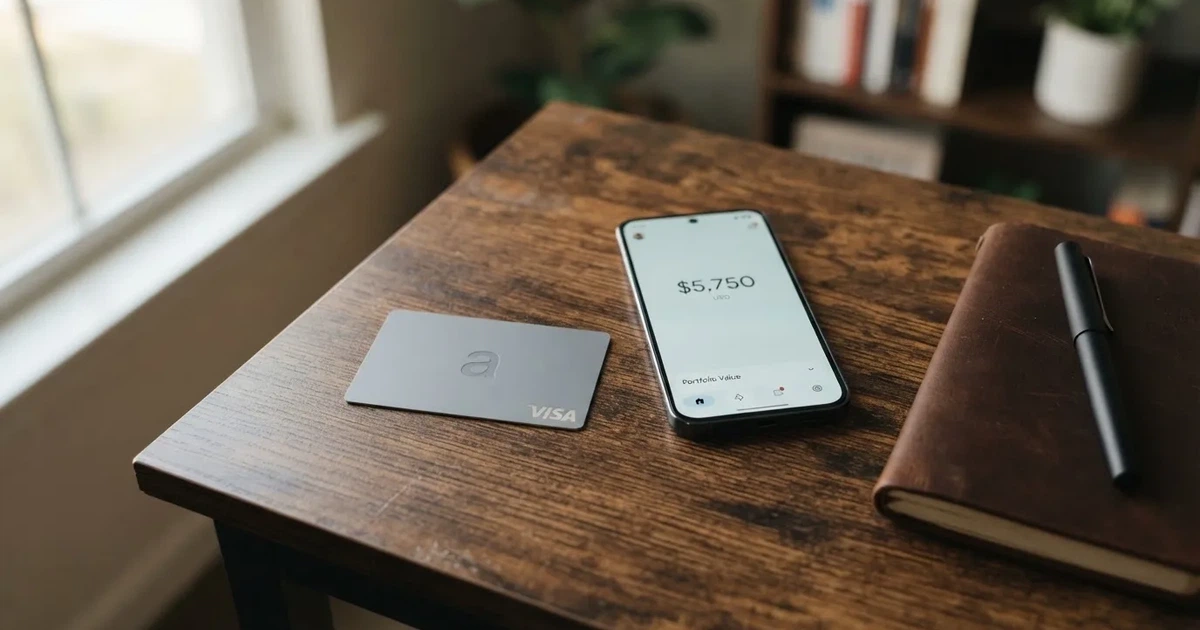
The conditions described below are current as of October 28, 2026.
Verdict: 4.9 out of 10, best for people already holding USDT
The card suits one reader very specifically: someone who already has USDT sitting in a wallet, already accepts that their balance is custodial, and wants to turn it into everyday spending without a bank in the middle. For that reader the card does its job — USDT goes in, a balance appears, you spend it, and the monthly fee is $5. For everyone else the fee schedule is heavy, the card is virtual only, and several important things are simply not stated anywhere the public pages reach.
It does not suit a reader who wants a physical card in their hand, who needs cash from an ATM, who buys in a currency other than US dollars, or who is uneasy about verification freezing their account. It also does not suit a reader who plans to spend large amounts, because the top-tier limits are still far below what a normal debit card does.
Here is how the score is built, criterion by criterion:
| Criterion | Mark | Why |
|---|---|---|
| Who can get it | 9 / 10 | Works wherever Mastercard is accepted, except payments in 13 countries: Afghanistan, Belarus, Cuba, Iran, North Korea, Syria, Venezuela, Russia, Myanmar, Somalia, Ukraine, Yemen, China |
| Cost | 2 / 10 | Plus $19, Premium $25 issuance; $5 monthly; top-up 1.5%; purchase 1.5% + $0.50; non-USD conversion 3%; unofficial: 2.5% top-up |
| Top-up options | 4 / 10 | Only USDT from the main wallet account, network not stated, minimum $20 |
| Reliability and complaints | 4 / 10 | Issuer and legal entity not named; network stated as both Visa and Mastercard; Trustpilot reports blocks after KYC and slow support |
| Everyday use | 5 / 10 | Virtual only; Apple Pay and Google Pay listed as coming soon; no ATM; no 3-D Secure |
| Total | 4.9 / 10 | — |
The strongest mark is reach, which is genuinely wide. The weakest is cost, and I want to explain that in the fees section rather than bury it, because the numbers are the reason this card sits near the middle of the scale despite working reasonably well in narrow ways.
Will they give you the card?
Mostly yes, and this is where the card scores highest. The card page says it works “worldwide” wherever cards are accepted. The help centre is more precise: the card works wherever Mastercard is accepted, except that payments are not available in Afghanistan, Belarus, Cuba, Iran, North Korea, Syria, Venezuela, Russia, Myanmar, Somalia, Ukraine, Yemen, China.
That list is worth reading twice if you live in one of those places, because “the card exists” and “you can pay with it here” are different questions. The card page also carries a notice saying some EMCD services are unavailable in certain jurisdictions, without naming them. And a note in the help-centre article was previously reported to list Russia as restricted, so if Russia is your situation, check the live help centre rather than trusting any summary, including mine.
Beyond geography, the more likely blocker is verification rather than eligibility. Identity verification is standard EMCD procedure, described as an ID and about 5 minutes. Proof of address and age requirements are not stated on the public pages, so I cannot tell you what documents to have ready beyond a government ID.
One thing that is not stated anywhere, and that I would want before applying: which legal entity you are contracting with, which institution issues the card, and in which country it is licensed. The card page gives the brand and the wallet, not the issuer. That is a disclosure gap, not evidence of anything wrong — plenty of legitimate programmes are structured exactly this way, with a programme manager in front and a licensed issuer behind — but it means you are relying on the operator’s standing rather than on a named, checkable issuer.
How to get it
The order flow described on the card is short. You register, complete standard EMCD identity verification with an ID and about 5 minutes, and place an order that requires $15 of funding which stays in your balance rather than being charged as a fee. Verification is mandatory after your first top-up, using a valid government ID, and is described as usually taking a few minutes. The card then activates by itself. If verification fails, you retry with a different document.
What you end up with is a virtual card. The card page describes it as a virtual Visa Platinum. The help centre describes the same card as running on Mastercard, virtual and in US dollars. Those two official pages disagree, and I am not going to pick a winner for you — check which one your account shows when the card appears. The practical effect is small for most payments but not zero, because network restrictions, which wallets accept the card, and how disputes are handled can all differ between the two.
There is no physical card today. The help centre says plainly: currently, we only offer virtual cards, with no delivery. ATM withdrawals are not supported, and the FAQ frames cash as something that will become available when a physical card launches — a launch date that is not stated. Cards are valid for two years, and after expiry a new card with a new number is issued rather than the old one being reissued.
Verification levels and whether proof of address is required at any stage are not stated, so I cannot tell you whether a second round of documents may be waiting after the first.
What it really costs: fees, tiers and two everyday payments
This is the section that decides the score, so let me put the whole schedule in front of you first, then walk through what it means when you actually buy something.

| Fee or limit | Value |
|---|---|
| Active tier issuance | Free to issue |
| Plus issuance | $19 |
| Premium issuance | $25 |
| Monthly maintenance | $5 |
| Account closure | $15 |
| Top-up | 1.5% |
| Purchase | 1.5% + $0.50 per transaction |
| Declined payment | $1.50 |
| Refund | $0.50 |
| Reversal | $2.00 |
| Chargeback | $35 |
| Non-USD purchase | Possible 3% bank conversion fee |
| Plus limits | $1,000 per transaction, $3,000 daily, $10,000 monthly |
| Premium limits | $10,000 per transaction, $50,000 daily, $400,000 monthly |
| Active cards at once | Up to 2 |
| ATM withdrawal | Not available |
| Numeric limits on the free tier | Not stated; limits can be set in the app |
Three things in that table are contradictions rather than prices, and you should hold them in mind.
The card page advertises the Active tier with “0% fees” on standard purchases. The help-centre fee schedule lists 1.5% plus $0.50 per purchase and a $5 monthly maintenance charge, without naming which tier it applies to. A third-party site, CoinInterestRate, in 2026 quotes 2.5% for top-up and conversion and no monthly or annual fee, and says there are no FX fees — which contradicts the official figures on both the monthly fee and the top-up fee. I would treat the official help-centre schedule as the one to plan around, and the “0%” line as marketing for a tier whose actual terms are not spelled out. Whether the $19 and $25 issuance charges are one-off or periodic is not stated.
Now, three ordinary payments, so the percentages mean something concrete.
A $20 top-up. You send $20 of USDT and 1.5% comes off, so about $19.70 lands as balance. Separately, $15 of that first top-up is held as a reserve until your total card spending passes $2,500 — which means at this moment you have roughly $4.70 genuinely spendable, not $19.70. Anyone budgeting from the visible balance in week one will be wrong. The card page also frames a separate $15 order requirement as funding that stays in the balance, so it is worth being clear with yourself about how much money is sitting locked versus available.
A $30 supermarket shop paid in dollars. Purchase fee of 1.5% plus $0.50 is $0.45 plus $0.50, so about $0.95; with the 1.5% top-up fee, the costs on a $30 spend add up. If the shop is outside the US and charges in another currency, add a possible 3% bank conversion fee on top. Note that the reserve condition does not apply here — it is a first-top-up condition.
A $4.80 bus ticket bought through a wallet or app that your card’s network and merchant category do not permit. Some merchants decline prepaid or foreign-issued cards because the card’s identifying prefix reveals the card type and issuer country, and a declined authorisation leaves a $1.50 charge. A hold from a declined attempt can also sit on the balance for several days. So a small purchase that fails can cost more in fees than the purchase itself.
Your balance is held in US dollars. Whether a multi-currency balance is available is not stated, and I have no reason to assume it is.
How to top up the card
There is one route, and it is narrower than the word “top up” usually implies on other cards.
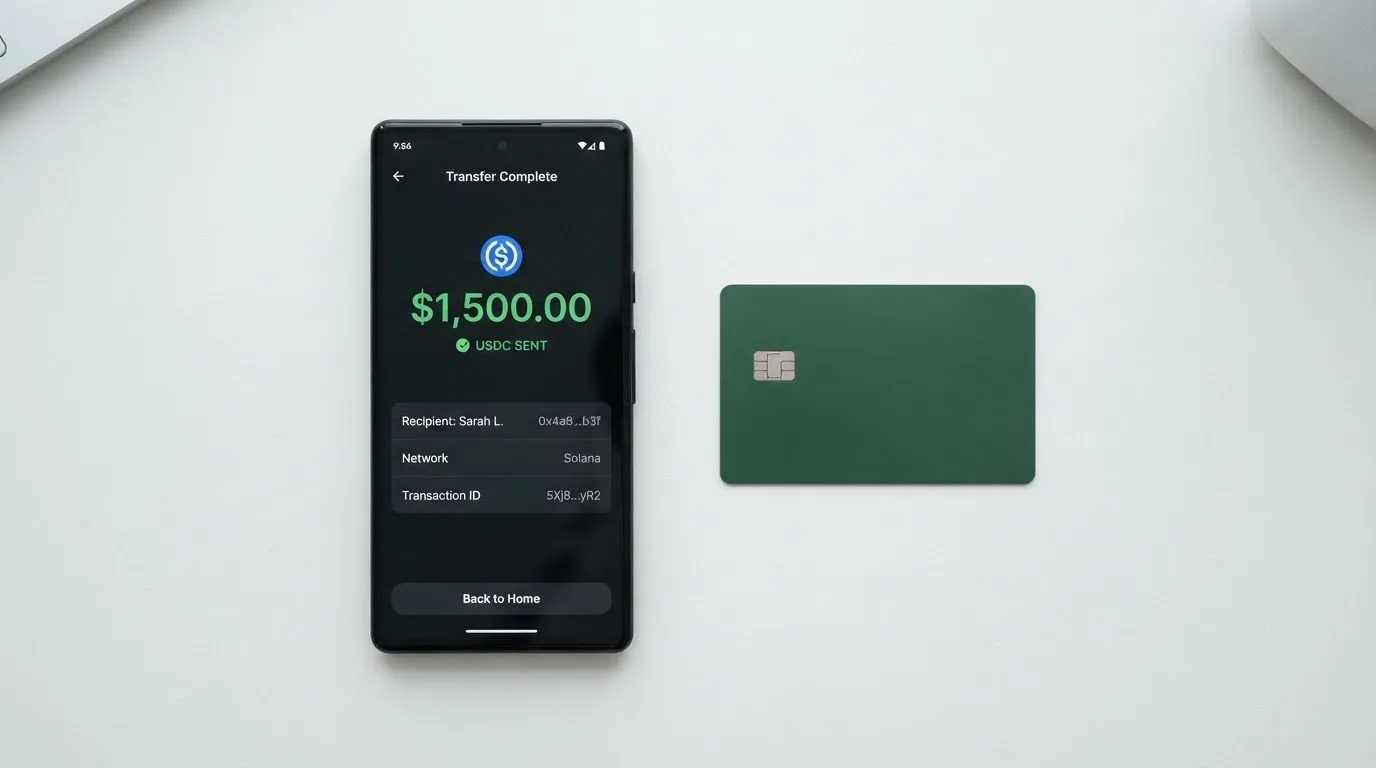
You top up with USDT from the Coinhold Wallet main account. You cannot top up by card number. The first top-up must be at least $20. The transfer normally takes three to five minutes. Who pays the blockchain network fee is not stated, and that is not a small thing when you are topping up frequently — network cost is charged by the blockchain, not by the card provider, so it comes out of your transfer rather than appearing as a card fee.
The network used for the USDT transfer is not stated anywhere on the pages I checked, and this is the single detail I would most want confirmed before sending a first deposit. Stablecoins exist on several chains — USDT has been issued on Ethereum, Tron, Solana, Polygon, Avalanche and others — and a transfer sent on a network the provider does not support, or to an address belonging to a different network, can be lost outright or need a manual support recovery with no guarantee attached. There is a second trap on Ethereum specifically: gas must be paid in ETH, so a wallet holding USDT with no ETH cannot send at all. Because the network is not disclosed, check the deposit screen in the app for the exact chain before your first transfer, and keep a small amount of the chain’s own native token available.
Two more conditions on the money side. First, the terms depend on your card plan and may change. Second, a free transfer from the card balance back to your main account is not supported — so this is not a two-way street. On closure, the remaining US dollar balance is converted to USDT and credited to your main EMCD account. The issuing bank may close the card if the balance is $20 or less, or if there is no activity for 30 days.
Paying with it every day
You manage the card in the EMCD app, where you can freeze and unfreeze it and set limits. No numeric limits are published for the free Active tier, and a help-centre article on a “Light” and “Active” tier exists with amounts I did not read.
Apple Pay and Google Pay are the intended everyday path. The FAQ says the card works with both, while the feature list on the same page marks them “Coming soon”. That conflict is unresolved. If your daily life runs on a phone wallet, treat this as untested until you have added the card yourself and made a small payment with it.
What you cannot do is take cash out. ATM withdrawals are not supported, and the card has no 3-D Secure, so merchants that require a step-up identity check for online payments will decline it. In several countries that check is mandatory for card payments, which is a blunt fact worth sitting with before you rely on this card for anything.
Categories the help centre says are blocked: fuel, ride-hailing, AI subscriptions, money transfers, crypto exchanges, gambling and brokerage, and most entertainment apart from cinemas and theatres. Fuel and ride-hailing being on that list removes a surprising amount of ordinary spending. Whether merchants can block it beyond that is not stated — merchants can decline prepaid or foreign-issued cards on their own judgement as well.
No cashback is mentioned anywhere. Your balance is custodial: the credentials are held by the provider, not by you, so the money is an amount you are owed by a company rather than a key you control. If you have read the histories — Mt. Gox, Coincheck, Ronin Network — you know what that category of risk looks like, and holding a balance with a custodian carries it. Whether this card’s funds are safeguarded or insured is not stated.
What can go wrong
Here I am working from user reports and from the card’s own pages, and I will separate those two clearly.
The two official pages disagree about what the card is. Visa Platinum on the card page, Mastercard in the help centre. Card network affects which merchants accept you, which wallets work, and how a dispute is handled.
Nobody is named. The legal entity, the registration country, the issuer and the licences are not stated on the card page. CoinInterestRate lists the network as Mastercard, the platform as Coinhold, the offerer as EMCD.io, and still does not name an issuer. You are therefore trusting a brand name and a domain rather than an institution you can look up in a register.
Accounts get blocked after verification. On Trustpilot, EMCD the company — not the card — has 190 reviews with the score hidden “due to a breach of guidelines”, 83% five-star and 11% one-star as read on 20 October 2026. EMCD says it removed fake reviews. Recurring themes across reviews from November 2025 to April 2026: accounts blocked or banned after KYC/AML review; slow KYC and document checks in November 2025; referral and welcome bonuses unpaid without KYC in November 2025; slow or missing support replies between November 2025 and March 2026. One reviewer describes being unable to add a UK phone number and getting no reply. Positive reviews cite 12% annual interest and fast payouts, and a 2025 review says it always paid. I found no complaint specific to the Coinhold card itself, no Reddit threads, and no official incidents.
That mixture is the honest picture: the service is not a catastrophe, but the failure mode people describe is exactly the one that would hurt you — verification passes or does not, and you cannot always find out why in time.
US users have been blocked since 1 May 2025 according to the review record.
There is no 3-D Secure and no ATM, which is not a risk so much as a limit, but it removes your usual fallback when a payment fails.
Transfers are one-way and networks are undisclosed, as covered above.
A closure leaves you with a conversion. On closure the balance is converted to USDT and credited to your main account — not returned as dollars — and the bank may close a card at $20 or below or after 30 days of no activity. Programme closures in this category typically follow a pattern: a notice period, then spending and loading stop, then users are asked to withdraw remaining balances. Card programmes have been shut down before, and a card that works today is not a promise about next year.
Support is a help centre at help.coinhold.io in English, Portuguese, Russian and Spanish, with “Support 24/7” in the menu and an email address in the footer. Which languages card support itself actually answers in is not stated, and given that one review theme is slow replies, I would not build a plan around the 24/7 claim.
On taxes, I will say only this much and no more: in the US the IRS treats digital assets as property, so converting crypto to dollars to pay for something is generally a taxable disposal measured at fair market value on the date of the transaction. That is a general property-tax fact, not advice about your situation — take your own advice on this.
What to take instead
If the reason you are reading this is that a bank card is hard to get, the honest comparison is not “EMCD versus nothing” — it is EMCD against other crypto cards with clearer issuers, better fee structures, or wider networks. Three alternatives scored higher in my assessment: Coinbase Card at 6.4, OKX at 6.2, and Bybit Card at 6.0. None of them is universal either.
| Card | Score | Who can get it | Card | Key costs |
|---|---|---|---|---|
| EMCD | 4.9 | Wherever Mastercard is accepted except 13 countries | Virtual only | $19/$25 issuance, $5 monthly, 1.5% top-up, 1.5% + $0.50 purchase |
| Coinbase Card | 6.4 | All US states except Hawaii; US identity rules | Visa prepaid, virtual or physical | No spending fees, no annual fees; conversion spread applies |
| OKX | 6.2 | EU plus Norway, launched 28 January 2026; Iceland and Liechtenstein excluded | Mastercard virtual debit in euro, linked to OKX Pay | No card fee; conversion spread 0.1% or 0.4% depending on source |
| Bybit Card | 6.0 | Named regional programmes; EEA customers strictly prohibited | Virtual and physical in some regions | No virtual issuance fee; FX 2% on top of network rate in some regions |
Coinbase Card is the plainest option and the most restricted. It is a Visa prepaid debit card, virtual or physical, available in all US states except Hawaii, and it spends cash or crypto with crypto converted to US dollars. It states zero spending fees and no annual fees; what you pay is the spread when Coinbase buys, sells or trades crypto, which applies at payment time. It is also the only one of the four with a physical option and a named, familiar issuer. If you are in the US outside Hawaii and your problem is a card rather than a crypto habit, this is the sensible first call.
OKX is the euro option inside the EU. A Mastercard virtual debit card denominated in euros, linked to OKX Pay, issued through an unnamed European licensed payment provider, launched 28 January 2026 for the EU plus Norway, with Iceland and Liechtenstein excluded — though one explanatory source concluded the exclusion covered the entire EEA, which contradicts the launch material. The rule is that EEA users are served by OKX Europe Ltd., the MiCAR-licensed entity. No transaction fee and no OKX FX fee; a conversion spread of 0.1% in a May 2026 explainer against 0.4% market spread in the launch release, with the explainer being the newer figure. You hold USDC or USDG in OKX Pay; other coins must be converted first, there is no auto top-up, and a payment is declined if the balance is insufficient. Cashback only on USDG purchases — USDC earns none. Worth noting the card is virtual only, like EMCD’s.
Bybit Card is the broadest but the most complicated. It runs in named regions — Argentina, AIFC (Kazakhstan), Georgia, Kazakhstan, Australia, Mexico, Brazil, Peru, Asia Pacific — and if your country of residence is not on the list, Bybit says it will register your interest. The cards page is emphatic that the product is not meant for European Economic Area customers and that all EEA participation is strictly prohibited. Card currency varies by region. Networks vary: Mastercard prepaid in Argentina, Mastercard credit card in AIFC, Georgia, Kazakhstan, Australia and Mexico as written, Visa prepaid in Brazil and Peru, Visa credit in Asia Pacific. Virtual issuance is free in all regions “until further notice”. The catch is the fee structure: a crypto conversion fee of 0.9% over the One-Click Sell rate in most regions, FX fees of 2% on top of the network rate in several, 7% in Argentina, plus Argentine taxes. And since 5 October 2026 at 10:00 UTC, only crypto-funded transactions earn points or cashback; fiat-funded spending earns nothing.
The pattern across all three alternatives is the same one that decides EMCD’s score: these cards are cheap when your spending is small, in dollars, and funded from crypto, and expensive or unusable when it is not.
Who I would recommend it to
I would recommend this card to a reader who ticks most of these boxes: you already hold USDT, you are comfortable with a custodial balance, you spend in US dollars or accept the possible 3% conversion charge, your monthly spending is modest, you do not need cash from an ATM, you do not need a card in a physical wallet, and you have verified that the network the app asks for on deposit is the one you can send on. In that situation the $5 a month plus a small percentage is a fair price for spending money you already decided to hold in crypto.
I would recommend it against if any of these apply: you are in one of the 13 listed countries; you are in the US; you need a physical card; you plan to spend more than $1,000 in one transaction; you want to withdraw cash; you need a card that works at a petrol station or in a taxi; or you want to know, in advance and in writing, which legal entity holds your money and which institution issued your card. If a card being blocked after a KYC review would strand you, choose a programme with a named issuer and a published complaints record instead.
And if your actual problem is that a bank will not give you an account at all, the honest first move is to solve that problem — with a bank or an e-money institution you can name, verify in a public register, and complain to — rather than to route your spending through an unnamed crypto programme. A card is a symptom; the account is the thing.
Frequently asked questions
What is the EMCD card?
The EMCD card is a virtual payment card tied to the Coinhold Wallet. You load it with USDT, the balance is converted into US dollars, and you spend that balance like a prepaid card. It is virtual only, with no physical version currently available, and no ATM withdrawals. The card page describes it as a virtual Visa Platinum while the help centre says Mastercard, so the network is worth confirming in your own account.
How does the EMCD card work?
You register, verify your identity with a government ID, and place an order that requires $15 of funding which stays in your balance. After your first top-up, mandatory identity verification runs and the card activates by itself. You then send USDT from your main wallet account — minimum $20 — and spend the resulting dollar balance in the app, where you can also freeze the card and set limits.
Is EMCD a bank?
The card’s own pages do not say so, and they do not name a bank, a legal entity, a registration country or a licence. EMCD is presented as a brand operating with the Coinhold Wallet. That does not by itself mean anything is wrong — many legitimate card programmes are managed by a front-end company with a licensed issuer behind it — but it does mean you cannot check the issuer against a public register from what is published.
Who owns EMCD?
The public pages name EMCD and the Coinhold Wallet but not the owning legal entity. One third-party site lists the platform as Coinhold and the offerer as EMCD.io, with Mastercard as the network, and it does not name an issuer either. Trustpilot reviews refer to EMCD as a company, with 190 reviews and the score hidden. For an unofficial picture of the company, that is as far as the material goes.
Which countries can I use the EMCD card in?
Anywhere Mastercard is accepted, with one exception list: payments are not available in Afghanistan, Belarus, Cuba, Iran, North Korea, Syria, Venezuela, Russia, Myanmar, Somalia, Ukraine, Yemen or China. The card page separately notes that some EMCD services are unavailable in certain jurisdictions without naming them, and a note in the help-centre article was previously reported to list Russia as restricted.
How do I top up the EMCD card?
Only with USDT from the main account of your Coinhold Wallet — there is no top-up by card number. The minimum first top-up is $20, the top-up fee is 1.5%, and the transfer typically takes three to five minutes. The network used is not stated on the public pages, so check the deposit screen in the app for the exact chain before your first transfer, and confirm whether network fees come out of your amount.
How much does the EMCD card cost?
Issuance is free on the Active tier, $19 for Plus and $25 for Premium, and whether those are one-off or periodic is not stated. Then there is $5 a month, a 1.5% top-up fee, 1.5% plus $0.50 per purchase, and a possible 3% bank conversion fee on non-USD purchases. Charges also apply to failures and disputes: $1.50 declined, $0.50 refund, $2.00 reversal, $35 chargeback. The card page advertises “0% fees” on Active, which the help-centre schedule does not confirm.
Can I withdraw money from an EMCD card?
No. ATM cash withdrawals are not supported, and the FAQ frames cash as something that will become available once a physical card launches — no launch date is stated. A free transfer from the card balance back to your main account is also not supported. On closure, the remaining dollar balance is converted to USDT and credited to your main account, and the bank may close a card at $20 or below or after 30 days without activity.
Is the EMCD card safe?
It is custodial, so the provider holds the credentials and you hold a claim on a company rather than control of your own key. The card does not support 3-D Secure, so merchants requiring an online identity check will decline it. Trustpilot reviews of EMCD mention accounts blocked after KYC and AML review between November 2025 and April 2026, slow support replies, and US users blocked since 1 May 2025. Whether funds are safeguarded or insured is not stated.
Is the EMCD card worth it?
Worth it if you already hold USDT, spend in dollars, keep your monthly spending modest, and need a virtual card more than a physical one — the $5 monthly plus small percentages is a fair price for that. Not worth it if you need cash, a physical card, petrol and taxi payments, or spending above $1,000 in one go. If you are in the US, the Coinbase Card states no spending fees and no annual fees, which is a stronger starting position.
Exchange cards – cryptocardchooser.com
Content created by the «cryptocardchooser.com» team