
A free virtual Visa that spends your USDC — with eligibility gaps and an ATM promise you may not get
 Available in US
Tangem Pay scores 6.9 out of 10 in my review. That middle-of-the-road number is not a hedge: it is what you get when a genuinely free virtual Visa with real cashback sits next to an eligibility list nobody publishes, cash withdrawals that may not actually work on the free tier, and a fee schedule that points you at a separate PDF for the numbers you most want to know.
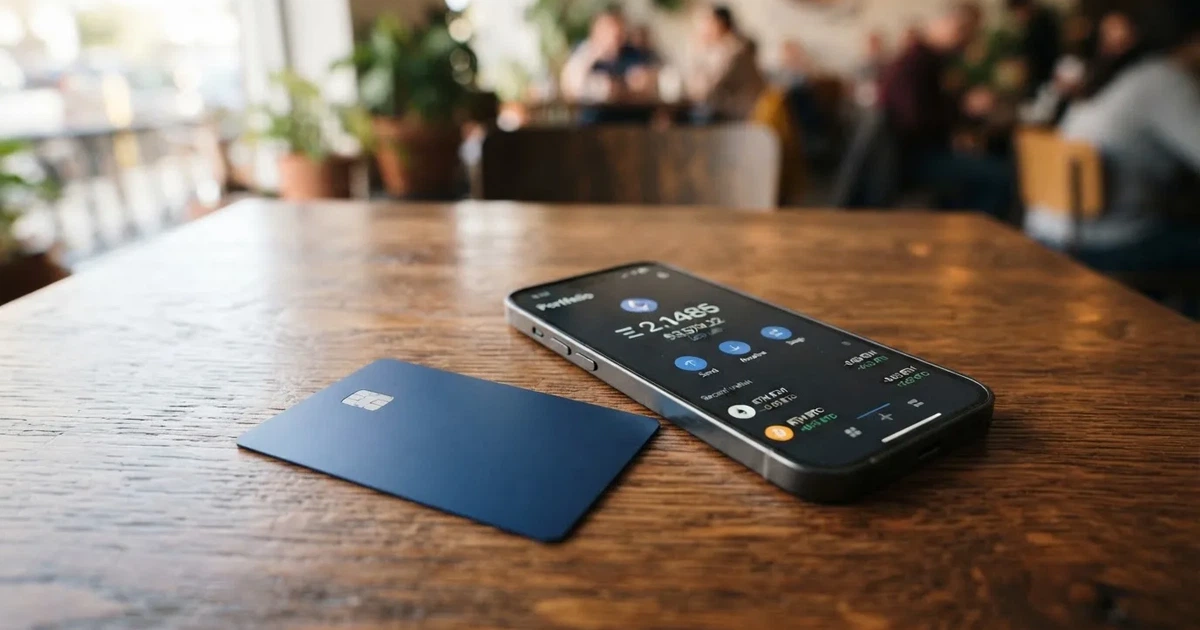
Here is who I think it suits. If you already keep your money in a Tangem Wallet, you want a card that costs nothing to hold, you only need a virtual card in your phone’s wallet, and you are willing to treat the balance as “spend it or lose it” — you will like this card. If you need a physical card in the post, if you live in the UK or the EU, if you plan to live on cash withdrawals, or if you want your crypto back out to a bank account on demand, this is not the card for you, and no amount of reading will change that.
Conditions are current as of October 28, 2026.
The score, criterion by criterion
The table below is my own scoring, broken down by the criteria I use for every card. The numbers are the ones I arrived at; the reasons are mine, in my own words.
| Criterion | Mark | Why |
|---|---|---|
| Who can get it | 7 / 10 | Available in the United States (not all states) and selected countries in Latin America, Asia-Pacific, the Middle East and Africa. The country list is not published. The UK and the EU are planned for 2026. |
| Cost | 7 / 10 | Basic is free, Plus is $29.99 a month. Transaction fee $0. Foreign exchange is the Visa exchange rate plus 1.5%. ATM is 4% on Basic. Plastic delivery is $14.53 to $82.10. |
| Top-up options | 6 / 10 | Native USDC on Polygon from any wallet, or an in-app swap; bank top-up by ACH or FedWire in some regions. One network, one coin, and the bank route is not everywhere. |
| Reliability and complaints | 7 / 10 | The card is issued by Third National, the programme is managed by Rain, the service is operated by Paera LLC, and Tangem itself is not regulated as a financial services provider. There are user reports of declines at fuel pumps and KYC lockouts after the card was issued. |
| Everyday use | 7 / 10 | Basic is virtual, Plus is plastic, Apple Pay and Google Pay work from the card details. ATM is 4% on Basic and 2% on Plus. Unconfirmed third-party reporting says withdrawals are not yet available in practice and physical cards are not widely issued. |
| Total | 6.9 / 10 | Free to hold and genuinely useful if you spend from a stablecoin balance, with real friction around eligibility, cash and plastic. |
Two words on how to read this. The 7s are not faint praise — several of these criteria are genuinely good for the kind of person this card is built for. The 6.9 is a total, and the total is dragged down by the one place where the card’s usefulness collapses: if you need physical cash or a bank-linked refund path, the free tier does not really have it.
Will they give you the card
Short answer: probably yes if you live in the United States outside a handful of states or in one of several regions, but you cannot tell from the public pages, and only the app will tell you.
The card’s own wording is that “Eligibility is determined based on your country and region of residence”, and that check happens inside the app during onboarding. That is the honest position — the decision is made case by case, in the app, after you start. What is published is the shape of the map: available in the U.S. (not all states) and in select countries across Latin America, Asia-Pacific, the Middle East and Africa. The widest claim anywhere is that the card works at “Visa-accepting merchants in over 150 countries”.
That last number is about where you can *spend*, not where you can *sign up*, and those two are constantly confused. Being able to pay somewhere tells you nothing about whether you can open the account.
The card’s public pages do not publish the country list. What I can tell you is this, and it is third-party information I could not confirm with Tangem: a list circulated by crypto card comparison sites names 31 countries where it is reported to be available, including Argentina, Australia, Brazil, Chile, Colombia, Costa Rica, the Dominican Republic, Ecuador, El Salvador, Guatemala, Hong Kong, Japan, Mexico, New Zealand, Panama, Paraguay, Peru, the Philippines, Singapore, South Africa, Trinidad and Tobago, the United Arab Emirates and Uruguay. The same source reports the UK, Andorra and the EU states as restricted. Treat all of that as a rumour with a source attached, not as a guarantee — the app is the only authority.
One more thing worth knowing before you invest time. Tangem says physical card shipping covers nearly 200 countries except about 20, including China, Russia, North Korea and Palestine. That figure comes from press coverage of a Tangem statement, and I could not confirm the date or the full list. If you are outside the covered area, the virtual card is the part you can count on.
Who is left out, and it is not only geography
There are three ways to be ineligible that have nothing to do with where you live, and all three are worth weighing before you download anything.
- The country of residence. Decided in the app, and not published in advance.
- The document you hold. Nationality is screened separately from residence, because sanctions screening and issuer risk policy apply to citizenship and country of birth as well as address. An ID from a restricted region can block an application even from a supported country.
- The verification level you reach. Limits depend on your “risk profile, verification level, and account history”. The levels themselves are not named, so you cannot know in advance what a successful check unlocks.
How to get it
It is a Visa, applied for inside the Tangem app, and the identity check is real. The card’s own description: “ID verification and eligibility checks”. What documents are required, whether proof of address is needed, and what age applies — the public pages do not say.
What I can tell you is the shape of it. The check is run by Sumsub, a government ID and face verification, and takes two minutes. That applies to the Pay account only, not to your Tangem Wallet — the wallet itself is the non-custodial part of the product. After the check passes, your limits are set according to your risk profile, verification level and account history.
The tiers, which matter because everything else in this review depends on which one you pick:
| Tier | Card | Format | What you get |
|---|---|---|---|
| Basic | Visa Platinum | Virtual | Free. 3 cards. ATM 4%. Cashback 1%, capped at $100 a month. |
| Plus | Visa Signature | Plastic | $29.99 a month. 5 cards. ATM 2%. Cashback 2%, capped at $300. Extended warranty, price protection, purchase protection, auto rental insurance, Visa Luxury Hotels, two free lounge visits a year (coming soon). |
| Prestige | Visa Infinite | Virtual, plastic, metal | “Coming soon”; shown as $83 a month or $999 as a single yearly payment. 10 cards. ATM 1%. Cashback 4%, capped at $1,000. Metal card, 8 lounge visits a year, baggage delay and loss insurance. |
Note the shape of that table. The tier you can actually use today is the free one, and the tier with the interesting extras — metal, 1% ATM, 4% cashback — is not yet live.
On physical cards: the delivery fee is $14.53 to $82.10 depending on the address, shown in the app when you order. The first physical card issues for $0. An additional virtual card costs $5, a replacement $1. Delivery time and the shipping country list are not stated. Unconfirmed third-party reporting describes the live format as a virtual Visa only, with most cards issued within five minutes and manual review taking up to 48 hours, and Tangem press coverage putting the first physical batch at a cap of 5,000 cards. That is the shape of a programme in rollout.
Fees: what it really costs
The Basic plan is free and the transaction fee is $0, which is the headline. The costs that bite are in three places: currency conversion, cash withdrawal, and the fee for getting plastic in the mail.

| Fee or limit | Basic | Plus | Prestige |
|---|---|---|---|
| Plan fee | $0 | $29.99 / month | $999 / year (shown also as $83 / month) |
| First physical card, issuing fee | $0 | $0 | Not stated |
| Additional virtual card | $5 | $5 | $5 |
| Replacement card | $1 | $1 | $1 |
| Physical delivery | $14.53 – $82.10 | $14.53 – $82.10 | $14.53 – $82.10 |
| Transaction fee | $0 | $0 | $0 |
| Foreign exchange (non-USD) | Visa exchange rate + 1.5% | Visa exchange rate + 1.5% | Visa exchange rate + 1.5% |
| ATM fee | 4% | 2% | 1% |
| Bank top-up via ACH | $1 | $0 | Not stated |
| Bank top-up via FedWire | $10 (Basic, per the fees listing) | $0 | Not stated |
| Bank withdrawal via ACH | $1 | $1 | Not stated |
| Bank withdrawal via FedWire | $11 | $11 | Not stated |
| On-chain withdrawal | $0 | $0 | $0 |
| Dispute fee | $30 | $30 | $30 |
| Daily POS spend per card | $10,000 | $50,000 | $100,000 |
| Cards per user | 3 | 5 | 10 |
| Annual limit per card | $10,000,000 | $10,000,000 | $10,000,000 |
| Transactions per day / month | 100 / 1000 | 100 / 1000 | 100 / 1000 |
| Monthly spend limit | Not stated | Not stated | Not stated |
Two honest gaps. The crypto conversion fee is not stated — the page refers you to a separate tariffs PDF, and that PDF still leaves the number off. And the free ATM allowance is not stated, if there is one.
The PDF is dated as applicable from September 2026, though its title reads as an earlier date. Small thing, but it tells you the fee sheet is being revised as the product changes, which is a reason to look at the current version rather than trust a figure you read six months ago.
The card is USD-denominated and purchases convert 1:1 to USD. Multi-currency balances are not supported on the evidence I can see.
Three ordinary payments, priced
Let’s take something you do every week rather than something dramatic.
A $30 lunch in your own country, on Basic. The Basic plan is free and the transaction fee is $0. USDC converts 1:1 to USD. Net cost: $30, minus 1% cashback, so $29.70 back. There is a monthly cashback cap of $100, so this is nowhere near it.
A €40 dinner abroad, on Basic. Here the 1.5% lands on top of whatever Visa’s rate is on the day. On €40 that is €0.60 in the fee, plus the difference between the Visa rate and what your money is actually worth. Cashback still applies at 1%, so €39.60 back. The exchange-rate line is the one that actually costs you money, and it is the one to watch in a month when the euro moves.
$60 in cash from an ATM, on Basic. Four percent, so $2.40. Then subtract $60 from a balance that is gone either way. Unconfirmed third-party reporting says cash withdrawal is “not available” at Basic in practice, so treat this as a scenario rather than something to plan around. On Plus the same $60 costs $1.20 — which is what the $29.99 a month is arguably buying, if you take out more than about $1,000 a month in cash at 4% versus 2%. Do the division yourself before you pay.
The category-wide point that applies to every card in this space: network gas fees on your deposit are charged by the blockchain, not by the card provider. Your $5 top-up costs a few cents on Polygon, but it is still your cost and it still has to be in the currency the network uses.
How to top it up
Two routes, and only two. “Stablecoins or directly from your bank account”, the card says. The specifics are clearer in the fee document: funding is native USDC on the Polygon network, from any wallet that supports it, or an in-app swap; and a bank-details route exists by ACH or FedWire where the jurisdiction allows it. The minimum top-up is not stated.
Two things to be careful about, and the second one is the one that catches people.
First, “native USDC on Polygon” is narrower than it sounds. It is one token on one network. If your USDC lives on Ethereum, or your balance is in USDT, or you hold on Solana, you are looking at a bridge, a swap, or both — and each of those has a fee, a delay and a failure mode. Sending the wrong network’s USDC to an address is the classic irreversible loss in this whole category.
Second, the Polygon gas token is paid by you, to the network. Not a rounding error, but not free either, and you need a little native token in the wallet before you send anything. A wallet holding USDC and no gas token cannot move the USDC.
On the bank route, availability varies by jurisdiction, so this is not something to rely on in planning. On-chain withdrawal is $0. The bank off-ramp is $1 by ACH or $11 by FedWire on both Basic and Plus. The remaining balance “stays in the account you control” — it is in a smart contract — and the closure procedure for an account is not stated.
What this means practically: the cheap, clean route is USDC on Polygon into the app, and the awkward routes are everything else.
Paying with it every day
Everyday use is where this card is at its best, provided you stay in the ordinary lane.
Apple Pay and Google Pay work by adding the card details from the app to your phone’s wallet. The card’s public pages do not state whether the card can be tokenised in other ways, and the list of blocked merchant categories is not published either. Third-party reporting names gambling, online casinos and liquor stores among the blocked categories, and adds “and others” — the full list was not readable.
Cashback is the reason many people would stay on Basic. Ongoing cashback is 1% on Basic, 2% on Plus, 4% on Prestige, with monthly caps of $100, $300 and $1,000. Boosted rates of 5%, 10% and 15% on the first $500 are marked “coming soon”, as is a welcome bonus “up to $75”. What currency cashback is paid in is not stated, so if you spend in euros the value to you depends on that unstated detail.
Two further costs that only appear when something goes wrong: a dispute costs $30, and the dispute timeframes are not stated. That is a fee to know about before you need it, not after.
The app itself is a reasonable comfort. Tangem’s app on iOS 16.4+ and Android carries a 4.9/5 rating from 25K ratings in the App Store — though read that carefully, because it covers the whole wallet app, not the Pay feature specifically. Tangem Pay requires app version 5.35 or later.
Two limits that will not bite most people but are worth knowing: three ATMs per 24 hours, and $250 per withdrawal, on the ATM route.
What can go wrong
This is the section I would read twice, because the failures here are not exotic.
Declines at the pump and in restaurants. A secondary aggregator summarising user reports — Reddit-based, not verified by me — describes declines at fuel pumps, hotels and restaurants, in the context of pre-authorisation holds, and mentions a $175 hold at a fuel pump. Pre-authorisation holds are the ordinary mechanism here: a hotel or a filling station places a hold, and a declined authorisation can leave a hold on funds for several days. On a pre-loaded balance model, that money is simply not spendable while it sits there.
KYC lockouts after the card is already issued. The same unverified source reports accounts being locked at the KYC stage after a card had been issued, and activation problems where support asked for a video proof. This is the pattern I find most unsettling, because it lands after you have already committed money.
The ATM promise versus the ATM reality. The advertised 4% / 2% / 1% is real as a published rate. Third-party reporting from August 2026 says withdrawals are “not available” at Basic in practice, and that higher tiers advertise ATM pricing that is not yet live. If cash is part of your plan, this is the single thing to verify in the app before you rely on it.
Plastic that has not shipped yet. Also third-party and unconfirmed: physical cards are not generally available, the first batch was capped at 5,000 cards. The Plus plan at $29.99 a month sells you a tier whose centrepiece is a plastic card that may not yet reach you.
The company structure, which is not a reassurance so much as a map. Third National issues the Visa. Rain manages the programme and is described as a Visa Principal Member. Paera LLC operates the service and handles onboarding, KYC and AML. Tangem AG, the non-custodial wallet maker, is the brand on the app and is explicitly *not* regulated as a financial services provider. Tangem says it “does not hold, custody, or control users’ assets”. The card’s own page names Rain as issuer while newer announcements name Third National — that inconsistency is a small thing, but it tells you the programme is still settling.
This structure is not automatically bad. It is how most crypto cards are built: the crypto brand is a programme manager or front-end, the network is Visa or Mastercard, and the issuer is a licensed institution. What it does mean is that there are more parties who can stop your spending than there would be with a plain bank account.
Where Tangem is clear, and that is a genuine strength. The Pay account is non-custodial inside the wallet app: the USDC “sits in a smart contract you control”. Freezing the card disconnects it from Visa but does not touch the on-chain balance. Identity verification is run by Sumsub, and Tangem says it does not see the identity data. Transaction monitoring is by Elliptic. What is not stated anywhere: whether the balance is insured. Do not read “non-custodial” as “protected” — they are different words answering different questions.
Support exists. There is a Help Center and online support “available 24 hours a day, 7 days a week”, plus community channels on Reddit, Telegram and Discord. The site languages include English, Deutsch, Français, Español, Português, Türkçe, Chinese, Korean, Japanese and Ukrainian — there is no Russian in that list, which matters if that is your first language. Third-party reporting indicates Paera handles Pay account questions, so your first line of support is not obviously the wallet team you already know.
Where it went wrong for people, in the category as a whole. Visa terminated its agreements with FTX on 13 November 2022 and the FTX US debit card was wound down. WaveCrest, a Visa issuer that supplied crypto card brands, was suspended by Visa in Europe in 2018, closing all of its Visa programmes. Programme closures typically mean a notice period, then spending and loading stop, then you are asked to withdraw. One 2026 closure reported by a secondary source had new loads ending 8 July 2026 and spending stopping 8 August 2026 — a single unconfirmed source, and I include it only to show the shape of the risk, not as a fact about Tangem.
Taxes, briefly and without advice. The IRS treats digital assets as property, so exchanging them for goods, services or dollars generally produces a taxable gain or loss, measured in local fiat currency at fair market value on the date of the transaction. Each card payment funded from crypto may therefore be a separate disposal. I am not qualified to advise you and this is not tax advice — but if you will be spending meaningfully, ask someone who is.
What to take instead
I want to be clear about the comparison: these are different products with different strengths, not worse versions of the same thing. Here is where each one beats Tangem Pay.
| Tangem Pay | MetaMask | KAST | Zeal | |
|---|---|---|---|---|
| Score | 6.9 / 10 | 7.1 / 10 | 6.1 / 10 | 6.1 / 10 |
| Network | Visa | Mastercard | Visa | Visa |
| Free tier | Yes, virtual | Yes, virtual | Yes, Standard | Not stated |
| Where you can sign up | U.S. (not all states), selected LATAM/APAC/MEA/Africa; list not published | 45 listed countries/territories; US and UK sign-ups temporarily closed | Residence-based, list shown at KYC but not published | Card programme live in EU, UK, Brazil, Colombia, Mexico, Japan, Singapore, Philippines, Indonesia, Thailand |
| Card currency | USD | Not stated | USD | EUR, USD, GBP |
| Cashback | 1% Basic, cap $100/month | 1% Virtual in mUSD; Metal headline 3%, footnote limits 3% to the first $10,000 then 1% | 1.5% / 2% / 3% USD on capped monthly spend | Up to 4% cashback in GNO, must hold GNO in the card Safe |
| Non-USD FX | Visa rate + 1.5% | No additional MetaMask fee; Mastercard rate | 0.5% – 1.75% depending on residence and programme; 0.10 USD on non-USD transactions under 25 USD | No additional FX fee; Visa wholesale rate |
| ATM | 4% Basic / 2% Plus; availability unconfirmed | Not stated on pages read | Not stated | Gnosis Pay fees may apply |
| Other fees | $1 ACH onramp, $10 FedWire onramp; $30 dispute | “Minimal fee for each transaction”, amount not stated | Inactivity 1 USD/month after 12 months; declined transaction 0.50 USD | Not published on zeal.app or the App Store |
| Notable | Non-custodial USDC on Polygon you control | Nine tokens named; networks Linea, Base, Monad, Solana | Up to 10 cards, stablecoin deposits converted 1:1 with 0% spread | Balances live in a card Safe on Gnosis Chain and Celo |
Choose MetaMask if you want the widest published sign-up list and a card that spends directly from a connected wallet rather than from a pre-loaded balance. Its virtual card is free with no annual or maintenance fee, and it names nine supported tokens across four networks. The catch is that the listing is not stable — US and UK sign-ups are currently closed — and the Metal card costs $199 a year. Its cashback footnote is worth reading twice: 3% applies to the first $10,000 spent, then it drops to 1%.
Choose KAST if you want the lowest non-USD FX cost in this group. Its fees are unusually explicit: 0% stablecoin top-up, 0% card spend in USD, 0% transaction fee, 0% Apple and Google Pay, and an FX fee of 0.5% to 1.75%. It also supports up to 10 cards per user. The prices are the trade-off — Premium is 1,000 USD a year and Private is 10,000 USD a year, billed annually upfront. Its eligibility rules are also stricter and more publicly explained: if your country is not listed you are not eligible, and holding only an ID from a restricted region can disqualify you even when you live in a supported country. A VPN does not bypass KYC.
Choose Zeal if you are in a region where its card programme is actually live, or if you hold GNO. It charges no additional FX fee beyond the Visa wholesale rate, it works in EUR, USD and GBP, and it pays cashback in GNO — up to 4% — which only qualifies if you keep GNO in the card Safe. It does not publish a fee schedule at all, and physical cards are not mentioned, so you are buying on trust.
Who I would recommend it to
Yes, if you are already inside the Tangem Wallet ecosystem and want a free virtual Visa to spend from a USDC balance without touching a bank. You want Apple Pay or Google Pay. You spend in USD or you are comfortable with a 1.5% foreign-exchange surcharge on top of Visa’s rate. You are happy with 1% cashback capped at $100 a month. You accept that eligibility is decided in the app and that the country list is not something you can read in advance. And you treat the loaded balance as money you are spending, not money you are saving.
No, if any of these are true:
- You need a physical card in the post. That part of the product is still in rollout.
- You live in the UK or the EU. Planned for 2026, not available now.
- Cash withdrawals are part of your life. The advertised rate is one thing, third-party reports say it is not live at Basic, and there is no free allowance stated.
- You are outside the US and the listed LATAM, APAC, MEA and Africa regions and cannot verify your eligibility before committing.
- You want to hold a balance and take it out later on demand. The account closure procedure is not stated, and bank off-ramp costs $1 by ACH or $11 by FedWire.
- You want the crypto conversion rate published. It is not on the page; the fee sheet points to a separate PDF.
- You want to know your balance is insured. Insurance of funds is not stated anywhere I could read.
The honest summary is that this is a well-built, unusually free card for one specific profile of person, wrapped in a rollout that has not finished. If you are that person, the free tier costs you nothing to try. If you are anyone else, one of the alternatives above will serve you better today.
Frequently asked questions
What is the Tangem Pay card?
Tangem Pay is a Visa payment card you hold inside the Tangem Wallet app, spending a stablecoin balance rather than a bank account. Your USDC sits in a smart contract you control rather than with a company. It comes in three tiers: Basic, free with a virtual card; Plus at $29.99 a month with plastic; and Prestige, marked “coming soon”. Visa routes the payments, a licensed issuer holds the programme.
Is Tangem Pay a bank, and who actually runs it?
No, it is not a bank, and Tangem is explicit that it “does not hold, custody, or control users’ assets” and “is not regulated as a financial services provider”. Third National issues the Visa card, Rain manages the programme and is described as a Visa Principal Member, and Paera LLC operates the service, handling onboarding, KYC and AML. Tangem AG is the non-custodial wallet maker behind the brand.
Is Tangem Pay available in my country?
Possibly, and you cannot find out from the public pages — the country list is not published. The card says eligibility is based on your country and region of residence, shown in the app during onboarding, and it is available in the US (not all states) and selected countries in Latin America, Asia-Pacific, the Middle East and Africa. Third-party lists name 31 countries as available but are unconfirmed. The UK and EU are planned for 2026.
Does Tangem Pay require KYC, and how long does it take?
Yes. Tangem describes “ID verification and eligibility checks” run through Sumsub, covering government ID and face verification, taking two minutes. The check applies to the Pay account only, not to your wallet. The public pages do not state which documents, whether proof of address is required, or what age applies. Your limits then depend on your risk profile, verification level and account history.
How much does Tangem Pay cost?
Basic is free and Plus is $29.99 a month; Prestige is shown as $999 a year. The transaction fee is $0 and USDC converts 1:1 to USD. The costs to watch: 1.5% on top of Visa’s exchange rate for non-USD purchases, 4% ATM on Basic and 2% on Plus, $14.53 to $82.10 for plastic delivery, $5 per additional virtual card, $1 for a replacement, and a $30 dispute fee.
Can I use the card at ATMs?
The advertised rate is 4% on Basic, 2% on Plus and 1% on Prestige, with a maximum of three withdrawals per 24 hours and $250 each. However, third-party reporting from August 2026 says withdrawals are “not available” at Basic in practice and that higher tiers advertise pricing that is not live. No free allowance is stated. Check the app before you build any cash plan around this.
How do I top up the card?
Two ways: native USDC on the Polygon network from any wallet that supports it, or an in-app swap; and a bank top-up by ACH or FedWire in some regions. On-chain withdrawal is $0 and transaction fees are $0, but Polygon gas is paid by you to the network, so you need a little native token in your wallet first. ACH onramp is $1 on Basic and $0 on Plus; FedWire is $10 on Basic and $0 on Plus.
Can I add it to Apple Pay or Google Pay?
Yes — you add the card using the card details shown in the app, which is the standard way to tokenise a card into a phone wallet. Some merchant categories are blocked, including gambling, online casinos and liquor stores, though the full list is not published. One limit worth knowing: declines can leave a hold on your balance for several days, which is why reports of problems at fuel pumps and hotels keep appearing.
Is the Tangem Pay card safe for my money?
The card is non-custodial: your USDC sits in a smart contract you control, and freezing the card in the app disconnects it from Visa without touching the on-chain balance. Identity verification runs through Sumsub, which Tangem says does not share the identity data with it, and transaction monitoring is by Elliptic. What is not stated anywhere is whether the balance is insured — “non-custodial” answers who holds the keys, not who stands behind the money.
How do I withdraw money or close the account?
On-chain withdrawal is $0. A bank off-ramp costs $1 by ACH or $11 by FedWire on both Basic and Plus. The remaining balance “stays in the account you control” in the smart contract, but the closure procedure for a Tangem Pay account is not stated on the public pages. If closing it is part of your plan, that gap is worth raising with support before you load money.
Wallet cards – cryptocardchooser.com
Content created by the «cryptocardchooser.com» team