
How the Exodus card holds up in everyday use
 Available in US
The Exodus card is a debit card that draws from a self-custody crypto balance, issued by Monavate Ltd and program-managed by Baanx, both acquired by Exodus Movement on 1 May 2026. It looks straightforward on paper: zero annual fee on the Free tier, a Metal tier with cashback, and direct spending from USDT or USDC held in your own wallet. In practice, the picture is more uneven. New US card issuance is not open right now, the issuer reportedly cannot onboard new European customers, and the company has gone through a 25% workforce cut. A card from a self-custody wallet is a genuinely interesting idea, but right now the everyday experience has rough edges you should know about before applying.
The conditions described here are current as of October 28, 2026.
Verdict
Exodus comes out at 6.8 out of 10 — a middling score for a card with a strong concept (spend directly from your own crypto wallet) that has been hit by a string of operational changes over the past year. It suits people who already live inside the Exodus wallet, want to keep their own keys, and only need a card for the basics: shops, online, occasional ATM. It is a poor fit if you are not in one of the supported countries, if you need new US issuance today, or if a card that has just changed issuer and shrunk its staff worries you.
Score breakdown
| Criterion | Mark | Why |
|---|---|---|
| Who can get it | 7 / 10 | Card is supported in 42 countries across Europe, Canada, the United States (except Vermont), Mexico, Brazil, Argentina, Colombia and others; new US card issuance is not open, and the issuer reportedly cannot take new European customers. |
| Cost | 7 / 10 | Free tier costs $0 a year; cross-border use on Free is 1%, ATM withdrawals 2%, and a stablecoin in a non-cardholder currency carries 0.5%; Metal is $199 a year. |
| Top-up options | 9 / 10 | USDT and USDC across multiple networks (USDC on Solana, Ethereum, Arbitrum One, Base, BNB Smart Chain, Polygon; USDT on Arbitrum One, Solana, Ethereum, BNB Smart Chain, Polygon), plus debit card and Apple Pay. |
| Reliability and complaints | 5 / 10 | Issuer Monavate Ltd is FCA-authorised; both issuer and program manager were bought by Exodus on 1 May 2026; reports that Monavate cannot issue to new European clients; 25% workforce cut; Trustpilot score 4/5 from thousands of reviews. |
| Everyday use | 6 / 10 | Virtual and physical Metal card; ATM at 2%; Apple Pay described for top-up; wallets for paying with the card are not disclosed; the card does not currently support a PIN. |
The audience that fits best is Exodus wallet users in Europe and Latin America who want a card for routine spending without giving up control of their crypto. If that is not you, the alternatives below may suit you better.
Who will they give you the card
The headline is that the card is supported in 42 countries. The full list, as the card states it, is: Andorra, Argentina, Austria, Belgium, Bosnia and Herzegovina, Brazil, Bulgaria, Canada, Colombia, Croatia, Cyprus, Denmark, Finland, France, Germany, Gibraltar, Greece, Guatemala, Hungary, Iceland, Ireland, Isle of Man, Italy, Jersey, Liechtenstein, Lithuania, Luxembourg, Malta, Mexico, Netherlands, Niger, Norway, Poland, Portugal, Romania, Slovakia, Slovenia, Spain, Sweden, Switzerland, USA (excluding Vermont), Uruguay.
That sounds wide until you read the small print. Right now, new US card issuance is not open. Reports from Q2 2026 say the issuer cannot take on new European customers either, after a Bank of Lithuania inspection of Monavate UAB in late 2025. So while the country list is long, the door is narrower in practice.
If you already have a legacy Spend Card from before the change, you are migrated without re-verification. New applicants go through identity checks (see the next section) and are bound by the current country rules.
A few things the card pages do not spell out clearly: whether the card is a credit or debit product (it is a debit card usable wherever Mastercard is accepted, but the exact product line is not stated on the public pages); which card tier you qualify for from a given country; and whether nationality, dual citizenship or residency permit type matters beyond the address you live at. The card is a debit card, not a credit card, usable wherever Mastercard is accepted; it is offered as a virtual card and a physical Metal card. The issuer is Monavate Ltd, an FCA-authorised e-money institution, and the program manager is Baanx, both now owned by Exodus Movement.
How to get it
Signing up is a standard KYC path. You need a phone number that receives a code by WhatsApp or SMS, then email verification, then an ID check inside the app. The card itself requires identity verification, and the same checks cover cash deposits and redeeming points. Former Spend Card users do not have to re-verify.
The newer help articles describe this process in general terms but do not state which ID documents are accepted, what the processing times are, or what reasons can lead to a rejection. That lack of detail is worth noting if your documents are unusual in any way.
For the card itself:
- Type. Debit (not credit), usable wherever Mastercard is accepted; virtual and physical (Metal) cards; issued by Monavate Ltd (FCA-authorised e-money issuer); program manager Baanx (per EU+UK terms).
- Delivery. The Metal card is on a waitlist and expected 6–8 weeks after purchase. The Free tier physical card replacement: n/a. Metal replacement fee is $99. The virtual card is available alongside the physical one.
Because the product is a debit card that draws from a stored balance, the issuer is essentially an electronic money institution rather than a bank. That is the standard structure for crypto cards in Europe, and it determines a lot about how complaints and disputes get handled.
Fees: what it really costs
The headline price is good: $0 a year on Free, $199 a year on Metal. The real question is what gets added on top.

Cost summary
| Fee or limit | Free tier | Metal tier |
|---|---|---|
| Annual fee | $0 | $199 (auto-renews; cancel within 14 days for refund) |
| Cross-border use (Free 1%, Metal 0% with fair use) | 1% | None (fair usage) |
| ATM withdrawal fee | 2% (operator may add their own fee) | None up to $1,200/month, then 2% |
| ATM withdrawal limit | $1,000/day | $1,000/tx, $5,000/day |
| Per-transaction card limit | $10,000 | $20,000 |
| Daily card purchase limit | $9,500 globally / $15,000 in the United States | $30,000 |
| Foreign currency conversion | Converted from USD at the card network and payment processor rate at time of purchase (amount not stated) | Mastercard wholesale rate, no extra Exodus/Baanx conversion fee |
| Stablecoin in non-cardholder currency | 0.5% | 0.5% |
| Other crypto (e.g. wETH) | 0.875% | 0.875% |
| DeFi / yield tokens | None up to $1,200/month, then 0.5% | None up to $1,200/month, then 0.5% |
| Card replacement (Metal) | n/a | $99 |
A few details that matter in everyday use:
- The card is denominated in local currency for non-US cardholders and in USD for US cardholders. That means a eurozone user has a card in euros and a US user has one in dollars.
- Mastercard converts at its wholesale rate for cross-currency spend, and the terms say “Neither Baanx nor Exodus will charge an additional currency conversion fee” — so on Metal, the rate is Mastercard’s. On Free, the help article says other currencies are converted from USD at the network and processor rate, but the exact fee amount is not stated.
- For UK customers specifically, the terms also state £1,000 per ATM withdrawal and £10,000 per purchase / £15,000 per day, which is roughly in line with the dollar limits above.
Let me walk through three everyday situations to make this less abstract.
Situation 1: coffee in your own country. A €4 espresso in Spain, paid on a Spanish merchant, billed in euros. The conversion fee does not apply (euros to euros), the cross-border 1% on Free does not apply (same country), and the FX conversion line is irrelevant. This is the cleanest case: you should only pay the network’s merchant fee, if any.
Situation 2: shopping online from a US website in dollars. A €50 order paid in USD with a euro-denominated card. Mastercard converts the dollars to euros at its wholesale rate. On Free, the help article says “converted from USD at the card network and payment processor rate at time of purchase”, with the fee amount not stated. On Metal, the terms say “Neither Baanx nor Exodus will charge an additional currency conversion fee”. Practically, expect the wholesale rate plus a small margin that is hard to pin down from the public pages.
Situation 3: paying for a hotel in a third country. Say a Spanish cardholder paying in Thai baht in Bangkok. The card is denominated in euros, the merchant is outside the cardholder’s country, and the currency is neither euros nor the local merchant currency. You have the cross-border 1% on Free (none on Metal with fair use), then the wholesale FX conversion, and a stablecoin top-up in a non-cardholder currency adds 0.5% on both tiers. This is where Metal’s no-cross-border-fee structure can pay off — but only if you spend enough to justify the $199 a year.
One more thing the terms do not spell out clearly: how the conversion interacts with the on-chain side. The on-chain deposit itself is “no fee (no min. balance)” per the terms, with network gas small and variable (typically $0.01). So the chain side is cheap; the card side is where the real cost lives.
Top up: how to fund the card
Top-up is where the card stands out — it earned 9/10 on this in the score breakdown, and for good reason. You can fund the balance with two of the most-used stablecoins on five networks each, plus debit card and Apple Pay on iOS.
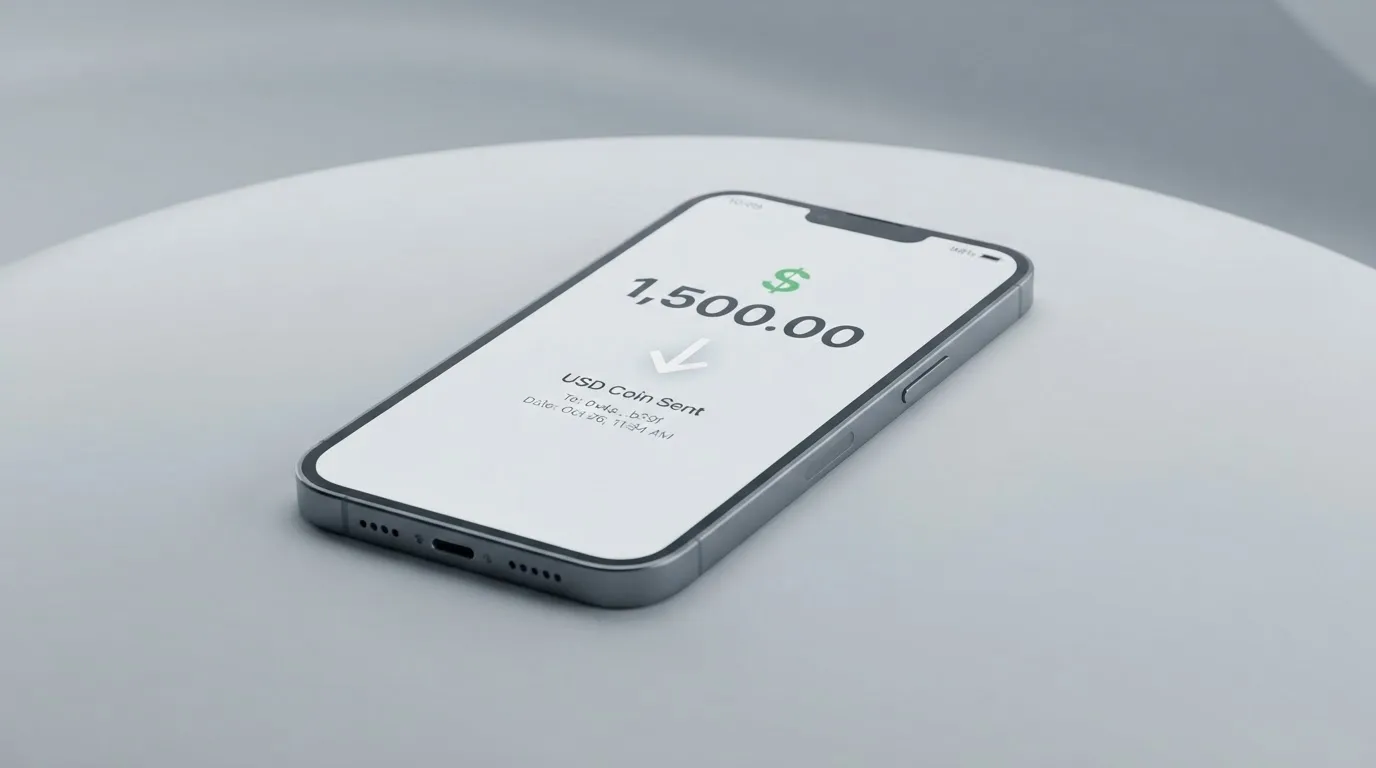
The card draws from your Exodus Pay balance on Solana in this order: USDT, then USDC, then XO Cash. A purchase must be covered by a single asset, not split across two. So if your Pay balance is in USDC and not enough for the bill, it will not top up with USDT mid-transaction — the payment will be declined.
Supported deposits:
- USDC on Solana, Ethereum, Arbitrum One, Base, BNB Smart Chain, Polygon
- USDT on Arbitrum One, Solana, Ethereum, BNB Smart Chain, Polygon
- Debit card and Apple Pay (iOS) to add money
Deposit fees:
- Stablecoin in a currency matching the cardholder or merchant country: no fee (no minimum balance)
- Stablecoin in a currency that is not the cardholder or merchant currency: 0.5%
- DeFi / yield tokens: no fee up to $1,200/month, then 0.5%
- Other cryptocurrencies (e.g. wETH): 0.875%
- Network gas: small and variable, typically about $0.01
Two practical things to keep in mind when funding the card:
- Pick the right network. The card provider does not support every chain USDC or USDT is issued on. Circle, for example, stopped supporting USDC on Tron in February 2024, and USDC on TRC-20 is not a native option here either. If you send on a chain the card does not support, the deposit may be lost, and recovery is manual support with no guarantee.
- The card holds the balance, not a credit line. This is a self-custody model in the sense that your crypto stays in your own wallet until the moment of payment. You do not withdraw from the card per se; refunds are credited to the Card Account (and may be unavailable for up to five days). On closing the Card Account, you can request a check of the remaining balance for a fee.
For users who already hold USDT or USDC on one of the supported networks, the top-up flow is straightforward: send to the deposit address, wait for confirmations, see the balance in the app, then spend.
Paying with it every day
Once the balance is funded, the card behaves like any other debit card. The wallet side, however, has its own quirks worth knowing.
What works:
- Virtual and physical (Metal) cards, both usable wherever Mastercard is accepted.
- Apple Pay on iOS for adding money.
- 3% cashback on Metal for the first $10,000 spent per year, then 1% — paid in a way the terms do not state precisely.
- A specific regional offer for Argentina, Brazil, Mexico, Colombia and Uruguay: from 1 July 2026, cardholders there can pay DGO and SKY+ subscriptions, and new customers in those markets could get a 25% cashback offer subject to terms. The general cashback rate beyond that is not stated.
What is missing or unclear:
- The card does not currently support a PIN. At terminals that ask for a PIN, the user may be able to confirm without one. That is fine for contactless and chip-and-signature, but it can cause friction at unattended terminals (parking machines, fuel pumps, ticket kiosks) that require a PIN.
- Wallets for paying with the card (Apple Pay, Google Pay, Garmin Pay and so on) are not disclosed. The help article describes Apple Pay only for adding money to the card on iOS, not for paying with the card. If mobile wallet support is important to you, this is a gap.
- Refunds are credited to the Card Account, sometimes unavailable for up to five days.
- Disputes with the program manager go to arbitration under Delaware law, with a class-action waiver. The chargeback time frames are not stated in the terms.
- The Exodus app itself scores 4.6 out of 5 on the App Store from 38,000 ratings (as of 2026-10-20), on iPhone, iPad and Vision; the Google Play rating was not read for this review.
For most people, the day-to-day experience will be: tap to pay in a shop, the terminal asks for a PIN, you confirm without one, and the purchase goes through. For the occasional ATM, the 2% on Free or the first $1,200/month free on Metal is the price for the convenience.
What can go wrong
This is the section the score reflects most heavily. The card is functional, but the past year has been turbulent for the company behind it.
Operational changes
- New US card issuance is not open at the time of writing.
- New European customers reportedly cannot be onboarded because the issuer cannot issue cards for new European clients, per a reported statement from the CEO, following a Bank of Lithuania inspection of Monavate UAB in late 2025.
- Exodus Movement completed the acquisition of Monavate Holdings (issuer Monavate Ltd, FCA-authorised) and Baanx on 1 May 2026, having acquired the shares from receivers after a W3C loan default; the $175 million deal was announced in November 2025.
- A 25% workforce cut was mentioned in Q2 2026 results.
Reputation
- Trustpilot for exodus.com is around 4 out of 5 from approximately 4,380 reviews, and the company responds to 93% of negative reviews.
- One user report describes a debit card validation failure that was fixed after escalation.
- Negative themes from the wallet side (not card-specific) include blocked transactions, high fees and unresponsive support, per a kimola analysis.
- No card-specific complaint threads or Reddit threads were found for this review, which is itself a small data point: either the card is too new for a complaint pattern, or the user base that has actually used it is small.
Security and support
- The terms describe a self-custody model: the card spends value from a self-custody Exodus wallet linked to the card; the user sets a spending limit, can freeze the card in the card dashboard, and add or remove wallets.
- Loss or theft of the card should be reported immediately; a toll-free number is on the back of the card.
- Support channels include [email protected] for Metal and replacement, [email protected] for the issuer, and a toll-free number on the card back.
- The newer Exodus Pay balance is on Solana; the custody wording in the newer help article is not stated as clearly as in the older Baanx terms, which is worth flagging.
- Insurance is not stated in the materials reviewed.
Legal and contractual
- Disputes with the program manager go to arbitration under Delaware law, with a class-action waiver.
- Liability for unauthorised transactions is limited to the face amount plus fees, per the terms.
- Funds are not bank deposits. The card is issued by an electronic money institution, so the safeguarded funds are covered by the e-money rules, not by deposit guarantee schemes. This is the standard arrangement for cards of this type, not a special risk of this card.
The single biggest practical risk is not fraud or theft — it is the issuer and program manager having just changed hands and shrunk. A card that works today can have its programme changed, paused or wound down with notice. Programmes in the wider crypto-card space have been closed before (FTX in 2022, WaveCrest in 2018). There is no indication that this is the trajectory here, but it is the trajectory the wider category has shown.
What to take instead
If the operational changes worry you, or if the Exodus wallet is not where your crypto lives, here is how the closest alternatives compare on the basics.
Alternatives at a glance
| MetaMask Card | KAST | Zeal | |
|---|---|---|---|
| Score | 7.1 / 10 | 6.1 / 10 | 6.1 / 10 |
| Where you can sign up | 45 listed countries/territories; waitlist elsewhere; US/UK sign-ups temporarily closed | Residence-based list shown at KYC; country list not published; unsupported country can create account but KYC stays locked | Spend in 150+ countries; card programme live in EU, UK, Brazil, Colombia, Mexico, Japan, Singapore, Philippines, Indonesia, Thailand; Zeal notes mention Mexico, Colombia, Bolivia |
| Card type | Mastercard; virtual first (instant), Metal pre-orderable in app; one card per user | Visa Platinum (Standard), Visa Infinite metal (Premium), Visa Infinite gold plated (Private); virtual and physical; up to 10 cards per user | Visa card; virtual for online use, addable to Apple Pay; physical not stated |
| Issuer / provider | Monovate / Crypto Life | not stated | Gnosis Pay |
| Annual cost | Virtual free, no annual or maintenance fee; Metal $199/year | Standard $0; Premium $1,000/year; Private $10,000/year (annual upfront); extra virtual card $2; Standard physical card $0 fee + $40 delivery; inactivity fee $1/month after 12 months | not stated |
| Cashback | Virtual 1% in mUSD; Metal headline 3%, footnote limits 3% to first $10,000 then 1% (mUSD into Money Account); plus $FLY bonus 5X (Virtual) / 7X (Metal) via Blackbird dining app | USD cashback: Standard 1.5% on first $2,000/month; Premium 2% on first $10,000/month; Private 3% on first $40,000/month; KAST Points: Premium +1%, Private +2% of eligible spend | Up to 4% in GNO on Gnosis Chain; GNO must be held in the card Safe; rate can change; up to 5% variable APY on EUR/USD balances advertised |
| FX | “Minimal fee per transaction” (amount not stated); no MetaMask fees; no foreign transaction fee, Mastercard rate | 0.5%–1.75% FX depending on residence country, transaction country and card programme; under-$25 non-USD transactions: $0.10 | No additional Zeal FX fee; Visa wholesale rate; Gnosis Pay fees may still apply |
| Funding | Connected wallet; networks Linea, Base, Monad, Solana; tokens include mUSD, wETH, EURe, GBPe, USDC, USDT (page says nine) | USDT, USDC, PYUSD, RLUSD on Ethereum, Solana, Polygon, Arbitrum, TRON; debit card top-up not stated | Balances in the card Safe (EUR/USD/GBP stablecoin accounts; Gnosis Chain, Celo); exact coins not stated for Zeal |
A quick read of the comparison:
- If you live inside the MetaMask wallet already, the MetaMask Card is a step up on funding flexibility (Linea and Base in particular) and earns a slightly higher overall score, with the same kind of Metal upgrade for $199 a year. The trade-off is that US and UK sign-ups are temporarily closed.
- KAST is the strongest on cashback at the top end (3% on Private) and on multi-card flexibility (up to 10 cards per user, with Visa Infinite and gold-plated options). The cost of entry for those higher tiers is much steeper than Exodus Metal or MetaMask Metal: $1,000 a year for Premium, $10,000 a year for Private.
- Zeal is the most international on the spending side (150+ countries) and the most distinctive on rewards (paid in GNO, the governance token of Gnosis Chain). The trade-off is the most opaque cost page of the four and an unclear physical-card story.
None of these is strictly better than the others — each is a different mix of country coverage, fee structure and reward design. The right one depends on which wallet you already use, where you live and what you want the card to do.
Who I would recommend it to
Pulling this together, the Exodus card is a reasonable choice for a fairly narrow audience. I would recommend it if:
- You already use the Exodus wallet as your main self-custody home for USDT or USDC, and you want to spend that balance directly without first selling to a bank.
- You are in one of the 42 supported countries and your country is currently accepting new applications (not the United States right now, and possibly not new European customers either).
- You are comfortable with a self-custody model, including the responsibility for keeping your seed phrase safe and double-checking deposit networks.
- Your spending is mostly domestic in the card’s denominated currency, with only occasional cross-border or cross-currency purchases.
- You do not need a PIN at the terminal for unattended payments, and you can get by without Google Pay, Garmin Pay or other tokenised wallets for spending.
I would not recommend it if:
- You are in the United States and not already a migrated Spend Card customer — new US issuance is not open.
- You need a card that has been stable for a year without issuer changes, workforce cuts and new on-boarding restrictions.
- Your main use is cross-border spending in many currencies, where the Free tier’s 1% cross-border fee plus the FX line will add up faster than the Metal tier’s $199 annual fee can offset.
- You rely on Google Pay or other mobile wallets for spending — the card’s wallet support for paying (as opposed to topping up on iOS) is not disclosed.
- You want a fee-free card with no surprises. A 2% ATM fee on Free, a 0.5% non-cardholder-currency stablecoin top-up fee, and a 0.875% fee on other crypto deposits are not free, even if the annual fee is.
If you do not fit the first list, look at MetaMask Card if you live in the MetaMask ecosystem, KAST if you want a premium tier with high cashback and are willing to pay for it, or Zeal if you travel widely and are comfortable holding GNO for rewards. The Crypto Card Chooser comparison pages cover all three in more depth.
Frequently asked questions
What is the Exodus card?
The Exodus card is a Mastercard debit card issued by Monavate Ltd (an FCA-authorised e-money institution) and program-managed by Baanx, both now owned by Exodus Movement. It draws from a self-custody crypto balance — your USDT or USDC stays in your own wallet until the moment of payment, and the card spends that value at Mastercard-accepting merchants.
How does the Exodus card work?
The card is linked to an Exodus Pay balance on Solana. When you pay, the card draws from USDT first, then USDC, then XO Cash, in that order. A purchase must be covered by a single asset, not split. You top up the Pay balance by sending USDC or USDT on one of the supported networks, or by adding money with a debit card or Apple Pay on iOS.
Is Exodus a bank?
No. Exodus is not a bank. The card is issued by Monavate Ltd, an electronic money institution authorised by the UK Financial Conduct Authority. E-money institutions can issue cards and e-wallets but cannot lend, and the safeguarded funds are not covered by deposit guarantee schemes in the same way as bank deposits.
Who owns Exodus?
Exodus Movement, the company behind the Exodus wallet, acquired the card’s issuer Monavate Holdings and program manager Baanx on 1 May 2026, having bought the shares from receivers after a W3C loan default; the deal was announced at $175 million in November 2025. The card programme and the wallet are now under the same parent company.
Is the Exodus card available in my country?
The card is supported in 42 countries, including most of the EU, the UK, Canada, the United States (excluding Vermont), Mexico, Brazil, Argentina, Colombia, Uruguay and a number of smaller European markets. However, new US card issuance is not currently open, and the issuer reportedly cannot onboard new European customers. The list is in the section above.
How do I get the Exodus card?
You download the Exodus app, complete identity verification (a phone number that receives a WhatsApp or SMS code, email verification, then an in-app ID check), request the card, and choose between a virtual card (instant) and a Metal physical card (waitlist, 6–8 weeks). Former Spend Card users are migrated without re-verification.
Does the Exodus card require KYC?
Yes. Identity verification is required for the card, for cash deposits and for redeeming points. The process is a phone number with a WhatsApp or SMS code, email verification, and an in-app ID check. The newer help article does not state which ID documents are accepted, processing times or rejection reasons.
How do I top up the Exodus card?
You top up the Exodus Pay balance with USDC on Solana, Ethereum, Arbitrum One, Base, BNB Smart Chain or Polygon, or with USDT on Arbitrum One, Solana, Ethereum, BNB Smart Chain or Polygon. You can also add money with a debit card or Apple Pay on iOS. The card draws from USDT, then USDC, then XO Cash in that order, and a purchase must be covered by a single asset.
How do I add the Exodus card to Apple Wallet?
The help articles describe Apple Pay on iOS for adding money to the card. Whether the card itself can be tokenised into Apple Pay for spending is not stated in the materials reviewed. If mobile wallet support for paying is important to you, check the current help article before you apply, as this may have changed.
Is the Exodus card safe?
The card uses a self-custody model: your crypto stays in your own wallet until the moment of payment, you can set a spending limit, freeze the card in the dashboard, and report loss or theft via a toll-free number on the card back. The issuer is FCA-authorised. The main risks are the operational changes over the past year (new US issuance closed, the issuer reportedly cannot take new European customers, a 25% workforce cut) and the fact that funds are not covered by deposit guarantee schemes.
Wallet cards – cryptocardchooser.com
Content created by the «cryptocardchooser.com» team